
Pale-backed clothes moth
Tinea pallescentella
Description
How to identify
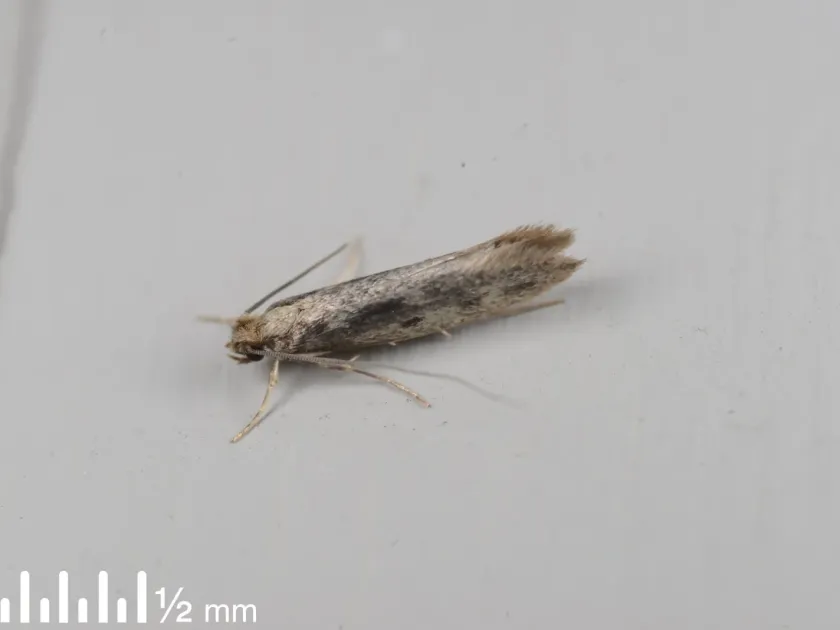
The pale-backed clothes moth (Tinea pallescentella) belongs to the order Lepidoptera, family Tineidae. The adult moth has a wingspan of approximately 15–20 mm, characterized by pale, yellowish-brown forewings with distinct dark spots.
The insect's body is slender and covered in scales. The head exhibits specific mouthpart structures, which may be specialized for feeding in the adult stage or reduced, depending on the environmental context of the habitat.
The larvae are cylindrical and typically dirty-white in color with a darker, sclerotized head capsule. They are highly active and capable of quickly spinning silk tubes that serve as protective retreats during feeding.
The insect undergoes complete metamorphosis: egg, larva, pupa, and adult. The life cycle is heavily influenced by temperature and humidity levels within storage facilities, which dictate the speed of generational development.
Identification of the species requires a detailed examination of morphological wing patterns, as the moth visually resembles other Tineidae species commonly found in synanthropic environments.
What it damages
This pest primarily damages products in warehouses, storage facilities, and domestic environments. The main damage is caused by the larvae, which are generalist feeders capable of consuming dry organic matter of both plant and animal origin.
In the agricultural sector, the moth can infest stored grain, legume seeds, and various dry animal feeds. It is frequently associated with areas where dust and plant debris accumulate, providing ample food sources.
Beyond grain-based products, the larvae may feed on woolen fabrics, furs, and leather items if contaminated with organic debris. This behavior makes the moth a serious pest for both agricultural storage and industrial manufacturers.
Damage results not only from direct consumption of the product but also from contamination with larval frass, silk webbing, and shed larval skins. This significantly reduces the market value and quality of the affected goods.
In cases of heavy infestation, the pest can cause significant economic losses by decreasing the weight and nutritional quality of agricultural commodities stored under poor environmental control.
When it appears
In enclosed storage facilities where a stable temperature is maintained, the pale-backed clothes moth can breed year-round, lacking a distinct seasonality in its life cycle.
Optimal conditions for rapid reproduction are found at temperatures between 20 and 25 degrees Celsius and moderate humidity. These favorable conditions significantly accelerate the generation time of the moth.
In unheated warehouses, insect activity decreases substantially during winter months. While development may pause below 10 degrees Celsius, the pest remains viable and can resume activity when conditions improve.
In the spring, as temperatures rise, the moth population tends to recover quickly. Monitoring the condition of storage facilities and checking commodity stocks is critical during this transition period.
Adult emergence often occurs in pulses, which complicates control efforts, as overlapping generations create a continuous cycle of infestation within the stored products.
Signs of infestation
The primary sign of infestation is the presence of adult moths flying within the warehouse, particularly in the evening or when artificial lights are turned on, as they are nocturnal or crepuscular.
The detection of silk webbing covering grain surfaces or surrounding damaged materials is a clear indication of larval activity, as these webs are used as protective tunnels.
The presence of fine, dark granular frass among the stored goods points to active larval feeding. Often, infested sections become matted or clumped together due to the dense silk produced by the larvae.
A characteristic sign is damage to packaging, which the larvae easily penetrate to reach the food source. Larvae are capable of gnawing through paper bags and thin plastic films used in storage.
Upon closer inspection of the grain bulk or the folds of stored materials, one can identify the larvae themselves or their cocoons, where pupation and the transformation into the adult stage occur.
Control measures
The foundation of effective protection is strict adherence to warehouse sanitation: regular removal of spilled grain, dust, and debris where larval populations can establish themselves.
Maintaining optimal storage conditions — relative humidity below 15% and temperatures below 15 degrees Celsius — can significantly slow down pest development and limit population growth.
Sealing storage facilities to prevent insect migration from the outside is an essential management step. Installing fine-mesh screens on ventilation openings reduces the risk of adult moths entering the building.
In instances of heavy infestation, chemical fumigation of the warehouse or commodities using registered insecticides is required, always following the specific manufacturer's instructions for safety and efficacy.
- Regular monitoring using pheromone or sticky traps is necessary to detect the emergence of the first adult moths and trigger intervention.
Taxonomy
- Latin name
- Tinea pallescentella
- Order
- Lepidoptera (butterflies)
- Family
- Tineidae
- EPPO code
- TINEPL
Discussion
No discussions yet — be the first.