
Tineid moths
Tinea
Description
How to identify
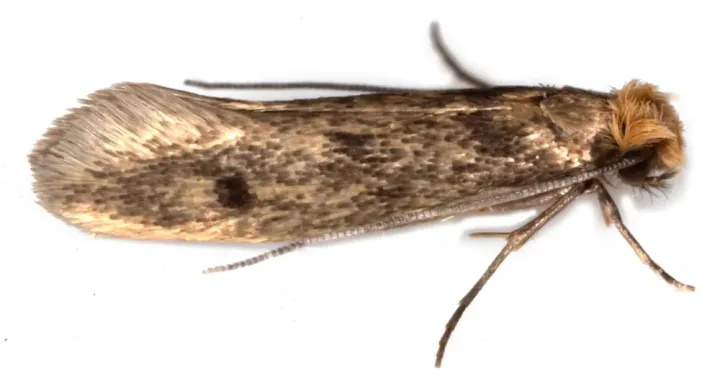
The family Tineidae (Tineid moths) belongs to the order Lepidoptera. These are small moths characterized by narrow, fringed wings and well-developed labial palps.
Adult moths typically possess dull, cryptic coloration such as grey, brown, or buff, which allows them to blend perfectly into the surfaces of storage facilities.
The larvae are known for their secretive behavior, often constructing portable cases or silk-lined galleries made from food debris, silk, and other fibers.
Their mouthparts are strong and well-adapted for feeding on tough materials, including stored grains, seeds, and various types of organic debris.
The life cycle encompasses four stages: egg, larva, pupa, and adult, with the larval stage being responsible for almost all damage to products.
What it damages
Tineid moths are considered significant pests of stored agricultural products, including various cereals, legumes, and oilseed crops stored in warehouses.
The larvae bore into individual grains, specifically targeting the germ, which drastically reduces the germination capacity of stored seed stocks.
Beyond grains, these pests infest dry vegetable products, dried mushrooms, and botanical materials, rendering the goods unfit for consumption or sale.
Damage is characterized by the presence of dense webbing and frass, which contaminates the product and encourages the growth of secondary mold species.
High infestation levels lead to substantial quantitative and qualitative losses, particularly in poorly ventilated storage facilities with high humidity levels.
When it appears
While outdoor populations follow seasonal cycles, Tineid moths in climate-controlled warehouses can reproduce continuously throughout the entire year.
Optimal conditions for rapid development are temperatures between +20°C and +26°C, accompanied by relative humidity levels exceeding 60%.
In cooler, unheated environments, development slows significantly, allowing larvae to survive in a state of diapause until conditions become favorable again.
Increased adult activity is often observed during spring and summer months as warehouse temperatures rise, facilitating the colonization of stored commodities.
The generation time depends heavily on the nutritional quality of the substrate, with high-energy seeds supporting faster population growth rates.
Signs of infestation
The most prominent sign of an infestation is the appearance of silken webbing on the surface of grain piles, bags, or within processing machinery.
Infested kernels often show characteristic exit holes or are hollowed out from within, leaving behind empty husks filled with waste materials.
The presence of adults (moths) flying near storage areas, particularly during twilight or when lights are turned on, indicates an active population.
A persistent, musty odor often permeates the storage facility, resulting from the accumulation of larval silk, frass, and mold stimulated by the moisture.
- Clumping of grains caused by excessive larval web production.
- Accumulation of larval exuviae (shed skins) and pupal cocoons in corners.
- Presence of fine, dust-like frass on packaging or storage floors.
Control measures
The primary control strategy is strict sanitation: the regular removal of grain dust, spilled commodities, and organic debris is essential for prevention.
Physical control methods include aerating and cooling the grain mass, as low temperatures effectively inhibit the growth and reproduction of the moths.
Monitoring using pheromone-baited traps provides early detection of adult moth populations, allowing for timely intervention before infestations escalate.
When heavy infestations occur, professional fumigation using regulated gases such as phosphine is necessary to eliminate pests hidden deep within grain bulk.
Preventive measures include sealing cracks in storage structures and ensuring that all incoming stocks are thoroughly inspected for prior signs of infestation.
Taxonomy
- Latin name
- Tinea
- Order
- Lepidoptera (butterflies)
- Family
- Tineidae
- EPPO code
- TINESP
Discussion
No discussions yet — be the first.