
Bagworm moth
Thyridopteryx ephemeraeformis
Description
How to identify
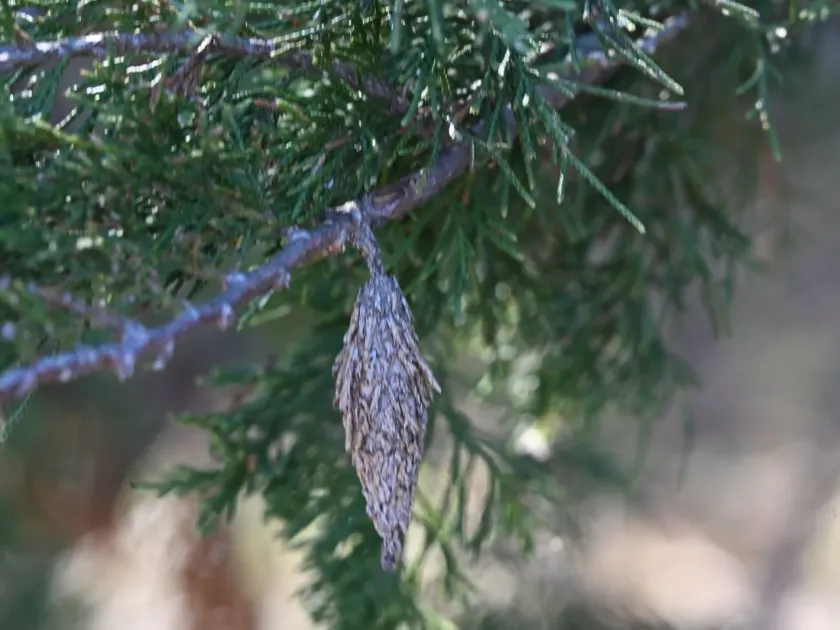
The bagworm moth belongs to the family Psychidae, order Lepidoptera. Its most distinct characteristic is the unique protective case the caterpillar builds using silk, bark pieces, needles, and leaves from its host plant.
Adult males are small moths with clear wings, while females remain inside their protective cocoons, lacking wings, legs, and developed eyes, resembling worm-like larvae.
The life cycle begins with eggs deposited inside the female's cocoon. After hatching, young caterpillars immediately start spinning their protective cases, which they carry throughout their development.
Caterpillar coloration ranges from dark brown to black, and they can reach sizes of 30–50 millimeters. Inside the case, the caterpillar is well-protected against most natural predators and adverse weather.
The presence of this pest is easily identified by the characteristic cocoons firmly attached with silk threads to tree branches, often resembling small pine cones or bits of dried debris.
What it damages
This pest is a polyphagous insect that attacks a wide variety of woody shrubs and trees, including both deciduous and coniferous species.
Commonly affected plants include junipers, arborvitae, spruces, pines, as well as fruit trees like apples, pears, and numerous ornamental shrubs.
Caterpillars consume needles and leaves, which, during heavy infestations, leads to partial or total defoliation, significantly weakening the plant's immune system.
Severe infestations can result in the death of young saplings or the loss of the decorative value of mature trees due to extensive foliage damage.
The strong silk threads used to attach the cocoons can cause constrictions and deformities in young branches, hindering normal sap flow and healthy growth.
When it appears
The bagworm moth typically completes one generation per year, overwintering in the egg stage inside the cocoon left by the female.
Larvae begin to hatch in the spring, usually during the budding period, providing them with immediate access to tender foliage for growth.
The period of active feeding and case construction occurs throughout late spring and summer months when caterpillars are most voracious and visible on branches.
In late summer or early autumn, the caterpillars secure their cases to branches for pupation, followed by the emergence of males and mating.
The life cycle is closely tied to local temperatures, meaning that in favorable warm seasons, the population can grow rapidly, necessitating strict monitoring.
Signs of infestation
The primary and most obvious sign of infestation is the presence of dangling "bags" on branches, which look like debris or dried plant material.
Damaged needles or leaves become ragged, quickly turn yellow or fall off, and the canopy may appear sparse or sickly in affected areas.
Upon closer inspection, one can notice small holes in the foliage or complete skeletonization of needles, indicating high population density.
During the pupation period, the number of cocoons reaches its peak; without intervention, the infestation will likely spread significantly the following year.
The discovery of numerous silk bands constricting young shoots is also a clear indication that the pest has established itself on the tree.
Control measures
The simplest and most effective control method for small areas is the manual removal and destruction of the cocoons from late autumn through early spring.
Biological insecticides containing Bacillus thuringiensis are effective when applied during the period of active feeding by younger caterpillars.
In cases of heavy infestation, systemic insecticides can be applied, as they are absorbed into the plant tissues and kill the caterpillars when they feed.
Timing is critical, as the tough protective case makes contact insecticides less effective; therefore, success depends heavily on the timing of the application.
- Regular inspection of garden plantings.
- Hand-picking and burning of cocoons.
- Application of insecticides during peak larval activity.
- Ensuring tree vitality to improve natural resistance.
Taxonomy
- Latin name
- Thyridopteryx ephemeraeformis
- Order
- Lepidoptera (butterflies)
- Family
- Psychidae
- EPPO code
- THYXEP
Discussion
No discussions yet — be the first.