
Flour mite
Thes
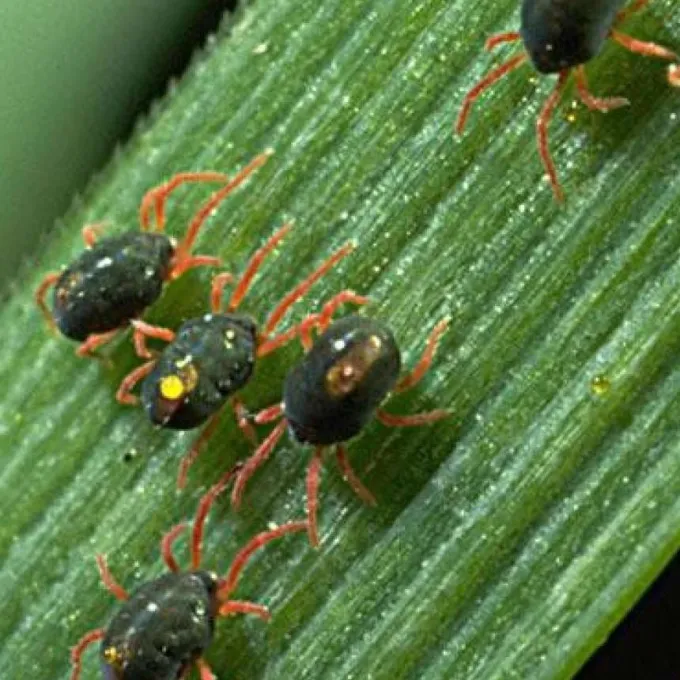
Description
How to identify
The flour mite (Acarus siro) is a microscopic pest belonging to the family Acaridae. Adults are pearly white, 0.3–0.5 mm long, with a smooth body and four pairs of legs that appear reddish-brown.
The life cycle is complex and includes several stages: egg, larva, protonymph, deutonymph (hypopus), tritonymph, and adult. The hypopus stage is highly resistant to extreme conditions, ensuring species survival.
They are primarily found in stored products with a moisture content above 13%. They thrive in dark, humid environments, often colonizing grain, flour, cheese, and even dried animal products.
Flour mites are extremely mobile at the nymph stage and can be dispersed by wind, rodents, birds, or humans moving infested materials between different storage locations.
Identification often requires a magnifying lens or microscope, as the mites are too small to be detected individually without specialized equipment, appearing only as a layer of dust to the naked eye.
What it damages
Flour mites cause direct damage by feeding on the germ of the grain kernel. This destruction results in a significant reduction in germination rates, rendering the grain unsuitable for sowing.
Infested products become contaminated with mite carcasses, molted skins, and feces, which introduce a sweet, sickly odor and can induce allergic reactions in humans who consume contaminated food.
The feeding activity creates heat and moisture hotspots within the grain bulk. This process, known as "self-heating," promotes the growth of toxic mold species and increases the risk of mycotoxin contamination.
In the milling industry, infested flour loses its baking quality. The proteins are degraded by enzymes introduced by the mites, leading to poor dough development and a bitter taste in baked products.
The economic impact is substantial, as infested grain stocks are often downgraded or rejected, leading to massive financial losses for farmers and grain storage facilities worldwide.
When it appears
In climate-controlled storage facilities, flour mites are active year-round. They do not have a seasonal cycle in the traditional sense, as indoor conditions often mimic the optimal environment for their growth.
Outbreaks are most frequent during the post-harvest season, particularly when grain is stored with higher-than-recommended moisture levels, providing an immediate opportunity for rapid colonization.
During colder months, if grain is not properly aerated or cooled, mites may persist in dormant states or continue slow development in deep, insulated sections of the grain mass.
Temperature fluctuations during transport often trigger sudden increases in mite activity if the storage facility fails to maintain strict temperature controls throughout the winter.
The species is highly resilient; while they do not thrive in open fields due to UV radiation and fluctuating humidity, they can persist in remnants of grain inside combine harvesters or transport trucks for long periods.
Signs of infestation
A distinctive sweet, pungent, or "musty" odor emanating from the stored grain is one of the most reliable early indicators of a flour mite infestation in a warehouse.
The presence of a fine, brownish dust on the surface of grain piles, bags, or machinery surfaces often indicates a large population of mites that have reached high densities.
Clumping of flour or grain particles into small, moist masses is a common sign, as the mite activity releases moisture that binds the fine particles together.
Unexpected spikes in temperature recorded by grain monitoring sensors are a definitive signal of an internal heat hotspot generated by mite respiration and mold development.
Visual observation of samples taken from the grain mass, especially near corners or ventilation ducts, may reveal visible movement of the mites when viewed under a microscope.
Control measures
The most critical control measure is grain moisture management. Maintaining moisture content below 13% makes it biologically impossible for flour mite populations to grow and thrive.
Effective sanitation of grain handling equipment and empty storage bins is essential. All debris and old grain must be removed before filling silos to prevent cross-contamination.
Fumigation with professional-grade phosphine-based products is the standard industrial approach to eradicate established populations in bulk stored grain effectively.
- Aeration systems to maintain uniform low temperatures.
- Regular inspection and cleaning of all transport vessels.
- Use of pest-proof containers for small-scale storage.
In organic or high-value storage, controlling atmospheric composition (CO2 enrichment) or using temperature reduction to below 5°C can effectively halt the reproductive cycle of the pest.
Taxonomy
- Latin name
- Thes
- Order
- Coleoptera (beetles)
- Family
- Latridiidae
- EPPO code
- THESSP
Discussion
No discussions yet — be the first.