
Fungus beetle
Corticaria
Description
How to identify
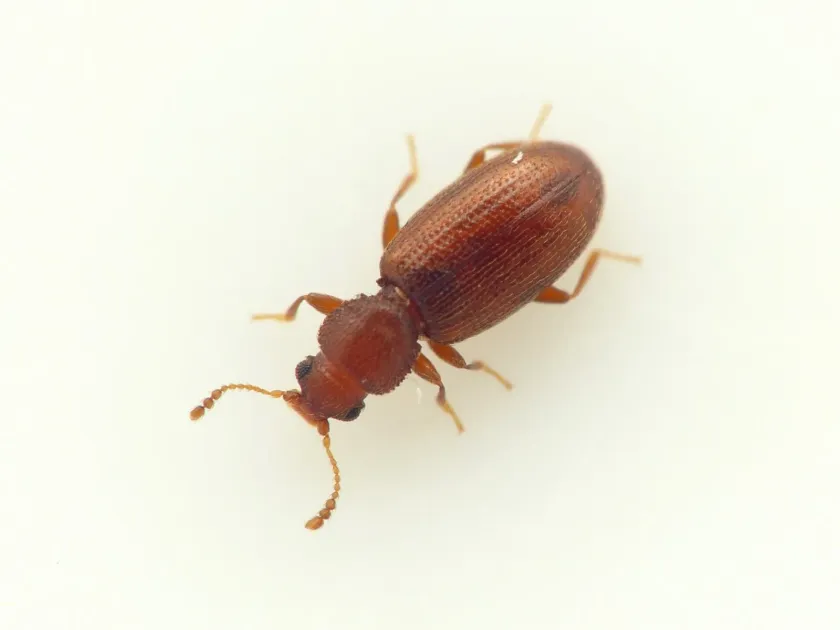
Fungus beetles (genus Corticaria) are small insects belonging to the family Latridiidae, order Coleoptera, commonly found in storage environments.
Adult beetles are typically very small, measuring between 1.5 and 2.5 millimeters in length, requiring magnification for accurate identification.
Their bodies are generally oval or elongated, with a reddish-brown to dark brown coloration and distinct parallel grooves along the elytra.
A key diagnostic feature is the shape of the pronotum, which often displays sharp lateral edges and specific indentations unique to the genus.
Because of their size, they are often overlooked until their populations reach significant numbers in damp areas of storage facilities.
What it damages
These insects are primarily associated with molds and fungi, feeding on microscopic flora that develops on stored agricultural products.
They infest grain, flour, dried fruits, and various stored goods, but only when moisture levels are sufficient to support fungal growth.
While they do not cause direct mechanical damage to healthy, dry seeds, their presence is a clear indicator of poor storage conditions and moisture issues.
They contribute to the spread of fungal spores throughout the grain pile, facilitating the further deterioration of the stored commodity.
Heavy infestations can lead to grain clumping, off-odors, and potential contamination that may render products unsuitable for processing.
When it appears
The life cycle of fungus beetles is largely dependent on the environmental conditions within the warehouse rather than the external season.
In temperature-controlled storage, these beetles can continue to breed and develop throughout the year, provided there is enough moisture.
Warmer temperatures significantly accelerate the larval development, which can take just a few weeks under optimal conditions.
Populations tend to peak during humid conditions, particularly during the transition months when moisture condensation occurs inside grain silos.
While they are cold-hardy, their reproductive activities effectively cease during extreme cold, though the adult beetles remain present in the substrate.
Signs of infestation
A musty or moldy odor emanating from the stored grain pile is the most common early sign of a fungus beetle infestation.
Direct inspection of damp grain surfaces often reveals the presence of small beetles moving actively across the surface or deep within the mass.
Sifting grain samples through a fine-mesh sieve is an effective method to confirm the presence of both adult beetles and their larvae.
Localized patches of spoiled, dark, or clumped grain often indicate the specific areas where the insects have established their primary colony.
Visual observation of the warehouse walls and equipment may also show individual beetles seeking moisture-rich environments.
Control measures
The most effective strategy for managing fungus beetles is the strict control of moisture levels in the stored product and the warehouse atmosphere.
- Maintaining grain moisture content below 13-14% is critical.
- Ensuring proper warehouse aeration and ventilation systems are operational.
- Removing all spilled grain and debris from the warehouse floor.
- Applying preventive insecticides to surfaces before loading new grain.
- Regular monitoring of stored products using traps to detect infestations early.
When infestation levels exceed acceptable thresholds, professional fumigation of the warehouse space may be required to eliminate the pest.
Effective hygiene practices, such as routine cleaning and drying of storage equipment, prevent the establishment of the fungal colonies that sustain these beetles.
Taxonomy
- Latin name
- Corticaria
- Order
- Coleoptera (beetles)
- Family
- Latridiidae
- EPPO code
- COTCSP
Discussion
No discussions yet — be the first.