
Long-bodied fungivore beetle
Corticaria elongata
Description
How to identify
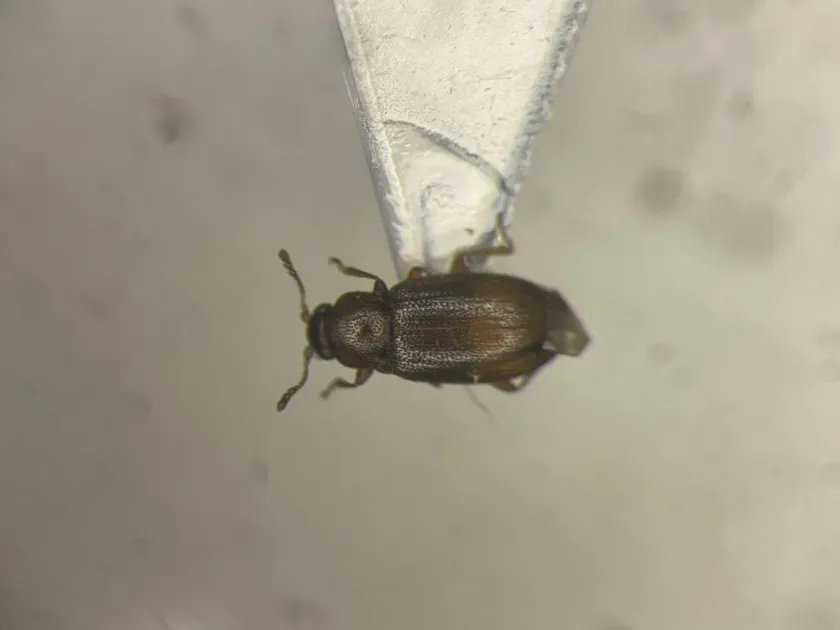
Corticaria elongata is a small beetle belonging to the Latridiidae family, commonly known as the long-bodied fungivore beetle. Adults are generally 1.5 to 2.5 mm long, with a slender, elongated body structure.
The beetle typically exhibits a reddish-brown to dark brown coloration. Its body is covered in fine hairs, which can be observed under magnification, and the antennae terminate in a clear three-segmented club.
The larvae are highly mobile and slender, adapted for living within grain debris, moldy substances, and decaying organic matter where they find their primary food source.
Identification often requires a microscope because these beetles are easily confused with other members of the Latridiidae family due to their diminutive size.
These insects are cosmopolitan and thrive in environments where organic matter is decomposing, making them a common sight in poorly maintained grain storage facilities.
What it damages
Corticaria elongata is recognized as a secondary storage pest. It primarily feeds on mold spores and fungi that grow on grain, rather than the grain kernel itself.
The presence of these beetles is a strong indicator of damp grain conditions, as they are attracted to the fungal blooms that occur when moisture levels exceed standard storage limits.
While they are not primary pests of sound grain, their activity contributes to the degradation of stored products. They contaminate grain with frass, shed skins, and fungal spores.
In cases of high infestation, they can cause damage to the germ portion of seeds, which negatively impacts the viability of the seed stock stored for planting.
Infestations often correlate with grain heating, which creates a positive feedback loop that further promotes fungal growth and general product spoilage.
When it appears
Within climate-controlled storage facilities, Corticaria elongata can breed continuously throughout the year, provided the temperature remains above 15°C.
The life cycle duration is highly dependent on humidity and temperature. Under optimal conditions, populations can increase rapidly, leading to significant infestations in localized areas of the storage unit.
In natural outdoor settings, these beetles are most active during the warmer months, moving between habitats to locate suitable sources of fungal growth.
As temperatures drop, they migrate to more protected environments such as warehouses, barns, and cellars to hibernate through the winter in the adult stage.
Regular monitoring schedules should be increased during the autumn months when beetles seek refuge in buildings, often arriving with newly harvested grain.
Signs of infestation
An unmistakable musty or moldy odor emanating from a grain pile is one of the most reliable early signs that the grain is damp and potentially infested with fungivore beetles.
Visual inspection often reveals the beetles crawling on the surface of grain bags or along the walls of storage bins, particularly in areas with visible signs of moisture or condensation.
A dusty layer, composed of insect debris and fungal material, often accumulates near storage corners or equipment bases, signaling a long-standing infestation.
Sieving grain samples is the standard procedure for detecting larvae and adult beetles deep within the commodity, providing a more accurate assessment of the infestation level.
Physical signs such as localized warm spots or crusting on the surface of stored grain indicate moisture buildup, which is the exact environment favored by Corticaria elongata.
Control measures
The primary control measure is the effective management of grain moisture levels. Keeping grain moisture below 14% prevents the fungal growth that these beetles feed upon.
Good sanitation practices, including the removal of grain dust, debris, and spilled product from storage floors and equipment, significantly reduce the beetle's ability to establish a colony.
If an infestation occurs, professional fumigation using approved gases is necessary to eliminate the pest population throughout the grain mass.
Proper aeration and ventilation systems should be maintained to ensure that moisture does not accumulate within the stored grain bulk.
- Maintain grain moisture below 14%
- Regular cleaning of storage facilities
- Proper ventilation and aeration systems
- Professional pest monitoring and fumigation
- Sealing cracks and crevices in warehouses
Taxonomy
- Latin name
- Corticaria elongata
- Order
- Coleoptera (beetles)
- Family
- Latridiidae
- EPPO code
- COTCEL
Discussion
No discussions yet — be the first.