
Tetragnatha maxillosa
Tetragnatha maxillosa
Description
How to identify
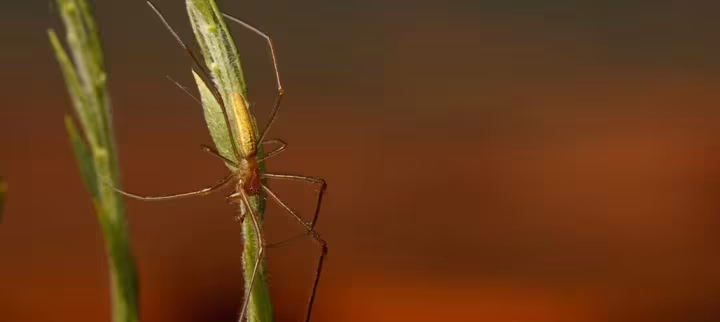
Tetragnatha maxillosa is a species of long-jawed orb weaver spider belonging to the Tetragnathidae family. These spiders are well-known for their elongated body shape.
The species is distinguished by its characteristic long legs and significantly enlarged chelicerae, especially pronounced in adult males, which are used in mating displays.
Their coloration typically ranges from light yellow to reddish-brown, providing excellent camouflage against the green stems and leaves of aquatic plants.
They are relatively small but highly adaptable to humid environments, often forming dense populations in irrigated agricultural systems like rice paddies.
The species is frequently found resting along stems, oriented vertically to blend into the foliage, making them difficult to detect during daylight hours.
What it damages
The primary agricultural damage is observed in rice cultivation, where these spiders establish their orb webs between the stems of the plants.
The presence of dense webbing can physically interfere with the plant structure, causing leaf curling and slowing down the vertical growth of young stalks.
Webbing disrupts the plant's microclimate by reducing airflow and light penetration, which are essential for healthy grain development.
While they are predators, the sheer density of their webs in intense farming systems can lead to physiological stress in the crop due to trapped humidity.
Excessive web accumulation can also harbor moisture, facilitating the spread of fungal diseases within the rice canopy by preventing proper drying.
When it appears
The activity of Tetragnatha maxillosa peaks during the active growing season of the host crops, particularly when plant height provides optimal support.
Warm and humid weather conditions are ideal for their population growth, leading to increased activity throughout the summer months.
Their life cycle is tightly synchronized with the irrigation cycles of rice fields, as they require standing water to maintain the surrounding environment.
As the harvest approaches and temperatures drop, the spider population migrates to nearby grassy areas or field edges to hibernate or hide.
Monitoring should be focused on the peak vegetative stages of the crop to prevent the establishment of multiple generations within the field.
Signs of infestation
The most evident sign of an infestation is the appearance of radial or orb-shaped webs spanning the gap between individual rice plants.
Visual confirmation of adult spiders resting in a linear position along the stems during the early morning hours confirms their presence.
Visible leaf distortion or minor mechanical injury to the leaf tips, caused by the tension of the webbing, acts as a primary indicator.
The accumulation of debris and insect carcasses within the sticky threads of the webs is a frequent sign of established spider colonies.
Stunted development in patches where webbing is most concentrated provides a clear signal for immediate field assessment.
Control measures
Effective management begins with maintaining proper water levels in paddies, which creates an unfavorable environment for excessive spider breeding.
Removing weeds along the field margins significantly reduces the reservoir population that moves into the crop during the growing season.
Integrated Pest Management (IPM) encourages the preservation of natural enemies, such as parasitic wasps, which can help keep spider numbers in check.
Chemical intervention should be considered a last resort and only applied if the density of the spiders exceeds the defined economic threshold.
Regular scouting and field monitoring are essential to identify the start of the infestation and apply targeted, low-toxicity cultural practices.
Taxonomy
- Latin name
- Tetragnatha maxillosa
- Family
- Tetragnathidae
- EPPO code
- TETGJA
Discussion
No discussions yet — be the first.