
Thistle fruit fly
Terellia ruficauda
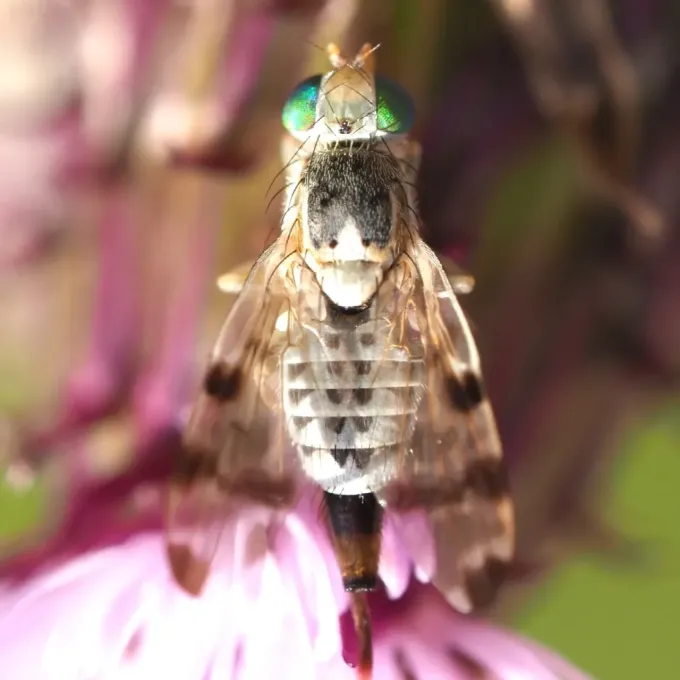
Description
How to identify
The thistle fruit fly (Terellia ruficauda) belongs to the Tephritidae family, also known as fruit flies or picture-winged flies, within the order Diptera. These small insects are characterized by their brownish-yellow bodies and distinctive dark wing patterns.
Adults have a specialized lapping mouthpart. Females are equipped with a well-developed ovipositor, which allows them to pierce the tight bracts of flower heads to deposit their eggs deep into the floral tissue.
The larvae are typically maggot-like: legless, cylindrical, and white or yellowish. They lead a cryptic lifestyle, living and feeding entirely within the flower heads of their host plants.
The life cycle involves complete metamorphosis (holometabolism), consisting of egg, larva, pupa, and adult stages. Understanding each stage is crucial for timing effective integrated pest management (IPM) strategies.
In field conditions, monitoring adults is best achieved using yellow sticky traps. These traps leverage the insect's attraction to color to help agronomists estimate population density and timing of emergence.
What it damages
The primary hosts for Terellia ruficauda are plants within the Asteraceae family. They are commonly associated with thistles (Cirsium and Carduus species) and other related weeds that act as reservoir hosts.
While often viewed as a pest of weeds, the thistle fruit fly can shift to cultivated Asteraceae crops, particularly those grown for seed. The larvae cause direct economic loss by feeding on developing seeds and receptacle tissue.
By consuming the internal parts of the flower head, larvae disrupt seed formation. This results in stunted, empty, or non-viable seeds, which significantly reduces the quality and market value of the harvested seed lot.
Heavy infestations can lead to significant yield losses. In addition to direct feeding, the larvae's activity within the flower head often creates entry points for secondary fungal and bacterial infections.
These secondary infections often cause premature browning and decay of the flower head, further degrading the crop and making the damage visible from a distance.
When it appears
The emergence of adults is highly dependent on regional climate conditions, particularly soil temperature and the onset of the flowering period for host plants in the vicinity.
The peak activity of adults usually occurs in the summer, coinciding with the budding and flowering phase of Asteraceae. During this period, females search for suitable flower heads for oviposition.
Larval development typically spans several weeks inside the flower head. Pupation may occur within the dried remains of the host plant or in the soil, depending on environmental conditions and seasonal cues.
Warm and dry summer conditions are generally favorable for the species, promoting higher survival rates and faster population growth compared to cooler, rainy seasons.
The species typically overwinters in the pupal stage, either in the soil or protected within plant debris. This biological strategy ensures the population survives the dormant winter months to re-emerge the following season.
Signs of infestation
Detecting an infestation often requires close inspection of the flower heads. Early indicators include tiny, pin-prick-sized entry holes on the bracts, created by the female during egg-laying.
Visible deformation or lopsided development of the flower head is a hallmark of larval presence. As the larvae feed, the structural integrity of the head is compromised, leading to abnormal growth patterns.
The presence of internal frass (larval waste) is a definitive sign. When a flower head is opened, the presence of maggots inside the seed mass confirms an active infestation.
- Physical distortion and discoloration of flower heads.
- Presence of white larvae within the seed head.
- Premature shedding of seeds from the plant.
- Reduced seed germination rates after harvest.
- Increased susceptibility to secondary pathogens.
Regular field scouting during the transition from budding to full bloom is the most reliable way to monitor for the first signs of the pest.
Control measures
Integrated control starts with aggressive cultural practices. Managing weeds on field borders—specifically thistles and related Asteraceae—is the most effective way to eliminate local breeding populations.
Deep fall plowing (tillage) is recommended to bury crop residues and pupae in the soil, effectively disrupting their life cycle and reducing the emergence rate for the next season.
In cases of severe economic threat, insecticide applications during the early budding stage can be effective. However, it is vital to select products with low toxicity to beneficial pollinators to minimize environmental impact.
Biological control focuses on enhancing the presence of natural enemies, such as parasitoid wasps that prey on the larvae. Preserving these beneficial insects can significantly keep fruit fly populations below the economic threshold.
A data-driven approach, using monitoring traps and threshold-based decisions, allows for targeted interventions, reducing the need for broad-spectrum chemical treatments.
Taxonomy
- Latin name
- Terellia ruficauda
- Order
- Diptera (flies)
- Family
- Tephritidae
- EPPO code
- TERERU
Discussion
No discussions yet — be the first.