
Terellia
Terellia
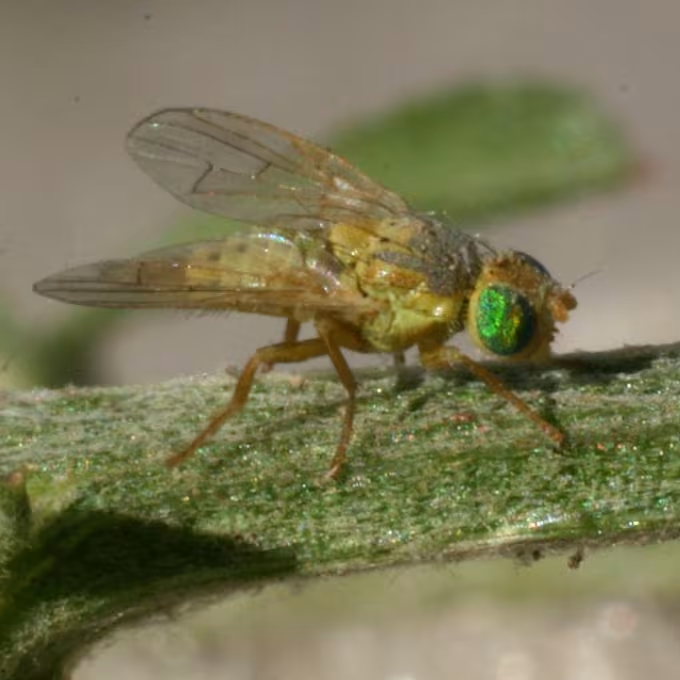
Description
How to identify
The genus Terellia belongs to the family Tephritidae, order Diptera. These are small flies easily recognized by the complex, patterned markings on their wings, which are typical for the family.
Adult flies typically measure between 3 to 6 millimeters in length. Their coloration ranges from yellow to brown, providing effective camouflage against the petals and flower heads of their host plants.
The larvae are typical of the family: legless, cream-colored, and maggot-like. They reside deep within the floral tissues, making them cryptic and difficult to detect during standard field scouting.
Differentiation from related genera is based on wing venation patterns and the morphology of the female ovipositor, which is specialized for piercing the robust flower tissues of Asteraceae.
These insects prefer open, sunny environments where their host plants—primarily members of the Asteraceae family—are abundant and in bloom.
What it damages
Terellia flies primarily infest plants in the Asteraceae family, including various thistles, knapweeds, and several agricultural crops that share botanical characteristics.
The primary damage is caused by the larvae, which burrow into the flower head. They consume the developing seeds and floral tissues, which directly impacts the plant's reproductive success.
The resulting damage includes reduced seed set, deformed flower heads, and premature wilting of the blossoms, leading to significant yield losses in seed-production fields.
Larval feeding creates entry points for secondary infections. Pathogenic fungi and bacteria often exploit these wounds, leading to rot and further degradation of the plant's structural integrity.
The economic impact is particularly pronounced in fields where seed quality is critical, as even moderate infestation levels can render a harvest non-viable for commercial use.
When it appears
Adult flight typically coincides with the flowering period of host plants, usually occurring from late spring throughout the summer months depending on the specific regional climate.
Females deposit eggs directly into unopened or freshly opening flower buds, ensuring that larvae have immediate access to food sources upon hatching.
The life cycle encompasses four stages: egg, larva, pupa, and adult. Multiple generations may occur within a single growing season if weather conditions remain favorable for both the pest and the host.
Overwintering usually takes place in the pupal or larval stage, either in the soil or within the dry remains of the host plant, allowing the species to persist through colder periods.
As temperatures rise in the spring, pupae emerge as adults, initiating the next reproductive cycle by seeking out suitable host plants for oviposition.
Signs of infestation
The first indicator of infestation is the presence of small puncture marks on the base of the flower bud, created by the female's ovipositor during egg-laying.
Upon opening a suspect flower head, one may find larval tunnels, frass, or decayed tissue inside the receptacle where the seeds should be developing normally.
Premature drying or browning of buds before they fully bloom is a reliable sign that the internal tissues have been compromised by larval feeding activity.
Adult flies may be observed resting on flower surfaces on sunny days. Their habit of frequently flicking their wings while walking makes them visible to the observant scout.
In heavily infested fields, a lack of seed development or empty, withered flower heads at harvest time clearly confirms the presence of Terellia pressure.
Control measures
Cultural control methods, such as deep autumn plowing, are highly effective as they bury and destroy pupae overwintering in the soil surface.
Sanitation is critical; removing and destroying weed reservoirs (specifically thistles and knapweeds) in and around the field drastically reduces the local population of the pest.
Biological control involves encouraging natural predators and parasitoids, specifically parasitic wasps, which can significantly regulate larval populations within the flower heads.
Chemical control must be timed precisely with adult flight activity. Once larvae are established within the flower heads, they are shielded from most contact insecticides, making treatment ineffective.
Monitoring with yellow sticky traps is recommended to track the arrival and activity of adult flies, allowing for timely intervention before large-scale oviposition occurs.
Taxonomy
- Latin name
- Terellia
- Order
- Diptera (flies)
- Family
- Tephritidae
- EPPO code
- TERESP
Discussion
No discussions yet — be the first.