
Tephritis formosa
Tephritis formosa
Description
How to identify
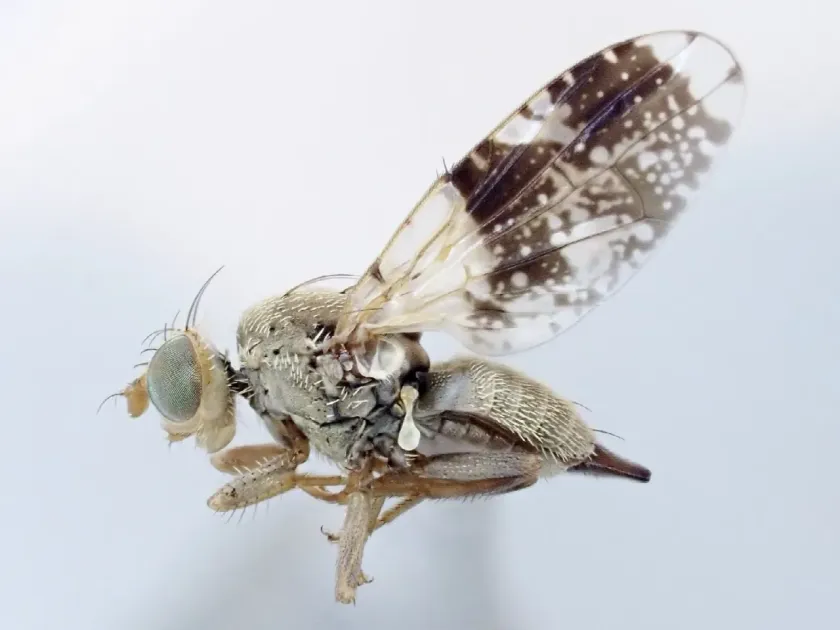
Tephritis formosa belongs to the Tephritidae family, order Diptera. This small fly is easily distinguished by the characteristic mottled pattern on its wings, consisting of dark spots and bands.
Adults have a slender body and prominent eyes. The insect's coloration is predominantly yellowish-brown or brownish, providing excellent camouflage while resting on host plants.
The larvae have a typical dipteran appearance: they are legless, whitish or cream-colored, with the body tapering towards the anterior end. Pupation occurs within the damaged tissues or in the soil, depending on environmental conditions.
The life cycle includes complete metamorphosis: egg, larva, pupa, and adult. Depending on the temperature, one or two generations may develop per season, making the pest a significant threat to specific agricultural crops.
Identification in the field requires close attention to the wing pattern, which is species-specific. Using yellow sticky traps helps monitor adult activity within crop fields effectively.
What it damages
The primary host plants for this species are members of the Asteraceae family. The pest prefers to parasitize the flowers and seeds of various composite plants.
The greatest damage is inflicted on floral crops and medicinal plants grown in commercial fields. Larvae feed on the internal tissues of the inflorescences, damaging the seed germs and the receptacle.
The damage manifests as a decrease in seed material quality, and in some cases, a total loss of commercial appearance of the flowers, which is critical for floriculture.
Heavy infestation leads to premature bud wilting, deformation of flower heads, and a lack of proper seed maturation. Damaged inflorescences are often susceptible to secondary fungal infections.
The economic importance of this species increases when cultivating high-value Asteraceae, where even a slight reduction in quality leads to significant economic losses for the farm.
When it appears
Adult activity of Tephritis formosa begins with the onset of stable warm temperatures in spring, when host plants start forming their first buds.
Mass emergence of adults usually coincides with the budding and flowering phases of the plants. Females actively lay eggs directly into the inflorescences, choosing the most succulent specimens.
During the summer, under conditions of sufficient humidity, larval development occurs quite rapidly, allowing the pest to increase population density in a short time.
By the end of the season, the pest enters hibernation as a pupa, residing in the soil or plant debris, which is a crucial factor for understanding the tactical approach to control measures.
Temperature fluctuations and prolonged rains can affect the intensity of adult emergence, which is why monitoring plant phenological phases is a key tool for agronomists.
Signs of infestation
One of the first signs of infestation is the presence of microscopic punctures on bracts and buds left by females during oviposition.
Inspecting the inflorescences reveals premature browning, shape deformation, or stunted growth. If the flower head is carefully opened, larvae feeding on the tissues can be found inside.
The presence of larval excrement within the flower head is also a sure sign of active feeding. Often, a web-like film or rot can be observed inside the flower head.
The appearance of a damaged plant often resembles an attack by other pests, so confirming the diagnosis requires finding the larvae or adults themselves.
- Bud deformation.
- Wilting of petals for no apparent reason.
- Presence of cavities inside the receptacle.
- Adult emergence from dry floral remains.
Control measures
Agrotechnical methods include mandatory deep plowing of the soil in the autumn, which contributes to the destruction of the pest's overwintering pupae.
It is important to timely remove and destroy plant debris, as well as weeds from the Asteraceae family, which can serve as natural reservoirs for the fly population.
During the flowering period, the application of systemic insecticides is possible if the economic threshold is exceeded. It is recommended to rotate products to prevent the development of resistance.
The use of biological control agents, such as entomophages, can be effective in greenhouse production or on organic plantations when release timing is chosen correctly.
Monitoring using yellow sticky traps allows for precise determination of the adult flight onset, enabling timely protective measures without unnecessary expenditure on pesticides.
Taxonomy
- Latin name
- Tephritis formosa
- Order
- Diptera (flies)
- Family
- Tephritidae
- EPPO code
- TEPRFO
Discussion
No discussions yet — be the first.