
Burdock fruit fly
Tephritis bardanae
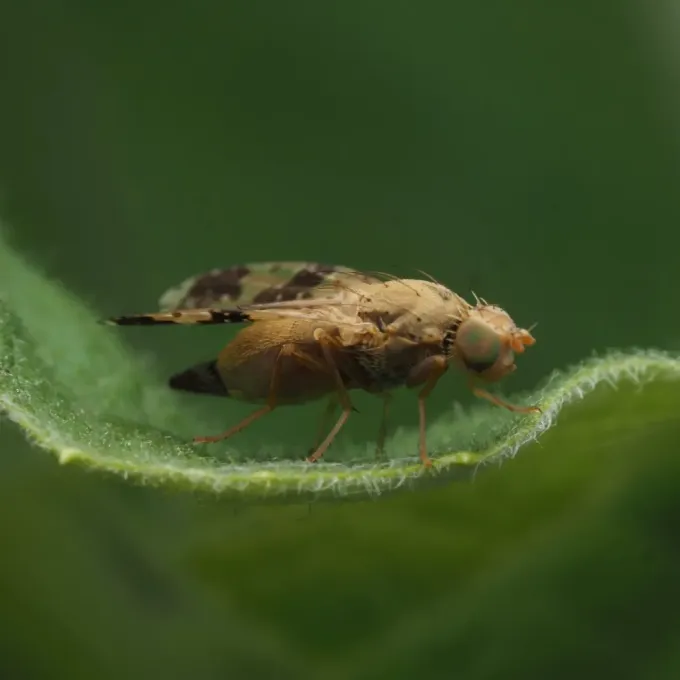
Description
How to identify
The Burdock fruit fly (Tephritis bardanae) belongs to the Tephritidae family, order Diptera. This insect is easily recognized by its wings, which feature a distinct brownish net-like or banded pattern, characteristic of the fruit fly family.
Adults typically reach a length of 5 to 6 millimeters. Their bodies are covered in fine hairs and range in color from yellowish-brown to gray, providing excellent camouflage against the flower heads of their host plants.
The larvae are legless, whitish or yellowish, and possess a typical fly-larva body shape, tapering towards the front. They live a secluded life, developing entirely within the flower heads of host plants.
The insect's life cycle is closely tied to the Asteraceae family. Development follows a complete metamorphosis: egg, larva, pupa, and adult.
Identification is based on wing venation patterns and the specific placement of eggs within the flower buds. Entomological nets are commonly used for field surveillance of the species.
What it damages
The primary host for this pest is the Burdock genus (Arctium), particularly the greater burdock and the lesser burdock. Occasionally, it may be found on other closely related members of the Asteraceae family.
The larvae damage exclusively the reproductive organs of the plant. By feeding on developing seeds and the receptacle tissue, they significantly reduce the seed-bearing potential of individual plants.
Infested flower heads often fail to develop normally, with seeds becoming stunted or completely destroyed. This damage plays a role in limiting the natural spread of burdock populations.
In agricultural settings, this species is rarely considered a major pest of crops. Instead, it is often viewed as a beneficial natural regulator of burdock, which is frequently a persistent weed.
The ecological importance of Tephritis bardanae lies in its role as a biological agent that restricts the propagation of burdock in fields, pastures, and along roadsides.
When it appears
Adult flight activity occurs during the summer months, typically from June to August. This activity is strictly synchronized with the flowering phase of the burdock plant.
Females oviposit directly into young, unopened flower heads using their ovipositor. Multiple larvae often develop within a single head, feeding simultaneously.
Larval development takes place within the flower head over several weeks. Once the seeds begin to mature, the larvae reach their maximum size and prepare for pupation.
Pupation frequently occurs within the flower head itself or in the top layer of soil beneath the host plant, depending on prevailing moisture and temperature conditions.
The overwintering stage is usually the puparium, which remains dormant through the winter to emerge as the next generation of adults the following spring.
Signs of infestation
The first visible sign of infestation is the presence of minute puncture marks on young flower buds, caused by the female's ovipositor during egg-laying.
Dissecting a flower head often reveals the presence of larvae tunneling through the receptacle tissue and consuming seed embryos. Affected flowers often appear deformed or wilted prematurely.
The external structure of the flower head may look distorted, and the bracts surrounding the head may exhibit abnormal development due to the internal feeding pressure.
Frass (larval excrement) found within the flower head is a reliable indicator of infestation. The interior may also show signs of secondary decay or fungal infection following larval damage.
A general reduction in the production of viable seeds by the plant can also serve as an indirect indicator that the Burdock fruit fly has been active within the reproductive structures.
Control measures
In most scenarios, Tephritis bardanae does not require control, as it acts as a natural biological control agent for weeds and generally avoids causing damage to main crops.
If management of burdock populations is necessary, mechanical mowing of the plants before they set seed and before the adult flies emerge is the most effective strategy.
Chemical insecticides are generally discouraged for this species, as they can harm beneficial pollinators and natural enemies that frequent the same flowering plants.
Biological control strategies may involve encouraging natural enemies, such as parasitic wasps that naturally limit the population density of the fruit fly.
Agricultural practices like deep plowing of infested areas can disrupt the life cycle by burying and killing the pupae that overwinter in the upper soil layers, effectively reducing the population for the next season.
Taxonomy
- Latin name
- Tephritis bardanae
- Order
- Diptera (flies)
- Family
- Tephritidae
- EPPO code
- TEPRBA
Discussion
No discussions yet — be the first.