
Arnica fruit fly
Tephritis arnicae
Description
How to identify
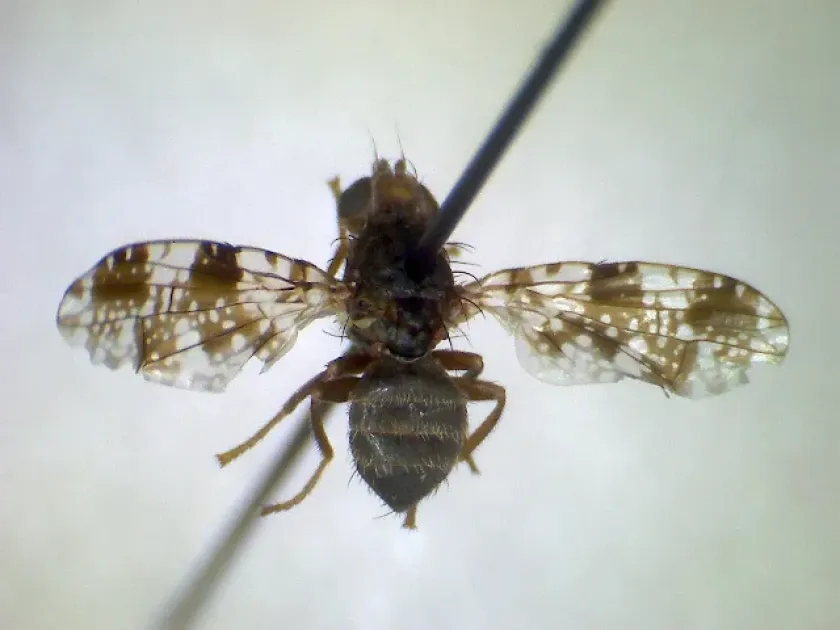
The arnica fruit fly (Tephritis arnicae) is a small dipteran insect belonging to the Tephritidae family. The adult fly is easily recognizable by the distinctive, intricate mottled pattern on its wings, which acts as camouflage while resting on flowers.
The body of the adult insect is yellowish-brown, measuring between 4 and 6 millimeters in length. It possesses large, prominent compound eyes, which are characteristic of this family, providing the fly with a wide field of vision for locating suitable host plants.
The larvae are apodous (legless) and exhibit the typical Tephritid form: tapered at the front and broader at the rear. They are generally whitish or creamy in color, with their bodies covered in tiny chitinous spines that aid in movement within plant tissues.
The life cycle of this insect is closely synchronized with the flowering stages of plants in the Asteraceae family. Adults are active during daylight hours, preferring sunny environments where their host plants thrive.
Early detection is challenging because the adults are inconspicuous, and their primary activity occurs during the blooming season, making it difficult to distinguish infested blossoms from healthy ones without close inspection.
What it damages
The primary hosts for the arnica fruit fly are arnica (Arnica montana) and various other members of the Asteraceae family. The pest specifically targets the flower heads of both wild and cultivated varieties.
The larvae are endophagous, meaning they develop within the flower heads by feeding on the soft tissues, developing ovaries, and internal juices. This leads to a direct reduction in seed production and destroys the aesthetic quality of the blooms.
Larval feeding creates entry points for secondary infections. Sites of puncture and internal tunnels often become infected with fungal pathogens and soft rot bacteria, which can cause the entire flower head to decay prematurely.
High infestation levels can result in significant losses of seed crops, which is particularly devastating for commercial herb growers and conservationists working to propagate arnica populations.
In ornamental gardening, the activity of the arnica fruit fly ruins the marketability of cut flowers. Infested buds are often deformed, fail to open fully, or wither before reaching maturity.
When it appears
The emergence of adult flies coincides with the beginning of the growing season and the bud-formation stage of host plants. Depending on the climate, adult activity is observed from mid-spring through early summer.
Females lay eggs directly into the buds or young flower heads. Larvae emerge within a few days and immediately begin feeding on the floral tissues inside the receptacle.
The larval feeding period lasts between two and four weeks, after which they pupate either within the flower head or in the upper soil layer beneath the host plant. In warmer climates, two generations per year are possible.
The pest typically overwinters as a puparium (a protective shell) in the soil or within plant debris. As temperatures rise in the spring, the new generation of adults emerges.
Monitoring for the presence of the pest should begin during the bud-separation stage, as this is the most critical window for implementing preventive cultural and chemical measures.
Signs of infestation
One of the most apparent signs of infestation is the deformation of flower heads. Buds may appear twisted, stunted, or develop an irregular shape compared to healthy, symmetrical flowers.
- Presence of dark, necrotic spots or lesions on the petals and involucre.
- Premature yellowing and drying of unopened buds.
- Larvae discovered inside the floral receptacle upon careful dissection.
- Exudation of sap from puncture sites, which attracts secondary pests like ants and wasps.
- Decreased seed viability in harvested material due to internal larval damage.
By closely inspecting the surface of the buds, one can sometimes see tiny puncture marks left by the female's ovipositor, serving as an early warning of an infestation.
Severely damaged flowers often fail to open properly. This is because the internal feeding destroys the structures responsible for the natural opening and development of the blossom.
Increased activity of wasps or ants on the flower heads can serve as an indirect indicator, as these insects are often attracted to the sweet secretions leaking from larval feeding tunnels.
Control measures
Cultural control is the most effective management strategy, starting with the thorough removal and destruction of all infested plant material at the end of the season to eliminate overwintering pupae.
Deep cultivation of the soil around the plants in the fall is highly recommended. This practice exposes overwintering pupae to the elements or buries them too deeply for successful emergence.
Systemic insecticides can be used during the bud-development stage if damage thresholds are exceeded. Applications must strictly follow safety regulations to minimize impact on beneficial pollinators.
Biological monitoring using pheromone traps is an effective way to track population density and determine the precise timing for intervention, helping to reduce reliance on broad-spectrum pesticides.
In smaller gardens, manual collection and destruction of visibly deformed or infested buds is a simple, non-toxic method to stop the larval development cycle and prevent further spread.
Taxonomy
- Latin name
- Tephritis arnicae
- Order
- Diptera (flies)
- Family
- Tephritidae
- EPPO code
- TEPRAR
Discussion
No discussions yet — be the first.