
Tephritis fly
Tephritis
Description
How to identify
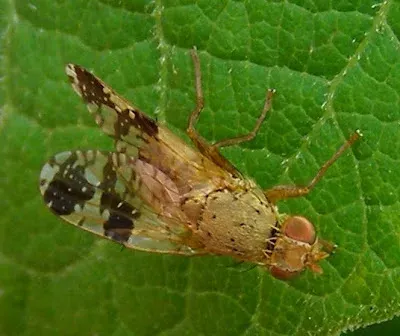
Tephritis is a genus of fruit flies belonging to the family Tephritidae. These insects are easily recognized by the complex, patterned markings on their wings, which often feature intricate brown or yellow reticulations.
The adult flies are small and typically found resting on the heads of composite flowers, where they feed on nectar and pollen. They are very active during sunny days and possess distinct, widely separated eyes.
The larvae are typically creamy-white, maggot-like, and lack legs. They are specialized feeders that inhabit the tissues of flowers, stems, or seed heads of host plants.
The life cycle consists of complete metamorphosis: eggs are laid in the tissues, followed by larval development, pupation, and emergence of adults. Pupation often occurs within the host plant or in the soil.
Most species of Tephritis are host-specific, primarily targeting plants within the Asteraceae family. Understanding the host plant is key to identifying the specific pest species.
What it damages
The larvae are the primary damaging stage. They burrow into developing flower buds and seed heads, consuming the interior tissues and seeds, which prevents normal plant development.
Damage results in distorted flowers, stunted growth, and a significant reduction in seed production. In ornamental plants, the loss of flower quality makes the plant unmarketable.
When larvae infest the seed heads, they hollow out the receptacles and consume the seeds, leaving behind frass (excrement) and causing secondary decay.
In cases of severe infestation, the flower head may fail to open entirely, or it may dry out prematurely, leading to total failure of the reproductive structures.
The damage is often hidden inside the plant, making it difficult to detect until the plant starts showing signs of wilting or visible signs of larval exit holes.
When it appears
Adult flies appear in late spring and early summer, coinciding with the budding phase of their host plants. Their emergence is triggered by warming temperatures.
Depending on the region and the species, there may be one or several overlapping generations throughout the growing season.
The peak activity and subsequent damage occur during the period of floral development and seed setting. This is when the larvae have the most nutrients available for rapid growth.
As the season progresses toward autumn, the final larval generation pupates and enters a state of diapause, either in the soil or protected within the debris of the host plant.
Optimal environmental conditions for the fly include warm, humid weather, which encourages both larval feeding and the maturation of adult flies.
Signs of infestation
Visible signs of infestation include misshapen, lopsided, or stunted flower buds that fail to develop into healthy, symmetric blooms.
Tiny entry or exit holes on the flower head are clear indicators of larval activity. Dark, necrotic patches may also appear on the surface of the buds.
If you inspect the inside of a suspected flower head, you may find the larvae, pupae, or empty cavities where the interior tissues have been consumed.
A powdery accumulation of waste (frass) near the base of the flower or on the leaves below is another strong sign of an active infestation.
Premature browning and wilting of flower buds, even when water levels are sufficient, are often caused by internal larval feeding that disrupts nutrient flow.
Control measures
The most effective strategy involves cultural control: removing and disposing of infested plant materials promptly to break the fly's life cycle and destroy developing larvae.
Monitoring using yellow sticky traps is an efficient way to detect the presence of adults and time the application of controls before egg-laying occurs.
Chemical control can be implemented using systemic insecticides, which are absorbed by the plant and target the larvae feeding within the protected flower heads.
Maintaining a weed-free garden is crucial, as many wild members of the Asteraceae family serve as secondary hosts and sources of infestation for cultivated plants.
- Deep tilling in autumn to expose pupae to predators;
- Biological control using parasitic wasps;
- Spatial isolation of seed production plots;
- Regular inspection and sanitation of flower beds.
Taxonomy
- Latin name
- Tephritis
- Order
- Diptera (flies)
- Family
- Tephritidae
- EPPO code
- TEPRSP
Discussion
No discussions yet — be the first.