
Guatemalan potato moth
Tecia solanivora
Description
How to identify
The Guatemalan potato moth (Tecia solanivora) is a destructive pest belonging to the order Lepidoptera and the family Gelechiidae. Adult moths are small, with a wingspan of approximately 12 to 15 mm.
The forewings are dark brown or greyish with a marbled pattern, providing excellent camouflage on the soil surface. The hindwings are lighter in color and possess a fringed edge characteristic of the family.
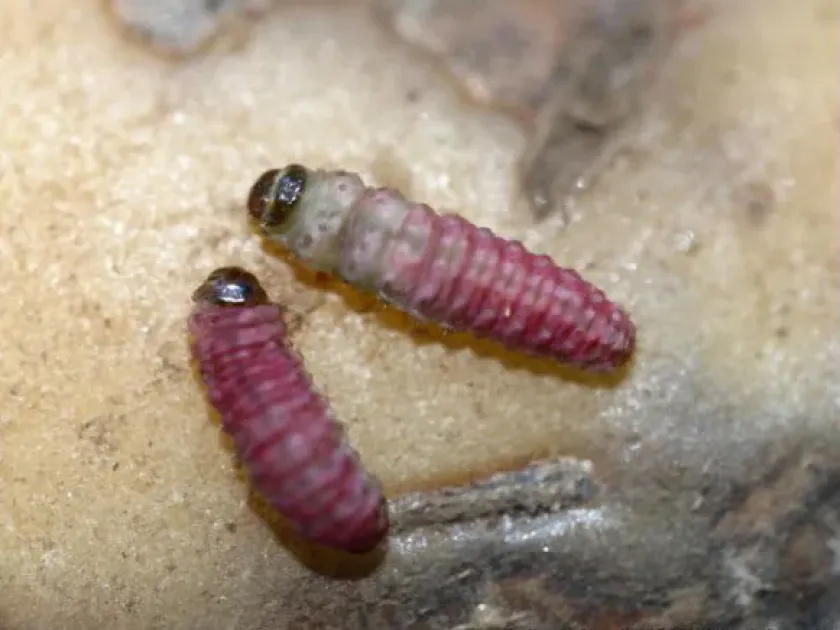
Larvae pass through several instars, changing from a pale creamy color to pink or purplish as they mature. The fully grown larvae reach up to 12 mm in length and have a dark head capsule.
This species is highly specialized, focusing almost exclusively on potatoes, making it one of the most significant threats to potato production in affected regions.
The biology of Tecia solanivora is temperature-dependent; under optimal conditions of 20–25°C, the life cycle is completed in about 40 to 50 days, allowing for several generations per year.
What it damages
The Guatemalan potato moth primarily targets potato tubers. Damage occurs both in the field during the growing season and in storage facilities, posing a severe risk to food security.
Larvae bore into the tubers, creating extensive tunnels. This feeding activity leads to significant weight loss and destroys the commercial quality of the potatoes, making them unfit for sale or consumption.
The tunnels created by the larvae serve as entry points for secondary infections, such as fungi and bacteria, which cause the tubers to rot rapidly during storage.
In cases of high infestation, the pest can cause nearly 100% loss of the harvested crop if left unmanaged, leading to catastrophic financial losses for farmers.
While potatoes are the preferred host, the larvae can sometimes survive on other solanaceous plants, maintaining the population in the field during the off-season.
When it appears
Adult moths are active throughout the warmer months. Being nocturnal, they are rarely seen during the day, which often leads to the infestation being detected only after significant damage has occurred.
In temperature-controlled storage environments, the Guatemalan potato moth can continue its development throughout the entire year, leading to overlapping generations and persistent pressure.
Egg-laying activity is most intense when tubers are maturing. Females prefer to lay eggs on exposed tubers or in soil cracks that provide access to the developing potato crop.
Winter survival is typically achieved in the pupal stage within the soil or in the larval stage hidden inside stored potatoes, which often acts as the primary source of new infections.
The pest's ability to adapt to varying climates makes it a resilient opponent in potato-growing regions, requiring consistent monitoring and management strategies.
Signs of infestation
The most reliable sign of an infestation is the presence of small entry holes on the skin of the tuber, often accompanied by the accumulation of larval excrement or "frass".
When an infested tuber is cut open, a complex network of tunnels filled with debris is revealed. This inner damage often leads to the breakdown of the tuber's structural integrity.
Infested storage facilities may show cocoons of the moth in cracks of wooden crates, on storage walls, or within the folds of packaging materials.
A foul smell emanating from stored potatoes is often an indication that secondary rot has set in following the feeding activity of the larvae.
- Small puncture marks on the potato surface.
- Presence of larval waste (frass) around exit holes.
- Internal tunneling found upon slicing tubers.
- Silk cocoons found in storage containers.
Control measures
Stricter quarantine measures are essential to prevent the spread of Tecia solanivora. Importing potato materials from infested zones should be strictly prohibited or highly regulated.
In the field, hilling (earthing up) is a crucial cultural practice to cover tubers with soil, thereby preventing female moths from reaching them to lay eggs.
Timely harvesting and the complete removal of all crop debris from fields are vital to reduce the carry-over population of the moth to the next season.
For storage, it is recommended to keep temperatures below 5°C, as this prevents larval development and reduces the activity of the pest significantly.
Integrated pest management (IPM) using pheromone traps allows for the early detection and monitoring of moth populations, enabling targeted insecticide applications before major damage occurs.
Taxonomy
- Latin name
- Tecia solanivora
- Order
- Lepidoptera (butterflies)
- Family
- Gelechiidae
- EPPO code
- TECASO
Discussion
No discussions yet — be the first.