
Cereal tarsonemid mite
Tarsonemus spirifex
Description
How to identify
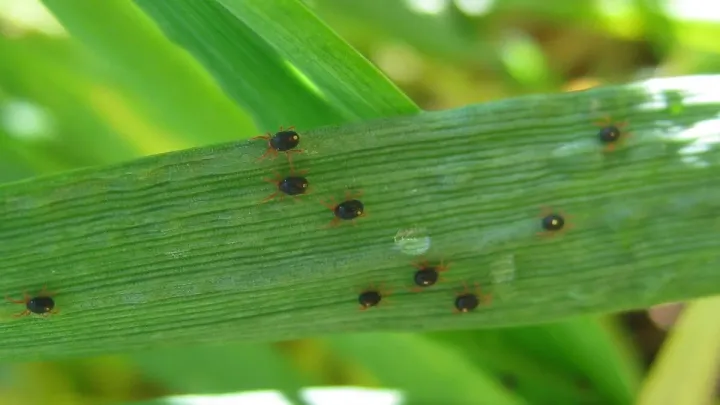
The cereal tarsonemid mite (Tarsonemus spirifex) belongs to the Tarsonemidae family. These are extremely small mites, typically measuring about 0.2 to 0.3 mm in length.
Adult females are oval-shaped and range in color from pale yellow to brownish. Due to their minute size and sedentary behavior, they are difficult to detect without magnification.
Their life cycle is highly temperature-dependent. Under favorable conditions, the development from egg to adult takes approximately one to two weeks, allowing for multiple generations per season.
Overwintering occurs as fertilized females, which remain dormant in soil, plant debris, or on the stems of perennial grasses. As temperatures rise in spring, they migrate to young crops.
High humidity and moderate temperatures are the most critical factors favoring rapid population expansion during the vegetative phase of grain crops.
What it damages
This mite primarily attacks crops such as oats, barley, millet, and various wild grass species. It feeds by piercing plant tissues and extracting cell sap.
The mites are usually found protected within leaf sheaths, where they feed on the developing stem and the emerging ear, leading to physiological stress.
Damage often manifests as stunted growth and deformation. If the mite infestation occurs early, the entire plant can become significantly dwarfed and unproductive.
Secondary infections by saprophytic fungi are common in areas damaged by the mites, further weakening the plant and deteriorating grain quality.
Under heavy infestation, the yield loss can be significant, as the mites directly interfere with the formation of the inflorescence and grain development.
Signs of infestation
Initial signs include the twisting, curling, and thickening of the upper leaves. Affected plants often exhibit visible malformations compared to healthy individuals.
The areas under the leaf sheaths may develop darkened, oily-looking spots where the mites have been feeding. Tissue brittleness and discoloration are also common.
A classic sign is the failure of the ear to emerge properly from the sheath. This phenomenon, often called "trapped ear," leads to poorly developed or empty spikes.
Under a magnifying lens, one can identify colonies of mites, larvae, and eggs within the leaf sheaths, appearing as a fine, whitish, dust-like substance.
Patches of stunted or yellowing plants in a field are indicators of an infestation, which often spreads from field margins or areas with high weed density.
Control measures
Effective management begins with strict crop rotation to disrupt the mite's life cycle. Avoiding continuous cereal cultivation is essential for reducing population pressure.
Sanitation practices, including the destruction of weeds and host grasses in field margins, are crucial to limit the survival of overwintering populations.
Deep plowing after harvest helps bury plant debris, effectively destroying the habitats where mites survive until the next growing season.
Chemical control involving acaricides may be necessary if infestation thresholds are exceeded. Applications should be timed when the mites are most active and exposed.
- Use certified and healthy seeds for planting.
- Regular field scouting during early tillering stages.
- Maintaining optimal soil fertility to enhance plant resistance.
Taxonomy
- Latin name
- Tarsonemus spirifex
- Order
- Mites
- Family
- Tarsonemidae
- EPPO code
- TARSSF
Discussion
No discussions yet — be the first.