

Pest · Coleoptera (beetles) · affects Fodder beet, Winter wheat, Winter barley
Beet leaf weevil
Tanymecus destructor
Description
How to identify
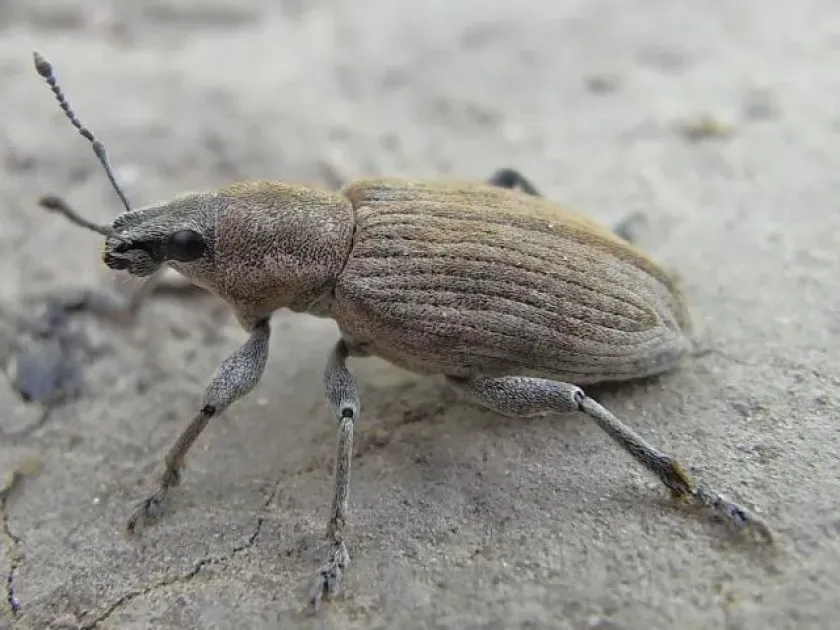
The beet leaf weevil (Tanymecus destructor) is a member of the Curculionidae family, within the order Coleoptera. Adult beetles are typically 10–12 mm long, featuring a grayish-brown body covered in dense hairs.
The insect possesses a distinct rostrum (snout) characteristic of weevils. Its elytra (wing covers) are marked with longitudinal grooves, providing both structural protection and camouflage against soil surfaces.
The larval stage consists of legless, C-shaped grubs with a creamy-white coloration and a darker head capsule. They are exclusively soil-dwelling and adapted for feeding on plant roots.
Adults exhibit behavior typical of many weevil species: they often play dead when disturbed. While capable of flight, they primarily rely on crawling across the soil surface to navigate between food sources.
Overwintering occurs in the adult stage within the soil profile. They move to significant depths (up to 50–60 cm) to escape harsh winter temperatures and survive until the following spring.
What it damages
Tanymecus destructor is a polyphagous pest, meaning it attacks a wide range of plants. While primarily known for its damage to sugar, table, and fodder beets, it also severely impacts sunflowers, maize, and soy.
The most devastating damage is inflicted on emerging seedlings. Adults feed on cotyledons and the hypocotyl, often causing complete plant loss before the crop can establish its first true leaves.
In established crops, adult feeding on leaf margins creates a ragged appearance. While rarely fatal to older plants, this defoliation reduces the photosynthetic capacity, leading to stunted growth and lower final yields.
Larval feeding on the root system is a hidden but significant threat. By consuming small rootlets, they disrupt nutrient and water uptake, resulting in weakened plants that are susceptible to drought stress and soil-borne pathogens.
Severe infestations can lead to substantial thinning of plant stands, forcing farmers to re-sow fields or apply emergency rescue treatments to protect the remaining crop population.
When it appears
The spring emergence of adults begins when soil temperatures reach 10–12 degrees Celsius. This timing usually coincides with the germination and early growth stages of sugar beet seedlings.
The period of peak activity occurs from late April through May. During this time, adults are most voracious, feeding actively and initiating their mating cycle to ensure the next generation.
This species is univoltine, completing one generation per year. After the spring breeding season, the adult population declines as they move deeper into the soil to complete the life cycle.
The larvae develop underground throughout the summer months. Their activity is hidden from surface observation, which makes monitoring difficult once the initial adult damage period has passed.
Pupation occurs in late summer, and the new generation of adults emerges shortly after, retreating back into the soil to begin the overwintering process once temperatures start to drop.
Signs of infestation
The most visible sign of infestation is irregular, ragged edges on leaves and cotyledons. This "scalloped" appearance is caused by the beetle’s mandibles as it feeds from the leaf edges inward.
Early signs often appear as missing plants or "bald spots" within the field. If plants are disappearing at the seedling stage, the beet leaf weevil is a primary suspect for investigation.
Visible adults on the soil surface, particularly during cooler parts of the day or early morning, confirm their presence. They are most active when the ground is warm and the soil is relatively dry.
Stunted, yellowish plants that do not respond to irrigation or fertilizer often indicate root damage caused by larval feeding. Digging into the root zone can reveal the grubs if they are present.
Field scouting should be systematic. By inspecting random 1-meter segments of rows across different parts of the field, agronomists can estimate population density and decide on intervention.
Control measures
The primary control strategy is the use of insecticidal seed treatments. This systemic approach protects the plant during its most vulnerable stage and is highly cost-effective against early-season weevil damage.
Crop rotation is fundamental to minimizing local populations. Avoiding consecutive planting of host crops in the same area reduces the chance of emerging beetles finding immediate food sources.
Promoting rapid crop growth through optimal fertilization and seedbed preparation helps plants outgrow the susceptible seedling phase as quickly as possible, mitigating the window of maximum vulnerability.
- Adhering to strict crop rotation cycles.
- Implementing integrated pest management (IPM) practices.
- Applying insecticides for foliar protection if the economic threshold is exceeded.
- Controlling weeds that serve as alternative food sources for the pests.
If the pest threshold is exceeded, emergency foliar sprays may be necessary. It is essential to select products that provide rapid knockdown action to stop ongoing defoliation immediately.
Content graph
Connections · Beet leaf weevil
Most often together:
Marketplace
Products · 59


Komanch WP
Nanjing No.1 Pesticide Factory of Red Sun Group Co., Ltd.
Insecticides
1
3
·
2.8K
2 offers
23.14 €per 1 l
Buy


Pirinex 48 EC, (chlorpyrifos, 480 g/l)
Makhteshim Chemical Works Ltd.
Insecticides
0
0
·
70
3 offers
2.29 €per 1 l
Buy


Nurik EC
Jiangsu SevenContinent Green Chemical Co., Ltd.
Insecticides
0
0
·
63
2 offers
7.65 €per 1 l
Buy

Diazin EC, a.i., (diazinon, 600 g
Nanjing No.1 Pesticide Factory of Red Sun Group Co., Ltd.
Insecticides
0
0
·
61
1 offer
22.28 €per 1 l
Buy


Fury w.e., (zeta-cypermethrin, 100 g/l)
Ф.ФМСі, Джексонвіль,США.
Insecticides
0
0
·
54
1 offer
72 €per 1 l
Buy

Zali, EC, Insecticide
Ф.Меатон Лімітед, Лондон, Великобританія.
Insecticides
0
0
·
53
3 offers
0.89 €per 1 l
Buy


Insecticide preparation «Chlorpirifit-agro», a.e., (chlorpyrifos 50
«Нанджин Ессенс Файн-Кемікал Ко. Лтд» (Китай)
Insecticides
0
0
·
51
3 offers
7.72 €per 1 l
Buy

Taipro Protect
Hangzhou Ruijiang Chemical Co., Ltd.
Insecticides
0
0
·
48
2 offers
6.65 €per 1 l
Buy


Superkil Forte 550 EC
Фадер Альянс Лтд., Великобританія (Fader Alliance Ltd., England) на заводах Нідерландів, Польщі
Insecticides
0
0
·
33
2 offers
7.48 €per 1 l
Buy


Furadan, etc., (carbofuran, 350 g/l)
Ф.ФМСі, Джексонвіль,США.
Insecticides
0
0
·
93
No offers
—
Details


Dimet
Шанхай Агрочайна Інтернешнел Трейд Ко., Лтд., Шанхай, Китай.
Insecticides
0
0
·
67
No offers
—
Details


Basalt C.E.
Sharda Worldwide Exports Pvt Ltd, Sharda World
Insecticides
0
0
·
52
No offers
—
Details

Dursaban 480
Доу АгроСайенсіс, Кінг’з-Лінн, Великобританія
Insecticides
0
0
·
51
No offers
—
Details

Alfazol w.r.k.
Nanjing No.1 Pesticide Factory of Red Sun Group Co., Ltd.
Insecticides
0
0
·
50
No offers
—
Details


Norton, c.e.
Ф.Суперус Ко ., Лтд., Гонг-Конг, Шанхай, Китай.
Insecticides
0
0
·
44
No offers
—
Details

Dragun c.e.
Nanjing No.1 Pesticide Factory of Red Sun Group Co., Ltd.
Insecticides
0
0
·
43
No offers
—
Details


Biology
Taxonomy
- Latin name
- Tanymecus destructor
- Order
- Coleoptera (beetles)
- Family
- Curculionidae
- EPPO code
- TANYDE
Community
Discussion
No discussions yet — be the first.