
Bagworm moth
Taleporia tubulosa
Description
How to identify
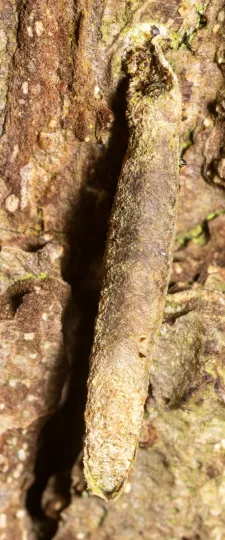
The bagworm moth (lat. Taleporia tubulosa) belongs to the Psychidae family, commonly known as bagworms, within the order Lepidoptera. This pest is named after the unique behavior of its larvae, which construct a protective portable case (bag) made from bark fragments, dried leaves, and soil particles.
Adult appearance varies significantly: males are small moths with a wingspan of about 15–18 mm, characterized by brownish coloration with dark patterns. Females, however, are wingless and worm-like, rarely leaving their cocoons, which makes visual detection of adults in the garden quite difficult.
The larvae, or caterpillars, lead a secretive lifestyle, remaining inside their cases at all times. They have well-developed thoracic legs and heads, enabling them to move efficiently across the substrate while foraging for food, all while remaining protected from predators and harsh environmental conditions.
The life cycle involves complete metamorphosis: egg, larva (caterpillar), pupa, and imago. Overwintering occurs at the larval stage within the case, which is firmly attached to tree trunks or shrubs, ensuring high survival rates for the species during the winter season.
Identification is primarily based on locating these distinctive cases, which look like small dry sticks or clumps of debris attached tightly to the bark, often mistakenly disregarded as natural organic litter by gardeners and growers.
What it damages
The bagworm moth is a polyphage, capable of damaging a wide variety of vegetation. The main damage is caused by the caterpillars, which feed on the bark epidermis of young shoots, buds, leaves, and even lichens growing on tree trunks.
Fruit trees such as apple, pear, and plum are frequent hosts, as well as various ornamental and forest deciduous trees. At high population densities, the damage can weaken young seedlings and stunt their overall growth and development.
The harmfulness of the bagworm moth lies not in total foliage destruction, but in the injury to buds and bark. This can facilitate the development of secondary infections in micro-wounds, posing a significant risk to young trees in nurseries and high-density planting orchards.
Caterpillars may also damage herbaceous plants in the vicinity, utilizing them as an additional food source and as material for enlarging or repairing their portable cases. While their impact is often secondary in commercial orchards, they can accumulate in significant numbers in organic farming systems.
The general health of the plant declines due to the compromise of the bark's integrity. While they rarely cause immediate crop failure, their constant feeding activity reduces the overall vitality and resilience of the affected garden flora.
When it appears
Caterpillar activity begins in early spring, immediately after temperatures rise, when they emerge from diapause to begin intensive feeding on plant tissues. This timing aligns closely with the bud-break phase of many deciduous trees.
Adult moth flight and mating typically occur in late spring or early summer. After fertilization, the female lays eggs directly within the old case or nearby the host plant, ensuring that the next generation has immediate access to food sources upon hatching.
Larval development continues throughout the summer period. During this time, they feed actively and periodically shed their old cases, replacing them with larger ones to accommodate their growing body size, which is a key biological trait of this species.
By autumn, the caterpillars prepare for wintering by seeking sheltered areas in bark crevices or tree branch crotches. They securely anchor their cases to the substrate using silk threads, effectively turning them into protective winter capsules.
The pest spends the entire winter in a state of rest inside these cases, capable of enduring significant temperature drops. Thus, the species' life cycle is perfectly synchronized with the phenological phases of woody plants, allowing for highly efficient resource utilization.
Signs of infestation
The primary sign of infestation is the presence of small «sticks» or dry formations on trunks, branches, and leaves. These objects exhibit clear signs of artificial construction, as they consist of bark fragments and plant remnants held together by silk.
Upon closer inspection, one may notice these «sticks» moving slowly when an active caterpillar is inside. This remains the most reliable identification method, distinguishing the pest from random forest debris or patches of lichen.
In feeding areas, one can observe characteristic «window-pane» patterns or scraped leaf epidermis where tissues have been consumed down to the veins. Bark may show small surface irregularities and gnaw marks that tend to darken over time due to weather exposure.
In cases of mass reproduction, hundreds of empty or occupied cases can be found clustered on tree branches. This creates an untidy appearance that detracts from the aesthetic value of shrubs and trees, especially in nurseries and private gardens.
The absence of caterpillars on leaf surfaces during the day is due to their defensive mechanism; they often hide in branch forks or bark depressions, becoming virtually invisible to the naked eye, which complicates effective monitoring without specific horticultural knowledge.
Control measures
Mechanical removal is the most effective initial method of control for small areas. Regular cleaning of trunks to remove dead bark and hand-picking the cases during autumn and spring significantly reduces the pest population.
Cultural practices that promote plant health play a vital role. Proper fertilization, adequate watering, and correct pruning techniques allow trees to heal micro-wounds more quickly, limiting the feeding opportunities for the bagworm moth.
The use of biological preparations based on Bacillus thuringiensis during periods of active larval feeding yields positive results. These agents are environmentally friendly and effectively suppress the development of lepidopteran pests when applied at the correct dosage.
In cases of high infestation, the application of systemic or contact insecticides is advisable. It is crucial to perform treatments when caterpillars are most active and not yet fully protected by their cases, though their secretive nature necessitates careful timing of spray schedules.
- Preventive bark cleaning and sanitation.
- Encouraging natural enemies and predatory insects.
- Maintaining crop rotation and spatial isolation in nurseries.
- Monitoring with pheromone traps if high infestation is detected.
Taxonomy
- Latin name
- Taleporia tubulosa
- Order
- Lepidoptera (butterflies)
- Family
- Psychidae
- EPPO code
- TALETU
Discussion
No discussions yet — be the first.