
Raspberry clearwing
Synanthedon vespiformis
Description
How to identify
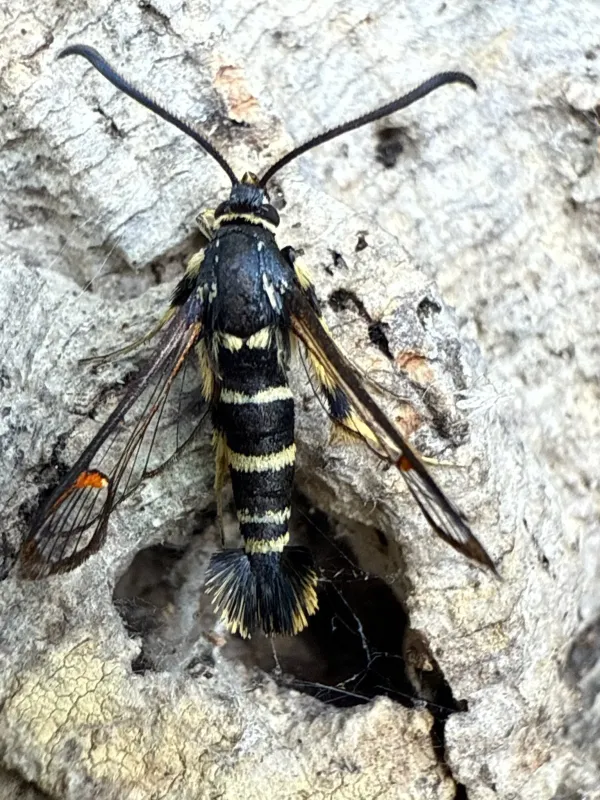
The raspberry clearwing moth, belonging to the Sesiidae family, is a remarkable example of Batesian mimicry, evolving to resemble a common wasp. This adaptation helps it evade predators in the wild.
Adults typically feature transparent wings with dark margins and a wingspan of approximately 20-30 mm. Their abdomens are adorned with yellow bands, perfectly mimicking the look of Hymenoptera.
The larvae are white or yellowish with well-developed thoracic legs and a brownish head. They spend their entire larval stage boring into the wood of host trees, making detection difficult.
Pupae are found within the galleries created by the larvae. Before the adult emerges, the pupa partially exits the gallery, leaving a distinct empty casing protruding from the tree bark.
Classified under the order Lepidoptera, this moth is a significant wood-boring pest that poses a serious threat to various deciduous trees in both garden and forest ecosystems.
What it damages
This pest primarily infests members of the Rosaceae family, causing extensive damage to species such as plums, cherries, peaches, and occasionally apple trees.
Larvae feed on the cambium and inner bark tissues, creating irregular tunnels that disrupt the flow of nutrients and water. This often leads to branch dieback or the death of the entire tree.
The damage caused by these larvae significantly weakens the tree's structure and overall vigor, leading to poor fruit production and making the tree susceptible to secondary fungal infections.
In young trees, extensive larval galleries can girdle the stem, cutting off nutrient circulation and resulting in rapid death, especially during periods of high environmental stress.
Economic losses in orchards are often severe, as infected trees may require removal and destruction to prevent the spread of the population to neighboring healthy plants.
When it appears
The adult flight period typically occurs between May and July. The exact timing depends on local climatic conditions, with higher temperatures often leading to earlier emergence.
The life cycle of this species is usually biennial in many regions, meaning it takes two years for the insect to complete its development from egg to adult moth.
Larvae hibernate inside the wood galleries during the winter months. They resume feeding in the early spring, preparing for the pupation phase that precedes the emergence of the adults.
Peak adult activity is observed during sunny, calm days, as they are most active during the daylight hours when searching for mates and suitable sites for oviposition.
Monitoring the flight of the adults is critical for implementing timely control strategies, as targeting the period of egg-laying or larval emergence is key to reducing infestation.
Signs of infestation
One of the earliest signs of infestation is the presence of frass (larval excrement) mixed with wood shavings, which is pushed out of holes in the bark onto the trunk's surface.
Gumming or sap flow from the bark is another common indicator, as the tree attempts to seal the wounds created by the boring activity of the larvae.
Empty pupal skins found protruding from holes in the tree bark provide definitive proof that the moth has emerged and that a population is present within the orchard.
External bark deformations or slight swellings may indicate the location of larval tunnels. Peeling away a small section of affected bark usually reveals the maze of galleries underneath.
Foliar symptoms include premature yellowing and wilting of branches, particularly during the mid-summer heat when the tree's internal water transport system is compromised.
Control measures
Cultural control is the most effective approach: regular pruning to remove infested branches and their subsequent destruction is essential to lower the pest population.
Sanitation practices such as cleaning wounds and applying pruning sealants can help the tree heal more effectively and prevent secondary rot or further insect attacks.
Pheromone traps are highly recommended for monitoring purposes and for "mating disruption" tactics, which can significantly reduce the number of fertile eggs laid in the orchard.
Biopesticides utilizing entomopathogenic fungi or bacteria can be applied during the larval emergence window to control the pest without damaging beneficial insects.
- Maintain good tree health through proper fertilization.
- Ensure adequate irrigation to help trees withstand damage.
- Whitewash tree trunks to protect against sunscald and discourage egg-laying.
- Encourage local bird populations to control adult moth numbers.
Taxonomy
- Latin name
- Synanthedon vespiformis
- Order
- Lepidoptera (butterflies)
- Family
- Sesiidae
- EPPO code
- SYNAVE
Discussion
No discussions yet — be the first.