
Cherry tree borer
Synanthedon stomoxyformis
Description
How to identify
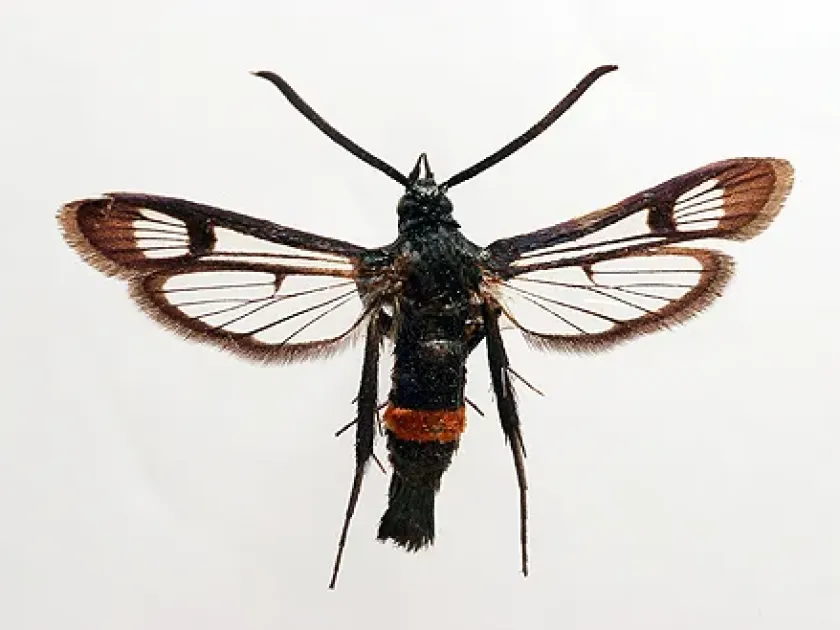
The Cherry tree borer (Synanthedon stomoxyformis) is a clearwing moth that mimics a wasp, featuring transparent wings and yellow bands on its abdomen. The wingspan usually reaches 20–25 millimeters.
The adult moth has a dark body with a metallic sheen. Unlike many other pests, this moth is active during daylight hours, preferring warm and sunny weather for flight and mating activities.
The larva is a caterpillar reaching up to 25 millimeters in length. It typically has a whitish body and a brown head, allowing it to remain well-hidden within the tree's vascular tissue.
The larval stage is the most destructive phase, as the caterpillar bores deep into the wood of host trees, remaining inaccessible to standard external treatments for the most of its life.
The insect undergoes complete metamorphosis: egg, larva, pupa, and adult. Each stage is perfectly adapted to ensure the survival of the species within the bark and sapwood of host trees.
What it damages
The primary hosts of this pest are stone fruit trees, especially cherry and sweet cherry. Occasionally, it can also infest plum or apricot trees if they are already stressed or wounded.
Larvae feed by boring galleries through the bark and sapwood, which disrupts the tree’s nutrient transportation system. This significantly weakens the plant and reduces its overall vitality.
Heavy infestation can lead to the death of branches or even the entire tree. Young orchards are particularly susceptible to severe damage, which can result in significant economic losses.
The damage caused by the larvae hinders fruit production as the tree struggles to survive, diverting energy from fruit development to tissue regeneration and defense mechanisms.
Openings created by the larvae often become entry points for various pathogens, including fungi and bacteria, leading to further decay of the wood and additional diseases.
When it appears
The flight period of adult moths typically occurs from late May through July. During this time, they actively search for suitable sites on the bark to lay their eggs.
Larvae develop over one or two years, residing inside the wood throughout the winter. They are highly resilient to cold temperatures, protected within the tree's internal galleries.
In spring, as temperatures rise, the overwintered larvae resume feeding and moving within the tree, preparing for their final pupation stage before emerging as adults.
Pupation takes place in May. Before emerging, the pupa pushes itself toward the bark surface, creating a small exit hole that is essential for the moth to escape the tree.
The lifecycle is strictly synchronized with the growing season, ensuring that the larvae have consistent access to the tree's nutrient-rich tissues throughout the year.
Signs of infestation
The most prominent sign of an infestation is the presence of sap or gum bleeding from the trunk and major branches. The gum hardens into lumps, indicating internal tissue damage.
Close inspection of the bark reveals small, round exit holes. Often, these holes are surrounded by frass (larval excrement), which looks like a mixture of sawdust and dried sap.
The bark in infested areas may become brittle, cracked, or loose. When pressed, these areas might feel soft or hollow due to the extensive gallery networks created by the larvae.
Wilting and premature drying of specific branches, even with adequate irrigation, strongly suggests that the vascular pathways have been severed by larval feeding activities.
- Yellowing leaves on affected branches.
- Reduced shoot elongation during the growing season.
- Visible accumulations of woody debris at the base of the trunk.
Control measures
The most important preventive measure is proper orchard hygiene, including the removal and destruction of infested branches and the sealing of any mechanical wounds with tree paint.
Sanitary pruning is essential. All dead or dying wood should be removed from the orchard and burned to prevent the emergence of the next generation of moths in the spring.
Pheromone traps are highly effective for monitoring the flight period of adult moths and can help to significantly reduce the population density by capturing males.
Chemical control should be applied during the period of egg-laying and early larval development. Contact insecticides should be sprayed thoroughly onto the trunk and main scaffolds.
Whitewashing the trunks with a lime-based solution can act as a deterrent, making it more difficult for females to locate suitable sites for egg deposition on the bark surface.
Taxonomy
- Latin name
- Synanthedon stomoxyformis
- Order
- Lepidoptera (butterflies)
- Family
- Sesiidae
- EPPO code
- SYNAST
Discussion
No discussions yet — be the first.