
Alder clearwing moth
Synanthedon spheciformis
Description
How to identify
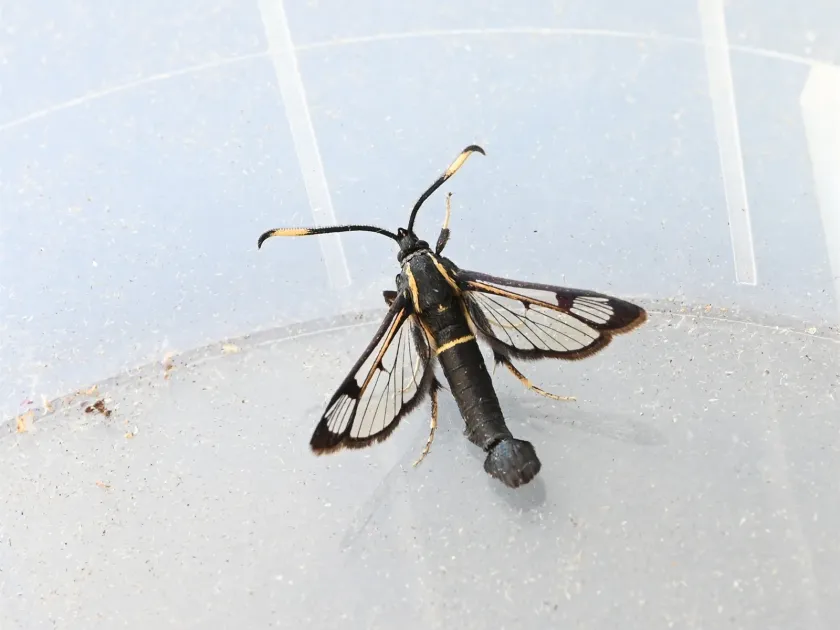
The Alder clearwing moth (Synanthedon spheciformis) belongs to the Sesiidae family. These moths are famous for their remarkable mimicry, as they physically resemble wasps or hornets, which helps them evade many predators.
The adult moth features transparent wings with dark borders and a distinct yellow or orange band across its abdomen. With a wingspan of roughly 25 to 30 millimeters, they are active fliers during the warm months.
The larvae are creamy-white caterpillars with brown heads that spend their entire development phase hidden within the wood of host trees, making them difficult to detect until significant damage has occurred.
The life cycle typically spans two years, involving a lengthy larval stage inside the trunk. The pupation phase occurs within the larval gallery, specifically near the exit point, allowing the emerging moth to break out easily.
The morphology of the pupa includes small spines on the abdominal segments, which assist the insect in maneuvering through the tunnel toward the exit hole before the final transformation into an adult.
What it damages
The primary hosts of this pest are Alder (Alnus) species, though it occasionally attacks birch trees (Betula). The larvae prefer to bore into the trunk or the thickest branches of younger, susceptible trees.
By feeding on the cambium and sapwood, the larvae create winding tunnels that disrupt the transport of nutrients and water. This girdling effect can severely weaken the tree and, in severe cases, kill the upper part of the trunk.
The physical damage caused by these galleries compromises the structural integrity of the wood, rendering it less valuable for timber and leaving the tree vulnerable to secondary wood-boring insects.
Furthermore, the wounds created by the moth serve as entry points for various pathogens, including fungi and bacteria, which can lead to localized rot or systemic decline of the tree's health.
In forest management, high populations of this clearwing moth are considered a serious nuisance as they impair the growth rates of saplings and can lead to the loss of entire stands if left unmanaged.
When it appears
The flight period for adult Alder clearwing moths occurs from late May through July. During this time, they mate and lay eggs on the bark of suitable host trees, often near existing scars or wounds.
Once the larvae hatch, they immediately bore into the bark. They spend the first winter deep within the tree’s woody tissues, surviving in a dormant or slow-growing state until spring growth resumes.
The peak feeding activity takes place during the spring and summer months when the tree's sap flow is most active. This is when the larvae do the most significant structural harm to the plant.
The emergence of adults is highly synchronized with seasonal temperatures. Warming trends have occasionally led to earlier emergence, which can affect the survival rate of the new generation if not matched by host plant availability.
Environmental factors such as moisture and temperature play a critical role in the moth's survival, and years with stable, warm summers often see higher rates of infestation in young plantations.
Signs of infestation
The most visible signs of infestation are the circular exit holes found on the trunks of host trees. Often, the shed pupal skins can be seen protruding from these holes after the adult moth has emerged.
Frass, which looks like fine wood shavings mixed with insect excrement, is frequently observed near the base of the tree or tucked into deep crevices in the bark, indicating active larvae inside.
Localized discolorations or sunken areas on the bark are clear indicators of subterranean tunneling. In some cases, sap may leak from the site of larval penetration, staining the trunk surface.
Yellowing leaves, stunted growth, and the dieback of branches are reliable indicators of long-term damage, as the larval tunnels have likely interfered with the tree's internal vascular system.
- Hollowed-out pupal casings protruding from the wood.
- Localized necrotic bark spots.
- Visible wood debris (frass) on the ground near the base.
- Increased foraging by woodpeckers on the trunk.
Control measures
Sanitation is the most effective management tool. Removing and destroying infested timber or weak, infected trees prevents the spread of the next generation and keeps population densities under control.
Chemical control using systemic or contact insecticides can be applied during the adult flight period to target moths before they deposit eggs, though this is usually reserved for high-value ornamental trees.
Promoting tree health through proper silvicultural practices, including balanced fertilization and minimizing mechanical damage to bark, helps trees maintain natural defenses against wood-boring pests.
Biological control methods involve supporting local populations of insectivorous birds and predatory wasps, which can naturally reduce the number of larvae and pupae within the stand.
Monitoring using pheromone-based traps is an essential step for professionals to predict the timing of the flight period and determine if and when protective chemical interventions are necessary.
Taxonomy
- Latin name
- Synanthedon spheciformis
- Order
- Lepidoptera (butterflies)
- Family
- Sesiidae
- EPPO code
- SYNASH
Discussion
No discussions yet — be the first.