
Birch clearwing
Synanthedon scoliaeformis
Description
How to identify
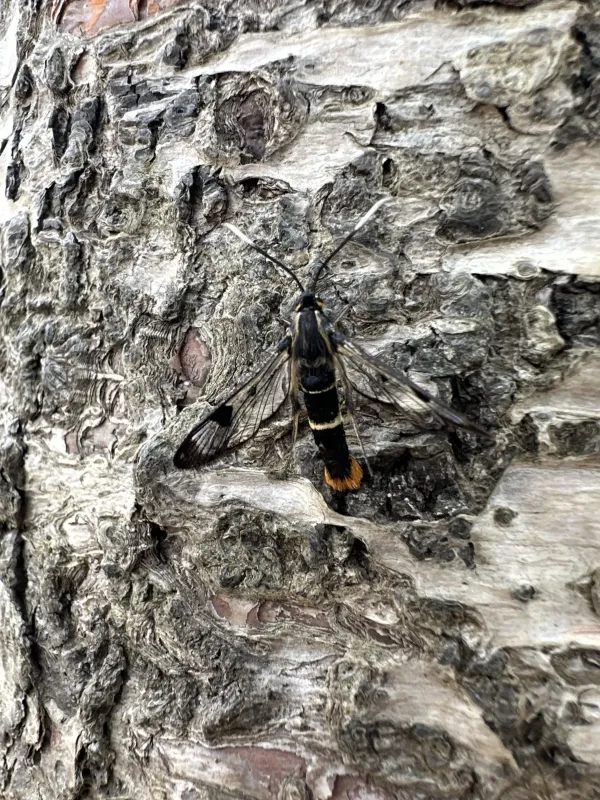
The birch clearwing moth Synanthedon scoliaeformis belongs to the order Lepidoptera, family Sesiidae. The adult moth mimics the appearance of a wasp or hornet, which is a classic example of mimicry to avoid predators.
The insect's body features characteristic transparent areas on the wings that lack scales. The wingspan of an adult moth typically ranges from 25 to 35 millimeters.
The abdomen is dark, almost black, with prominent yellow or orange transverse bands. Both male and female antennae have club-shaped thickenings at the tips.
The larvae (caterpillars) reach up to 30 millimeters in length and are white or yellowish with a brown head. The larval stage is the most destructive to the host tree.
Pupation occurs directly within the wood in specially constructed tunnels; before the moth emerges, the pupa partially protrudes from the exit hole.
What it damages
The primary food source for this species is trees of the genus Betula (birch). It most frequently infests old, weakened trees or those with existing bark damage.
The pest shows a preference for silver birch Betula pendula and downy birch Betula pubescens. In gardens and parks, it can settle on ornamental varieties of these trees.
Occasionally, larvae are found in alder wood, which expands the range of potential hosts. Damage to the wood facilitates the entry of secondary fungal infections.
Active infestation by the pest leads to the gradual dieback of individual branches or the entire canopy of the tree. Severely damaged trees become brittle and break during strong winds.
Mass outbreaks of the species can lead to the mortality of significant numbers of forest stands or ornamental plantings within an area.
When it appears
The flight period for adult birch clearwing moths occurs from late June through August. During this time, the adults mate and deposit their eggs.
Females lay eggs primarily in bark crevices, near wounds, or where the bark of old trees has started to peel. A single female can produce up to 200 eggs.
The larval development lasts about two years, during which the caterpillar feeds on the tree tissue, excavating long galleries under the bark and deep into the trunk.
Larvae of various instars overwinter directly inside the wood, which provides them with reliable protection against harsh winter temperatures.
Adult moths emerge through circular exit holes they bore into the bark just before their final transformation into the imago stage.
Signs of infestation
A primary sign of infestation is the presence of large amounts of frass (brownish wood dust) at the base of the trunk or caught in bark fissures.
Characteristic circular holes, approximately 5-6 millimeters in diameter, can be observed on the trunk where adult moths have emerged.
In areas where larvae have entered, one can often observe abnormal bark thickening or growths that resemble tumors on the trunk or branches.
When peeling back a small section of bark, galleries filled with larval frass are clearly visible, indicating the long-term presence of the pest.
Dieback of tree tops and yellowing of leaves during the peak growing season are also common indicators of the clearwing's internal activity.
Control measures
An effective preventive method is maintaining tree health through regular pruning of dead or damaged branches to reduce entry points.
Sealing wounds and frost cracks on birch trunks with horticultural sealant or paint prevents females from laying eggs in vulnerable areas.
During the flight period, pheromone traps can be used to monitor population levels and reduce the number of males, thus disrupting the breeding cycle.
- Excision and burning of severely infested wood segments containing larvae.
- Encouraging natural predators such as woodpeckers and parasitic wasps.
- Application of systemic insecticides during the early larval hatching period if necessary.
Timely disinfection of pruning cuts and bark damage significantly reduces the risk of re-infestation in the following seasons.
Taxonomy
- Latin name
- Synanthedon scoliaeformis
- Order
- Lepidoptera (butterflies)
- Family
- Sesiidae
- EPPO code
- SYNASC
Discussion
No discussions yet — be the first.