
Apple clearwing moth
Synanthedon pyri
Description
How to identify
The apple clearwing moth (Synanthedon pyri) is a moth belonging to the family Sesiidae, known for its striking resemblance to wasps.
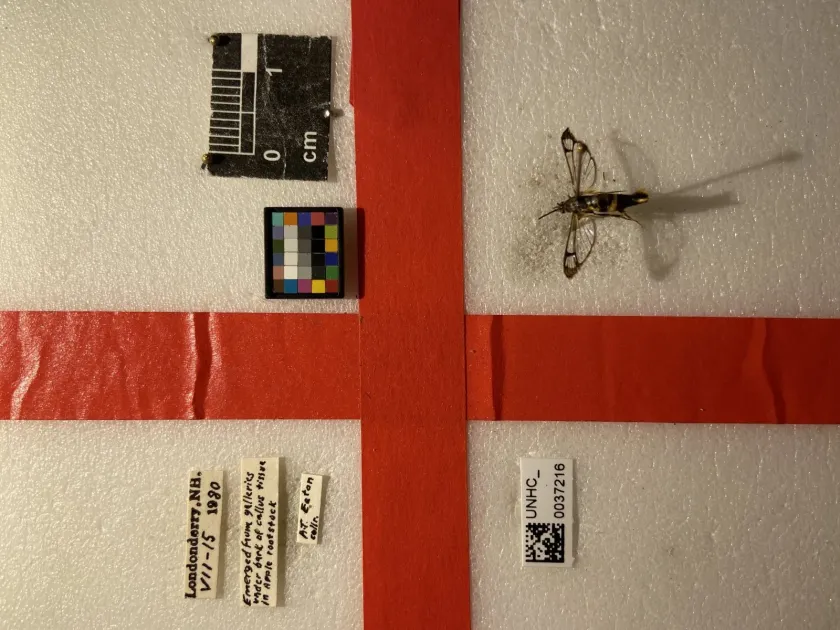
Adult moths have clear, transparent wings with dark margins and a wingspan of approximately 18–22 mm, which helps them blend in with various wasp species.
The larvae are yellowish-white with a dark brown head, typically growing up to 25 mm long while feeding inside the host tree's bark and cambium.
Pupae are found within the tree's wood, often inside a silken cocoon constructed by the larvae before they undergo metamorphosis.
The eggs are small and oval-shaped, typically deposited by females near fissures, graft unions, or areas with mechanical bark damage.
What it damages
This pest primary targets pome fruit trees like apple and pear, although it can also infest stone fruits such as cherry and plum.
The larvae tunnel into the bark and the cambial layer, causing galleries that can ring-bark the tree, severely restricting nutrient and water flow.
Heavy infestations lead to branch dieback, stunted tree growth, and increased susceptibility to secondary infections and environmental stress.
Visible symptoms include localized bark necrosis and, in the case of stone fruits, significant gumming around the exit holes.
Young trees are particularly vulnerable, as extensive tunneling can lead to structural weakness and, in extreme cases, the total death of the specimen.
When it appears
The life cycle of the apple clearwing moth is usually univoltine, meaning it completes one generation per year, though it may take two years in cooler climates.
Adult emergence typically begins in late spring, continuing throughout the summer months, with activity peaking on warm, sunny days.
Mating occurs shortly after emergence, and females search for suitable oviposition sites on the trunks and major limbs of fruit trees.
Once the eggs hatch, the larvae quickly bore into the bark to feed, continuing their development throughout the summer and autumn months.
The larvae overwinter within the protective galleries in the wood and pupate inside these tunnels the following spring before the next generation emerges.
Signs of infestation
A primary indicator of infestation is the presence of brown, frass-like excrement pushed out of small, circular holes in the bark surface.
The bark near the feeding sites may become cracked, sunken, or show signs of dead tissue as the larval tunnels disrupt the tree's normal growth.
- Presence of small circular exit holes on tree trunks.
- Accumulation of larval frass on the bark surface or near the base of the tree.
- Premature yellowing or wilting of individual branches.
- Exudation of sap or gum from the damaged bark area.
- Empty pupal cases protruding from the exit holes after the adult moth has emerged.
Control measures
Good orchard hygiene is essential, including the regular removal of loose bark and proper maintenance of tree trunks to prevent egg-laying.
All mechanical wounds, pruning cuts, and frost cracks should be treated immediately with wound paint to minimize potential entry points for the larvae.
Pheromone traps are highly effective for monitoring adult moth populations, allowing for precise timing of chemical interventions.
When necessary, systemic or contact insecticides are applied during the adult flight period to target the moths before they can lay their eggs.
Biological control methods, such as the application of entomopathogenic nematodes, can be used to treat existing galleries and reduce larval populations.
Taxonomy
- Latin name
- Synanthedon pyri
- Order
- Lepidoptera (butterflies)
- Family
- Sesiidae
- EPPO code
- SYNAPY
Discussion
No discussions yet — be the first.