
Apple clearwing
Synanthedon myopaeformis
Description
How to identify
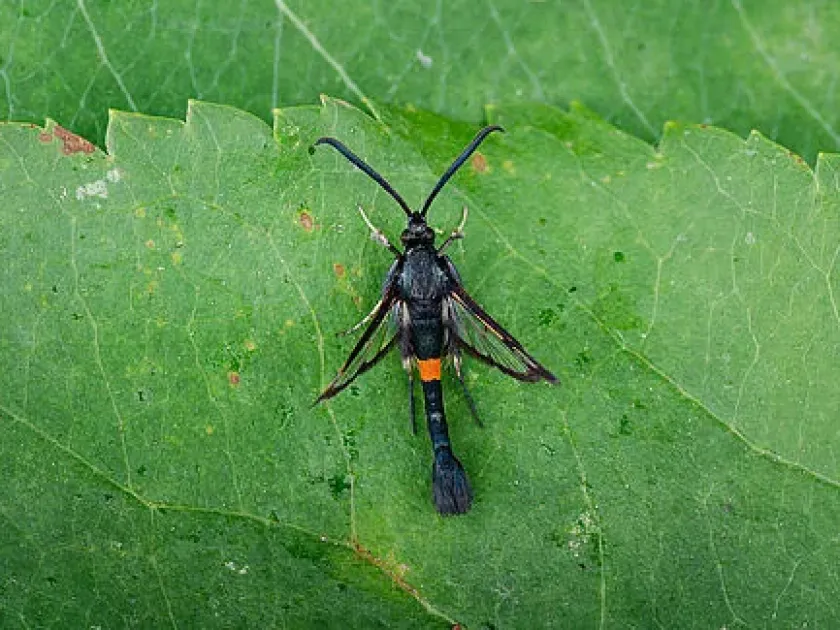
The apple clearwing (Synanthedon myopaeformis) is a moth belonging to the Sesiidae family. Its appearance is a form of Batesian mimicry, as it closely resembles a wasp or hornet to deter predators.
The adult moth has a wingspan of approximately 20–22 mm, characterized by transparent wings with dark margins and a distinct red or orange band across its abdomen.
The larvae are creamy-white with a brown head, reaching up to 20 mm in length. They spend their entire larval stage hidden within the bark and phloem of the host tree.
The life cycle usually spans two years in colder climates, though it can be completed in one year, involving stages of egg, larva, pupa, and adult imago.
Adults are diurnal and most active during warm, sunny days in the summer, which is when mating and egg-laying typically occur.
What it damages
While primarily affecting apple trees, the pest is also known to infest pears, quince, medlar, and sometimes hawthorn, leading to significant economic losses in orchards.
Larvae feed on the cambium and inner bark, creating irregular, winding galleries that severely disrupt the transport of water and nutrients throughout the tree.
Damage to the conductive tissues weakens the tree significantly, making it susceptible to winter injury, drought, and secondary infestations by fungi or other wood-boring insects.
Severe infestations often lead to bark necrosis, stunted growth, and in critical cases, the death of individual branches or the entire tree if the trunk is girdled.
Older trees with rough or damaged bark are especially prone to colonization, as these areas provide easy access for the larvae to bore into the tree structure.
When it appears
The emergence of adult moths typically begins in late May and lasts throughout the summer months, with activity peaking in June and July.
Females lay eggs singly, usually near cracks in the bark, graft unions, or areas affected by sunscald or mechanical damage, which provide entry points for the emerging larvae.
Upon hatching, larvae bore into the bark and begin feeding, creating tunnels that extend over the summer months as they grow and prepare for the winter period.
Larvae overwinter inside the galleries under the bark, remaining dormant until the spring when they resume feeding and eventually undergo pupation.
After pupation, the adult moth emerges from the bark, leaving behind an empty pupal case that protrudes from the exit hole, marking the completion of the cycle.
Signs of infestation
The most visible sign of an apple clearwing infestation is the presence of brown frass (a mixture of sawdust and excrement) pushed out from the larval tunnels onto the bark surface.
Affected bark areas often appear swollen, cracked, or sunken, and in some cases, sap may exude from the entry points, indicating localized tissue death.
Empty pupal cases protruding from the bark are a definitive sign of successful development and indicate that the adult moths have already emerged to start a new generation.
General symptoms of a heavily infested tree include premature leaf drop, reduced fruit yield, and a noticeable decline in the overall vigor and health of the tree canopy.
Careful inspection of the trunk, especially around the base and old pruning wounds, can reveal the small, circular emergence holes left behind by the moths.
Control measures
Cultural control practices include keeping trees healthy, pruning properly, avoiding sunscald by white-washing trunks, and removing old, dead, or loose bark during the winter.
Treating mechanical wounds and pruning cuts with professional sealants prevents the pest from accessing the vulnerable inner tissues where eggs are usually laid.
Pheromone traps are highly effective for monitoring adult moth flight and can be used to disrupt mating cycles by reducing the number of active males in the orchard.
Chemical control involving systemic or contact insecticides should be applied during the adult flight period, specifically targeting the time before eggs are laid.
Promoting natural biodiversity, such as encouraging birds and parasitic wasps, can help manage populations of the apple clearwing naturally without heavy chemical reliance.
Taxonomy
- Latin name
- Synanthedon myopaeformis
- Order
- Lepidoptera (butterflies)
- Family
- Sesiidae
- EPPO code
- SYNAMY
Discussion
No discussions yet — be the first.