
Apple clearwing moth
Synanthedon hector
Description
How to identify
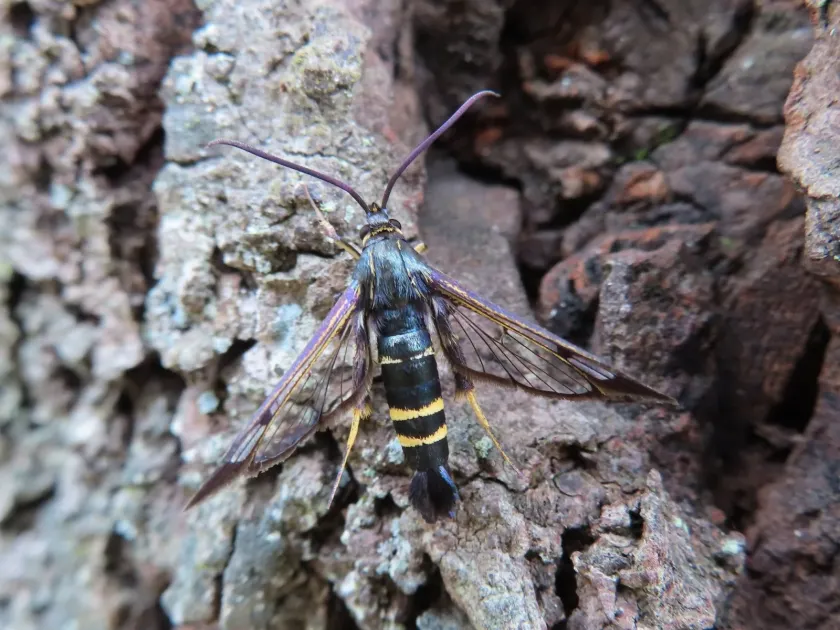
The apple clearwing moth (Synanthedon hector) is a moth species that mimics the appearance of a wasp or hornet to deter predators, featuring transparent wing sections and yellow abdominal bands.
Adult moths have a wingspan of approximately 25 millimeters. Their bodies are slender, dark-colored with distinct orange or yellow rings, demonstrating a classic case of Batesian mimicry.
The larvae, or caterpillars, possess a whitish body with a light brown head. Because they reside deep beneath the tree bark throughout their development, they are rarely seen by gardeners.
Taxonomically, this pest belongs to the order Lepidoptera and the family Sesiidae. Their entire life cycle is adapted to a hidden existence inside the woody parts of fruit-bearing trees.
The life cycle typically spans two years, during which the larvae perform extensive feeding, causing structural damage to the host plant before pupating in the spring.
What it damages
The primary hosts for this pest include apple, pear, and quince trees. Occasionally, it may also attack stone fruits such as cherries or plums, causing similar internal damage.
Larvae enter the tree through bark cracks, frost wounds, or improper pruning cuts. Once inside, they tunnel through the cambium and xylem layers, disrupting the flow of water and nutrients.
Heavy infestations can lead to the death of individual branches or even the entire tree. The girdling effect of larval tunnels significantly impairs the tree's health and reduces fruit yield.
Damaged tissues become highly susceptible to fungal pathogens like black rot and cytospora, which can colonize the weakened wood and hasten the tree's decline.
The cumulative damage often results in stunted growth and poor foliage density, making it difficult for the tree to survive winter stresses or periods of drought.
When it appears
The flight period for adult moths typically begins in late spring, around May, and extends through the summer months, depending on the local climate and temperature.
Females lay eggs individually in bark crevices or near existing wounds on the tree trunk. A single female can deposit up to 200 eggs, facilitating rapid spread within an orchard.
Upon hatching, the larvae bore directly into the bark to begin their feeding cycle. They remain active beneath the bark for most of their larval stage, even during winter months.
Pupation occurs in the spring of the second year. The pupa moves partially out of the exit hole before the adult moth emerges, leaving a visible, empty shell behind.
Monitoring for adults during the summer flight season is critical, as this is the period when chemical interventions against newly hatched larvae are most effective.
Signs of infestation
The most reliable sign of an infestation is the presence of brown, sawdust-like frass (excrement) pushed out from small holes in the tree bark near the base or trunk.
Sap exuding from the bark, which hardens into sticky droplets, often indicates that a larva is tunneling inside. This is a common defensive response from the tree.
Affected areas of the bark may appear swollen or cracked, and in severe cases, the bark might peel off, revealing the hollowed-out tunnels created by the larvae.
Empty pupal casings sticking out from the bark are a definitive sign that the moth has successfully completed its life cycle and emerged from the tree.
- Yellowing of leaves on specific branches
- Premature fruit drop
- Stunted annual twig growth
- Visible entry holes in the bark filled with wood dust
Control measures
Good orchard hygiene is essential: remove dead wood, seal pruning wounds with tree paint, and protect trunks from sunscald to prevent entry points for the moth.
Regularly inspect trunks for signs of tunneling. If found, manually clean out the tunnels and apply a protective wound sealant or authorized insecticide to the area.
Pheromone traps are highly effective for monitoring flight periods and capturing males, which helps reduce the total population and mating success in the orchard.
Targeted application of contact insecticides on the trunk during the peak egg-laying and hatching window can prevent young larvae from successfully penetrating the bark.
Biological control using entomopathogenic nematodes injected directly into the larval galleries has shown promise as a non-toxic method for managing established populations.
Taxonomy
- Latin name
- Synanthedon hector
- Order
- Lepidoptera (butterflies)
- Family
- Sesiidae
- EPPO code
- SYNAHE
Discussion
No discussions yet — be the first.