
Willow clearwing
Synanthedon flaviventris
Description
How to identify
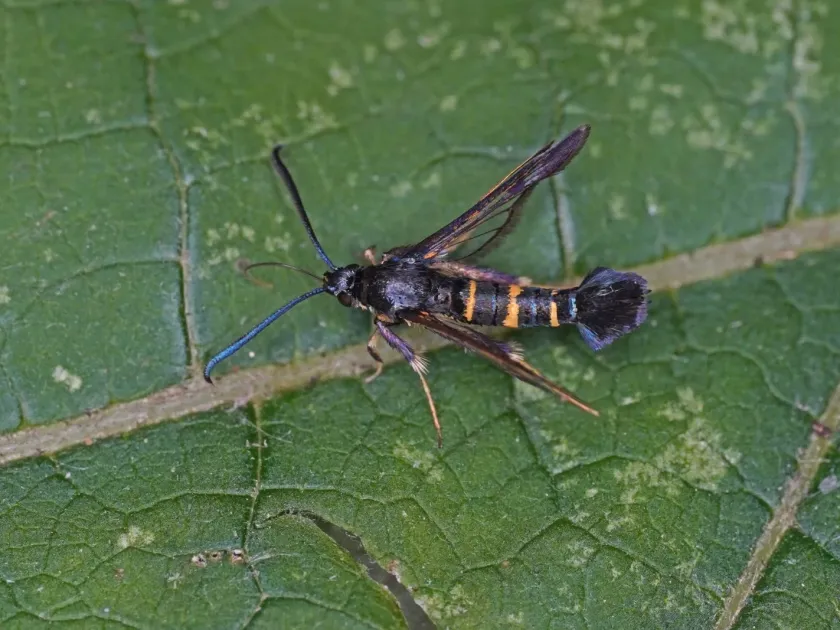
The willow clearwing (Synanthedon flaviventris) is a moth belonging to the family Sesiidae. These insects are famous for their mimicry, as they look remarkably like wasps or hornets, which helps them avoid predators during the day.
Adult moths have a wingspan of approximately 20–25 mm. Their wings are largely transparent, with thin dark margins, and their bodies are adorned with yellow and black bands, mimicking the appearance of stinging insects.
The larvae are whitish caterpillars with brown heads, reaching about 20 mm in length. They are specialized borers that spend their entire developmental period hidden inside the branches or trunks of their host plants.
Pupae are brown and possess small hooks, which they use to maneuver within the tunnel. Before the adult emerges, the pupa pushes itself partly out of the exit hole to allow the moth to emerge safely.
The life cycle is usually univoltine, meaning one generation per year. However, in cooler environments, the larvae may take two years to complete their development before pupating in early summer.
What it damages
The primary host for this pest is the willow tree (Salix). The clearwing moth targets young to medium-aged trees, which are particularly vulnerable to the structural damage caused by boring larvae.
While willows are the main host, the pest can occasionally affect poplars. Infestations typically occur in branches or main stems, which disrupts the flow of water and nutrients within the tree.
Larval feeding causes the formation of distinct galls—localized swellings on the branches. These galls weaken the wood, making the branches susceptible to wind breakage and secondary infections.
The cumulative damage leads to the dieback of infested branches. If the infestation is severe, especially in nursery settings, it can lead to the loss of entire plants or stunted growth.
Beyond the structural damage, the holes created by the larvae provide entry points for wood-decay fungi, which can exacerbate the health decline of the affected tree.
When it appears
Adult moths are active during the warm summer months, typically from June through July. They are sun-loving insects and are most active during the brightest hours of the day.
Eggs are laid individually or in small groups on the bark of twigs. Upon hatching, the young larvae immediately bore into the bark to reach the cambium and inner wood layers.
The larvae continue to feed throughout the summer and autumn. They tunnel longitudinally within the branch, creating protective galleries where they will eventually spend the winter.
Winter is passed in the larval stage inside the tree. When spring temperatures rise, the larvae resume feeding briefly before constructing a pupal chamber near the bark surface.
The emergence of adults in early summer completes the cycle, and the cycle continues as new eggs are laid for the next generation of borers.
Signs of infestation
The most visible sign of an infestation is the presence of swelling or galls on the branches. The bark covering these galls may become rough, cracked, or deformed over time.
Fresh wood shavings or larval frass (excrement) visible on the bark or caught in web-like silk at the entrance holes are clear indicators that larvae are actively feeding inside the branch.
Leaf yellowing or premature wilting of specific branches can indicate that the internal vascular system has been severely damaged by the borer's activity.
In spring, sap bleeding from small holes in the bark is a common reaction of the tree to the presence of the larvae within the stem.
Upon breaking a dead or weakened branch, one can observe the characteristic longitudinal galleries and the presence of brown larval waste, confirming the identity of the pest.
Control measures
Management of the willow clearwing relies on proactive monitoring and cultural practices to ensure tree health and reduce pest impact.
- Prune and destroy infested branches promptly to remove larvae before they emerge as adults.
- Maintain tree vigor through proper irrigation and fertilization, as healthy trees can better tolerate limited infestations.
- Use pheromone traps for monitoring to determine the timing of adult activity in your specific area.
- Apply biological controls, such as beneficial nematodes or entomopathogenic fungi, to target larvae in the galleries.
- If necessary, apply systemic insecticides during the peak egg-hatching period to prevent young larvae from establishing themselves.
Taxonomy
- Latin name
- Synanthedon flaviventris
- Order
- Lepidoptera (butterflies)
- Family
- Sesiidae
- EPPO code
- SYNAFL
Discussion
No discussions yet — be the first.