
Large red-belted clearwing
Synanthedon culiciformis
Description
How to identify
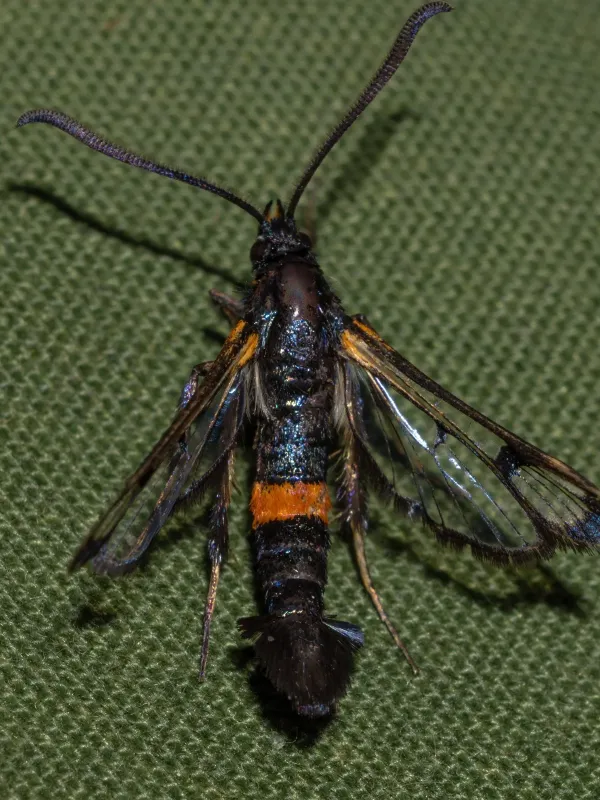
The Large red-belted clearwing (Synanthedon culiciformis) belongs to the order Lepidoptera, family Sesiidae. This moth is famous for its mimicry, closely resembling a wasp or a mosquito.
Adult moths have transparent wings with a span of approximately 20–25 mm. The abdomen is distinctively marked with a bright red or orange band, which makes it easily recognizable in the field.
The larvae are white with brown heads and can grow up to 20 mm in length. They develop as wood-borers, living entirely under the bark of host trees.
Pupation occurs within a silken cocoon mixed with bark frass, which the larva creates before emerging as an adult moth in late spring or early summer.
The species typically completes one generation per year, with the emergence timing highly dependent on local climatic conditions and host tree phenology.
What it damages
This moth primarily targets birch and alder trees, though it can occasionally infest other deciduous species if the tree is stressed or damaged.
The larvae feed on the inner bark and cambium layer, creating erratic galleries that disrupt nutrient transport within the tree’s vascular system.
In young saplings, heavy infestations can lead to partial or complete girdling of the stem, resulting in the decline or eventual death of the tree.
For larger trees, these galleries weaken the bark and provide an entry point for various wood-decay fungi and opportunistic pathogens.
Repeated attacks contribute to the long-term deterioration of wood quality and significantly reduce the overall vitality of forest and garden plantings.
Signs of infestation
The presence of fine, brown frass (larval excrement mixed with wood dust) appearing at the exit holes in the bark is a clear sign of infestation.
Exudation of sap or resin from wounds in the bark is a common secondary symptom indicating that larvae are active underneath the surface.
Dead or loose patches of bark often reveal extensive galleries where the larvae have been feeding, often centered around areas of previous physical injury.
The empty pupal skins protruding from the bark are visible evidence that adult moths have successfully emerged from the wood.
Signs of general decline, such as yellowing foliage, sparse canopy, and premature dieback of specific branches, are frequent indicators of severe larval damage.
Control measures
Sanitation is key; identifying and removing heavily infested branches or saplings during the dormant season helps to reduce the local population.
Pheromone traps are highly effective for monitoring the timing of adult emergence, which allows for precise and timely application of protective treatments.
Proper wound care, such as sealing pruning cuts and avoiding mechanical damage to tree trunks, minimizes the sites available for egg-laying.
In cases of high infestation, targeted insecticide applications during the adult flight period can reduce the number of eggs laid on the bark.
Maintaining high forest and garden health through adequate irrigation and nutrient management ensures trees can better withstand pest pressure.
Taxonomy
- Latin name
- Synanthedon culiciformis
- Order
- Lepidoptera (butterflies)
- Family
- Sesiidae
- EPPO code
- SYNACU
Discussion
No discussions yet — be the first.