
Codeti Clearwing
Synanthedon codeti
Description
How to identify
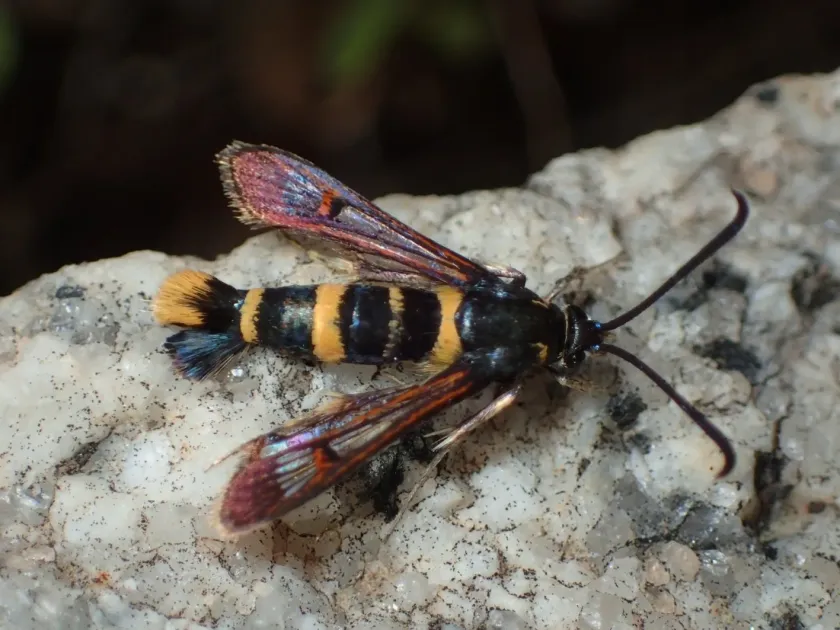
The Codeti clearwing (Synanthedon codeti) belongs to the Sesiidae family, within the order Lepidoptera. Adults exhibit a remarkable resemblance to Hymenoptera, specifically wasps or bees, which is a hallmark of this moth family.
The wings of the adults are almost entirely transparent, featuring distinctive dark margins and a characteristic cross-band. Their slender bodies often display bright transverse stripes, aiding their mimicry of stinging insects.
The larvae are typically whitish or yellowish with a brown head capsule. Because they develop hidden inside the wood, they are notoriously difficult to detect during the early stages of infestation.
The wingspan of the adult moth usually ranges from 20 to 25 mm. Unlike many nocturnal moths, these insects are most active during bright, sunny daylight hours.
Accurate identification is best achieved through the use of pheromone traps, as monitoring adult flight patterns requires specialized entomological knowledge.
What it damages
The primary hosts for this pest include stone fruit trees, with a specific preference for almond, peach, and various plum species.
The larvae lead a cryptic lifestyle, boring tunnels deep into the trunks and branches of young trees. They feed on the cambium and inner bark, severely disrupting the plant's vascular system.
Damage to the wood compromises the tree's structural integrity, making it highly susceptible to frost injury, fungal infections, and eventual decline.
A classic symptom of infestation is the production of gummosis (oozing sap) at the entry points of the larvae, which is common in stone fruits attacked by stem-boring insects.
Heavy infestations can lead to significant economic losses in young, intensive orchards where the health and longevity of every tree are vital to productivity.
Signs of infestation
The most visible indicator of an infestation is the presence of gum exudation leaking from holes located on the bark of the trunk or larger skeletal branches.
Surrounding these entry points, one can often find piles of brownish frass (larval excrement) mixed with fine wood dust or hardened sap.
As the vascular system of the tree is compromised, the canopy often displays signs of early chlorosis, premature yellowing, and leaf drop.
If the bark is carefully removed near the affected areas, one can see the serpentine, larvae-bored tunnels, often packed with debris and waste materials.
In severe cases, entire limbs may die back, or the tree itself may become so structurally weakened that it breaks during high-wind events.
Control measures
Effective management relies on a combination of robust horticultural practices and targeted chemical interventions to maintain orchard resilience.
- Performing regular sanitary pruning to remove and destroy infested wood.
- Sealing mechanical bark wounds with grafting wax or antiseptic tree pastes to prevent entry.
- Deploying pheromone traps to monitor population spikes and disrupt mating cycles of adult males.
- Applying systemic insecticides during peak egg-laying windows to eliminate young larvae before they penetrate the bark.
- Ensuring proper spatial isolation for new orchards in regions with a known high prevalence of the pest.
Taxonomy
- Latin name
- Synanthedon codeti
- Order
- Lepidoptera (butterflies)
- Family
- Sesiidae
- EPPO code
- SYNACD
Discussion
No discussions yet — be the first.