
Grape clearwing moth
Synanthedon bibiopennis
Description
How to identify
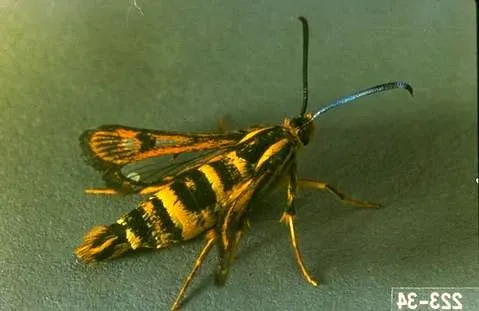
The adult insect is a moth that closely resembles a wasp or hornet, a classic example of Batesian mimicry. The wingspan ranges from 20 to 30 mm, and the wings are transparent with dark veins and margins.
The body displays a metallic blue-black color with distinct yellow bands on the abdomen. Tufts of hair at the base of the abdomen mimic a stinger, although the moth is completely harmless to humans.
Larvae are white or yellowish with a distinct brown head. Mature caterpillars reach 25-30 mm in length and possess strong mandibles adapted for boring into woody tissue.
Pupae are dark brown, equipped with small spines that facilitate their movement through the tunnels before the adult moth emerges.
The development cycle is cryptic, making it difficult to detect the infestation during the early stages. The life cycle usually spans two years, complicating standard control measures.
What it damages
The primary target of the larvae is the woody part of the grapevine. The pest infests both old trunks and younger shoots, causing gradual systemic decline.
In cases of high infestation, the larvae disrupt the sap flow by creating extensive galleries. This weakens the entire vine, reduces cold hardiness, and significantly decreases fruit production.
Young vineyards are particularly vulnerable, as the larvae can girdle the main trunk, potentially leading to the death of the entire plant structure.
The damaged areas often become sites for secondary fungal infections, as the open entrance holes serve as entry points for pathogens, leading to the dieback of entire arms.
Structural integrity is compromised, making the canes brittle and prone to breaking under the weight of the grapes or during strong wind events.
When it appears
Adult flight typically occurs from late May through mid-July. Moths are diurnal, showing peak activity during warm, sunny weather when mating and oviposition take place.
Females deposit eggs singly or in small clusters in bark crevices, pruning wounds, or near buds on older wood. A single female can produce several hundred eggs.
Upon hatching, the larvae immediately bore under the bark and enter the wood, where they spend nearly two years feeding and tunneling through the internal tissues.
The larvae overwinter in various stages of maturity inside the grapevine stems. After the winter period, they resume feeding before eventually entering the pupal stage.
Before emergence, the pupa partially exits the tunnel, leaving its cast-off skin protruding from the bark, which is a key sign of the pest's emergence.
Signs of infestation
The most reliable sign of an infestation is the presence of small holes in the bark, accompanied by brown frass (excrement) that looks like fine sawdust or wood shavings.
Affected branches show signs of stunted growth and leaf yellowing, often mistaken for nutrient deficiency, though the wilting is usually localized to specific arms.
Inspection of the vine reveals unusual swellings or localized distortions in the bark, indicating internal tunnels excavated by the larvae.
Empty pupal casings protruding from the bark are definitive evidence that the moth has successfully completed its life cycle in that specific plant.
Brittle wood is a hallmark of damage; when bent, an infested cane often snaps at the tunnel site, exposing the larval burrow inside.
Control measures
Effective management requires an integrated approach. The most critical cultural practice is thorough sanitation, which involves removing and burning all damaged or dead vines.
Properly sealing pruning cuts with wound paint or pruning sealer helps protect the vines from egg-laying females during the flight period.
- Using pheromone traps for monitoring and mass trapping of male moths.
- Promoting the presence of natural predators, such as insectivorous birds and parasitic wasps.
- Ensuring optimal plant nutrition to enhance the vine's natural defense mechanisms.
- Removing and destroying all infested plant material after winter pruning to eliminate the overwintering population.
Chemical control can be applied during the peak flight of the moths using contact insecticides. Success depends on timing the application based on monitoring trap data.
In cases of severe infestation, rejuvenation pruning involving the removal of heavily damaged arms is the most effective way to eliminate the pest from the vineyard.
Taxonomy
- Latin name
- Synanthedon bibiopennis
- Order
- Lepidoptera (butterflies)
- Family
- Sesiidae
- EPPO code
- SYNABI
Discussion
No discussions yet — be the first.