
White-horned Clearwing
Synanthedon albicornis
Description
How to identify
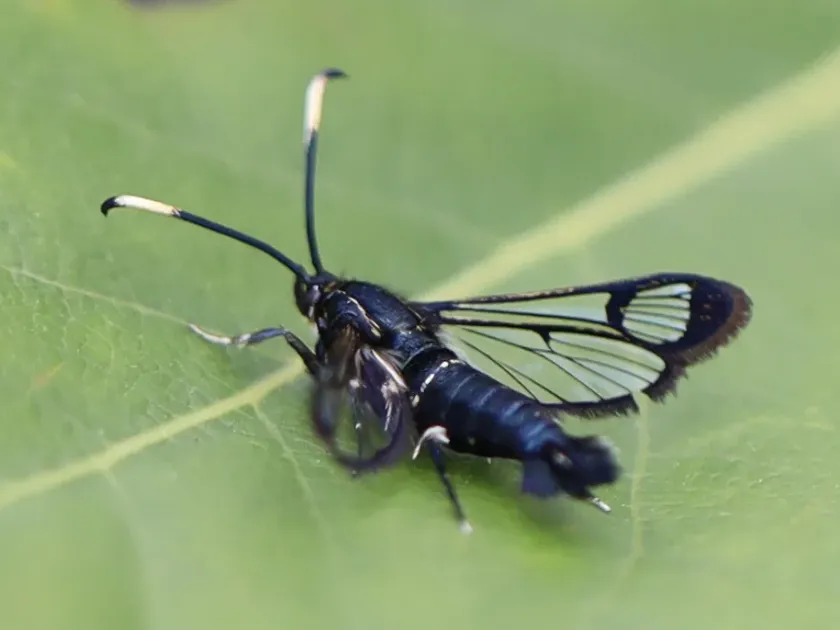
The White-horned Clearwing (Synanthedon albicornis) is a moth belonging to the Sesiidae family. These insects are well-known for their mimicry, as they closely resemble wasps and hornets.
The adult moth features narrow, transparent wings with dark margins and distinct veins. The body typically has yellow or white transverse bands, and the species is named after its characteristic white-colored antennae.
The wingspan of the adult generally ranges from 18 to 25 mm. Due to their deceptive appearance, they often go unnoticed by casual observers and sometimes even by predators.
The larvae are whitish with a darker, sclerotized head capsule and thoracic legs. They are exclusively wood-boring, spending their entire larval stage inside the host plant's tissues.
The pupal stage occurs inside the larval gallery within the wood. Upon maturation, the pupa pushes itself partially out of the exit hole, allowing the adult moth to emerge easily.
What it damages
The primary hosts for Synanthedon albicornis are various species of the genus Salix (willows). These pests frequently infest both ornamental and naturally occurring willow populations.
Larvae cause damage by boring galleries under the bark and deep into the wood. This boring activity severs the vascular system, significantly reducing the tree's vigor and nutrient transport.
Young trees and saplings are particularly susceptible. Severe infestations can cause branch breakage, stunted growth, and in some cases, the total death of the host tree.
The entrance and exit holes created by the larvae serve as entry points for secondary pathogens, such as fungi and bacteria, which can cause further rot and decay.
While willows are the main host, the pest has also been documented on alder (Alnus) species, indicating a broader range of potential host plants in riparian and forest ecosystems.
When it appears
Adult moths are typically active during late spring and throughout the summer months, with the peak flight period occurring between May and July, depending on the local climate.
After mating, females lay eggs individually on the bark, specifically targeting crevices, wounds, or areas where the bark is thin or damaged, facilitating larval entry.
The lifecycle of the White-horned Clearwing can span one or two years. Environmental temperature and host quality are major factors influencing the speed of larval development.
Overwintering occurs as larvae within the galleries inside the wood. They remain in a state of diapause through the winter months and resume feeding when temperatures increase in spring.
Because the flight period is staggered, it is common to find different larval instars inhabiting the same tree simultaneously, complicating the timing of chemical control efforts.
Signs of infestation
The most visible sign of an infestation is the presence of frass (a mixture of wood shavings and larval excrement) accumulating around the base of the tree or near exit holes on the trunk.
External symptoms often include bark swelling, cracks, or deformed wood growth. In some cases, sap flow can be observed at the site of the larval penetration.
- Visible boring holes on the bark surface.
- Empty pupal exuviae protruding from the bark.
- Branch dieback and sudden wilting of leaves during the growing season.
- Patches of dead or necrotic bark on branches or the trunk.
Upon removing a section of damaged bark, one can observe distinct larval galleries, which are often lined with silk and filled with granular frass.
Control measures
Cultural control is essential; this includes pruning and destroying infested branches as soon as they are identified to remove the larvae before they emerge as adults.
Good horticultural practices, such as preventing mechanical injury to the bark, help minimize sites where females can lay their eggs, thereby reducing infestation risk.
Pheromone traps are highly effective for monitoring the flight activity of adult males and can be used to disrupt the mating process if placed correctly in the infested area.
Chemical control involving systemic insecticides may be applied to the trunk during the period of egg hatching to prevent larvae from successfully boring into the wood.
Biological control methods, such as encouraging native woodpecker populations or applying entomopathogenic nematodes to the bark, can also help suppress pest numbers.
Taxonomy
- Latin name
- Synanthedon albicornis
- Order
- Lepidoptera (butterflies)
- Family
- Sesiidae
- EPPO code
- SYNAAL
Discussion
No discussions yet — be the first.