
Maple clearwing moth
Synanthedon acerni
Description
How to identify
The maple clearwing moth (Synanthedon acerni) is a clearwing moth species from the Sesiidae family, notable for its mimicry of Hymenoptera insects.
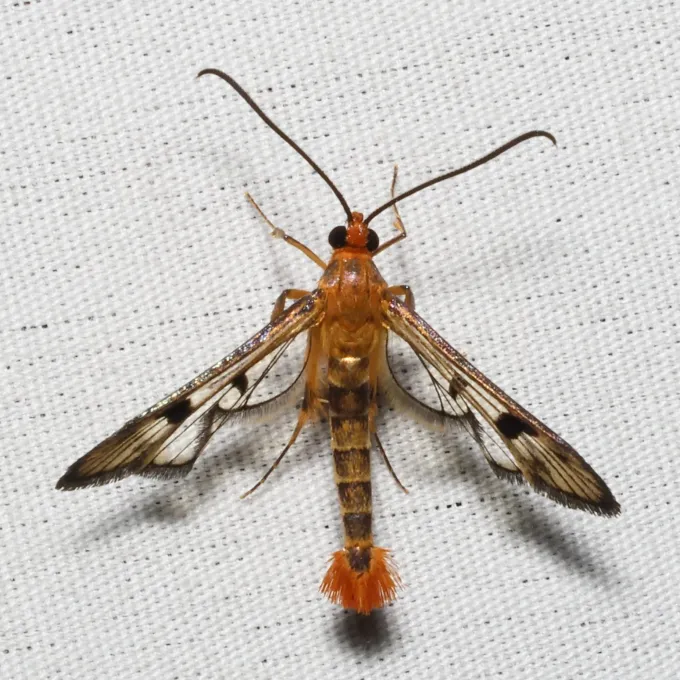
Adult moths feature transparent wings with dark borders and bright yellow or orange bands on their abdomen, which makes them look like wasps.
The wingspan typically measures around 20 to 25 mm, and their bodies are covered with fine hairs, enhancing their resemblance to stinging insects.
The larvae are creamy-white with a brown head capsule and possess strong mandibles, which they use to tunnel into the woody parts of the tree.
They undergo a complete metamorphosis, with pupation occurring inside the tree trunk or branches where the larva has been feeding.
What it damages
The primary hosts of the maple clearwing moth are trees belonging to the genus Acer, including common urban varieties like the sugar maple.
Larvae primarily infest the lower parts of the trunk, particularly targeting areas that have been previously damaged or have rough, irregular bark.
By boring into the cambium layer, the larvae disrupt the tree's vascular system, which can inhibit nutrient transport and overall tree growth.
The larval galleries provide entry points for various pathogens, which can exacerbate the physical damage caused by the moth itself.
Severe infestations often result in stunted growth, dieback of branches, and in cases of young saplings, potential death of the tree.
When it appears
The flight period for adult moths generally begins in late spring and continues throughout the summer months, with peaks in June and July.
Females deposit their eggs directly into crevices or damaged areas on the bark of host trees during the active flight season.
Once hatched, the larvae penetrate the bark and enter the inner layers of the tree, where they feed throughout the remainder of the growing season.
The larvae typically overwinter inside the tree and complete their development into pupae during the following spring.
Targeting the moths during their adult flight period is critical for preventing new generations from laying eggs on susceptible trees.
Signs of infestation
A classic sign of infestation is the presence of empty pupal exuviae (casings) protruding from small holes in the bark after the adults have emerged.
Accumulations of frass, which is a mix of larval excrement and fine sawdust, are often visible at the base of the infested tree.
Bark swelling or the appearance of localized galls on the trunk are common indicators of the tree's reaction to larval activity.
Fluid drainage from the trunk, known as sap weeping, is another visual indicator often associated with clearwing moth larvae infestations.
- Protruding pupal skins
- Visible sawdust-like frass
- Localized bark swelling
- Sap oozing from entry holes
Control measures
Maintaining tree vigor is the best defense, as healthy trees are better able to callous over wounds and resist larval penetration.
Pheromone traps are highly effective for monitoring populations and can be used to disrupt mating cycles in small-scale gardens or parks.
Insecticide applications directed at the bark during the adult flight period can kill eggs and newly hatched larvae before they enter the wood.
Proper pruning practices and removing infested limbs or damaged sections of the trunk can help reduce the population of moths locally.
Biocontrol agents, such as beneficial nematodes, have been studied for their potential to infect and kill clearwing larvae within their galleries.
Taxonomy
- Latin name
- Synanthedon acerni
- Order
- Lepidoptera (butterflies)
- Family
- Sesiidae
- EPPO code
- SYNAAC
Discussion
No discussions yet — be the first.