
Clearwing moth
Synanthedon
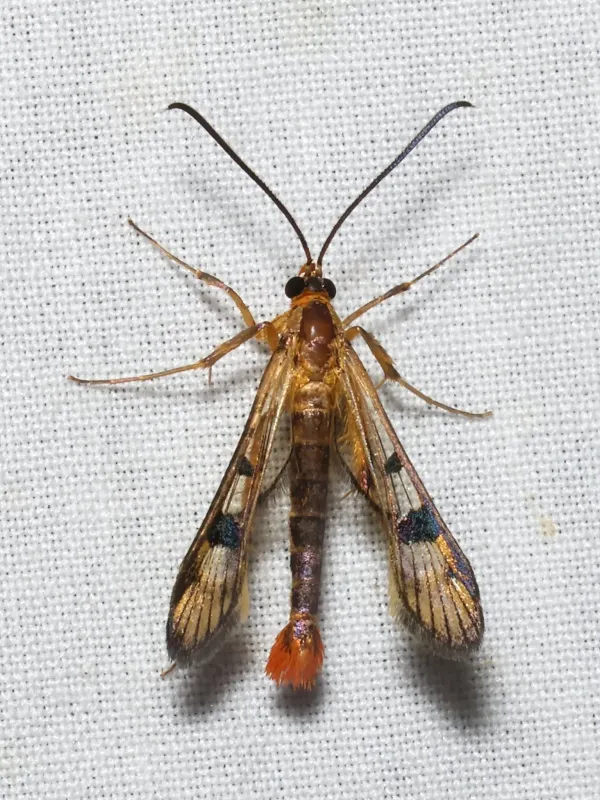
Description
How to identify
The clearwing moth (Synanthedon) belongs to the family Sesiidae, known for their remarkable mimicry, which makes them look almost identical to wasps.
Adults are characterized by narrow, largely transparent wings with dark margins and a distinct black-and-yellow or black-and-blue banded abdomen.
The wingspan typically ranges from 20 to 30 millimeters, and females are generally larger and more robustly built than their male counterparts.
They undergo complete metamorphosis: egg, larva, pupa, and adult, with adults being diurnal, flying actively during warm and sunny daytime hours.
The larvae are whitish caterpillars with brown heads, reaching lengths of up to 25 millimeters, and possess strong mandibles for boring into wood.
What it damages
Clearwing moths are notorious pests that primarily target woody stems of various berry and fruit plants, causing significant physiological damage.
Currants (both black and red) and gooseberries are the most common hosts, where the larvae cause substantial economic damage to commercial crops.
Other plants, including raspberries, peaches, and various stone fruits, can also be infested as the larvae tunnel into the core of the branches.
By boring through the pith, the larvae disrupt the vascular system of the plant, preventing the efficient transport of water and nutrients.
Chronic infestation results in stunted growth, failure to produce fruit, and eventually the death of entire branches or the whole shrub.
When it appears
The flight period of adult moths usually begins shortly after the flowering of the host plants, typically extending throughout early summer.
The adult stage lasts for several weeks, and during this time, females lay eggs near buds or existing fissures in the bark of the branches.
Upon hatching, the tiny larvae immediately bore into the shoot to feed on the pith, remaining protected inside the stem for the rest of their development.
The life cycle is often biennial, meaning the larvae spend two full seasons feeding within the woody tissue before they pupate and emerge as adults.
Winter is passed as larvae, which stay inside the hollowed-out branches, surviving low temperatures until they resume activity the following spring.
Signs of infestation
The most prominent sign of an infestation is the premature wilting and subsequent death of individual branches, often observed during the fruit-set phase.
Cutting open an infested stem reveals a hollowed-out central tunnel filled with frass, which is the powdery excrement produced by the feeding larvae.
Small exit holes on the bark, created by emerging adults, are another clear indication that the population has already completed its life cycle.
Infected branches become brittle and break easily under pressure, and the foliage on these stems often turns yellow or drops prematurely.
Observation of wasp-like insects flying around bushes during bloom should alert gardeners to monitor the plants for signs of larval tunneling.
Control measures
Sanitation is the most effective approach; all infested branches must be pruned back until healthy white tissue is visible on the cross-section.
It is vital to burn all removed plant material immediately, as the larvae inside would otherwise continue their development and emerge as new adults.
Maintaining vigorous plant health through proper fertilization and avoiding unnecessary mechanical damage to the bark helps the plant withstand attacks.
Pheromone traps are highly effective for monitoring and mass-trapping males, which significantly reduces the success of mating and subsequent egg laying.
If chemical control is necessary, applications must be timed to target the adult moths before they have the opportunity to lay eggs on the bark.
Taxonomy
- Latin name
- Synanthedon
- Order
- Lepidoptera (butterflies)
- Family
- Sesiidae
- EPPO code
- SYNASP
Discussion
No discussions yet — be the first.