
Cotton leaf roller
Syllepte derogata
Description
How to identify
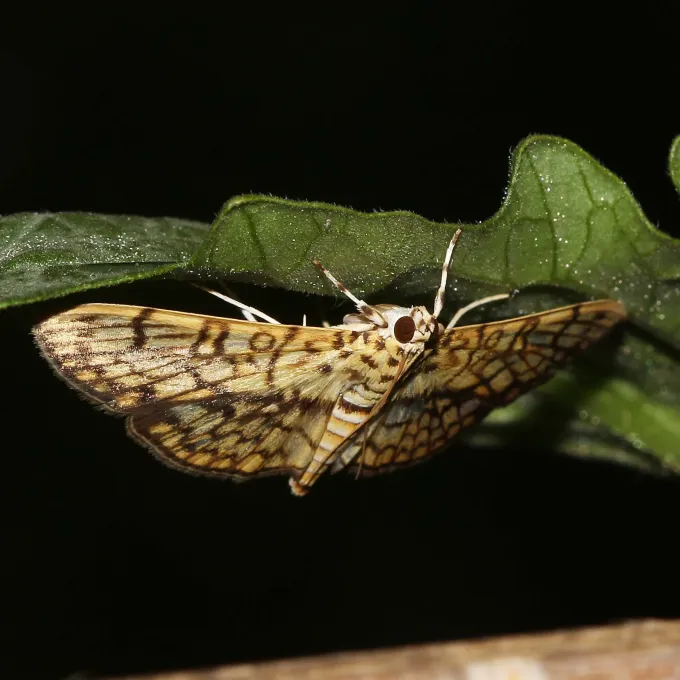
The cotton leaf roller Syllepte derogata is a moth belonging to the Crambidae family. The adult moth has a wingspan of approximately 30–35 mm, with pale yellow wings marked by numerous brown, zigzag lines.
The larvae, when fully grown, measure 20–25 mm in length. They have a greenish body, a dark brown or black head, and distinct black spots on each body segment from which sparse hairs emerge.
The pupa is brownish and is typically found inside the rolled-up leaves of the host plant, where it remains protected during the transition phase to the adult stage.
The life cycle involves complete metamorphosis, consisting of the egg, larva, pupa, and adult stages. The duration of each generation varies depending on local climate conditions and temperatures.
Overwintering occurs primarily in the pupal stage, hidden within plant debris or the upper layers of the soil, making field sanitation a critical management practice.
What it damages
While cotton is the primary host, this pest also attacks other plants in the Malvaceae family, including okra and hollyhock, which can serve as alternative food sources.
Larvae feed in a hidden manner by rolling the leaves into tubes or pockets using silk threads, which allows them to graze on the leaf tissue undisturbed by predators.
Extensive feeding destroys the leaf surface, leaving only a network of veins. This process severely reduces the plant's photosynthetic capacity, leading to weakened growth and reduced yield.
Severe infestations cause premature leaf fall and the shedding of flower buds, which directly impacts the development of cotton bolls and lowers the quality of the harvest.
In cases of high population density, entire fields can appear defoliated, resulting in significant economic losses for farmers if control measures are not implemented in time.
When it appears
The flight of the first-generation moths typically begins in late spring, coinciding with the rise in temperatures that favor the mating and oviposition processes.
The most damaging larval stages occur during the summer months, aligning with the active vegetative and reproductive growth phases of the cotton crop.
Depending on the region, the pest can complete three to five generations per season, often with population numbers peaking mid-season due to favorable environmental conditions.
The timing of the larvae's appearance often corresponds with the cotton squaring and flowering stages, making this period the most critical for crop surveillance.
Monitoring using light or pheromone traps is an effective strategy to determine the presence of adults and to predict when larval hatch will begin in the field.
Signs of infestation
The most prominent sign of infestation is the characteristic rolling of leaf margins, which creates tubes or pockets at the tips of the shoots.
Upon unrolling these leaves, one can observe the presence of larvae and their dark, granular excrement, which confirms an active infestation on the plant.
Leaves affected by the larvae show signs of skeletonization, where the green tissue has been consumed, leaving behind a brown, translucent framework of veins.
- Rolled-up leaves at the top of the plant.
- Presence of silk threads binding leaf edges.
- Skeletonized leaf patches.
- Premature yellowing and drying of the foliage.
In severe cases, the terminal buds may become stunted or distorted, visibly slowing down the vertical growth of the plant and affecting its structure.
Control measures
Effective management begins with cultural practices, such as deep plowing after harvest, which buries pupae and helps reduce the overwintering population.
Weed control, particularly removing wild Malvaceae species from field borders, is essential to limit the availability of secondary host plants for the moth.
Biological control methods, including the release of egg parasitoids like Trichogramma or the use of Bacillus thuringiensis sprays, are successful when applied early.
Chemical control is necessary when economic thresholds are reached; systemic and contact insecticides should be used in rotation to prevent the development of pesticide resistance.
Scouting is vital for success; treatments are most effective before the larvae reach older stages and construct their protective rolled-leaf shelters.
Taxonomy
- Latin name
- Syllepte derogata
- Order
- Lepidoptera (butterflies)
- Family
- Crambidae
- EPPO code
- SYLEDE
Discussion
No discussions yet — be the first.