

Pest · Hemiptera (bugs, aphids, leafhoppers) · affects Fodder beet, Common sunflower, Potato
Especially harmful
Beet root aphid
Pemphigus fuscicornis
Description
How to identify
The beet root aphid (Pemphigus fuscicornis) is a specialized pest belonging to the order Hemiptera and the family Aphididae. It is a soil-dwelling insect that spends most of its life cycle underground.
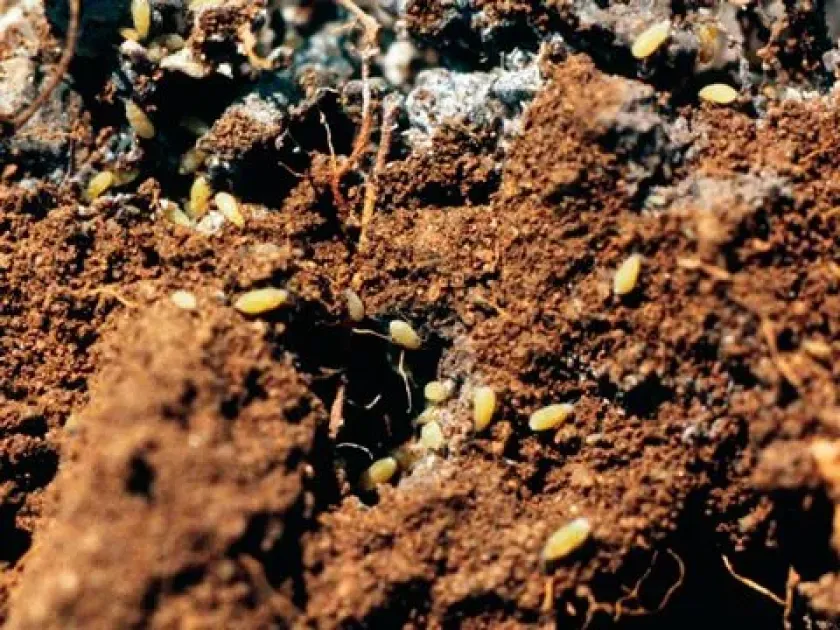
Adult aphids have a light yellowish-white body covered in a dense, white waxy secretion. This powdery substance protects them from soil moisture and helps them survive in the root zone.
The nymphs are smaller than the adults but share the same habit of feeding on plant roots. They reproduce rapidly, forming dense colonies that cover the roots of the host plant.
The lifecycle involves a complex alternation between underground generations on root crops and secondary hosts. This makes them difficult to eradicate once they establish a population.
They overwinter mainly as eggs in the soil or on the root systems of perennial weeds, awaiting favorable temperatures in the spring to begin their development.
What it damages
This pest primarily attacks sugar beets, fodder beets, and table beets. It feeds by piercing the roots and sucking the sap, which severely weakens the plant.
Beyond beets, the aphid can survive on various weed species within the Amaranthaceae family, using them as reservoirs to infest crop fields during the growing season.
The damage results in significantly lower sugar content and smaller root size, directly impacting the economic viability of the harvest for farmers.
By killing secondary roots and damaging the taproot, the aphid disrupts the plant's ability to take up water and nutrients, leading to physiological stress.
Severe infestations can lead to massive wilting and the total death of young beet plants, causing patchy crop emergence and reduced overall stand density.
When it appears
The aphid becomes active in late spring once soil temperatures reach levels conducive to insect development, usually starting from 12-15 degrees Celsius.
Peak population densities typically occur during the mid-summer months, specifically July and August, when hot and dry conditions prevail.
During dry seasons, the insect population can explode, as the dry soil provides a better environment for their movement and colony expansion.
As temperatures drop in the autumn, the aphids begin to shift their life cycle towards producing overwintering eggs, moving deeper into the soil profile.
The severity of an infestation is often negatively correlated with soil moisture; well-irrigated fields tend to experience less damage than those under drought stress.
Signs of infestation
The first noticeable sign is the wilting of leaves during the hottest part of the day, which does not recover even if the soil is watered appropriately.
Leaves slowly turn yellow, wither, and lose their integrity. If the infestation is severe, the entire foliage may die back prematurely due to root failure.
Upon inspecting the roots, one can see the characteristic white, waxy, fluff-like substance adhering to the beet surface and present in the soil cavities around it.
The beet roots themselves may appear stunted, deformed, and covered with lumps, with noticeable decay of the smaller lateral feeder roots.
A high presence of ants around the base of the beets is a major indicator, as ants frequently tend to aphids to feed on the honeydew they excrete.
Control measures
Crop rotation is the most critical cultural practice. Avoiding planting beets in the same field for at least 3-4 years significantly reduces pest pressure.
Effective weed management is vital; removing weeds of the Amaranthaceae family from field margins denies the aphid its early-season food source.
Deep autumn plowing helps expose the overwintering eggs to predators and harsh weather conditions, effectively reducing the population for the following year.
Maintaining optimal irrigation schedules helps plants survive aphid attacks and creates a less favorable environment for the insects to colonize the root zone.
- Use of systemic insecticides applied as soil treatments at planting time to protect early root growth.
- Regular field scouting and localized soil inspections to catch infestations before they spread across the entire plot.
Reference
Connections · Beet root aphid
Most often together:
Marketplace
Products · 1
Biology
Taxonomy
- Latin name
- Pemphigus fuscicornis
- Order
- Hemiptera (bugs, aphids, leafhoppers)
- Family
- Aphididae
- EPPO code
- PEMPFU
Community
Discussion
No discussions yet — be the first.