
Garlic fly
Suillia univittata
Description
How to identify
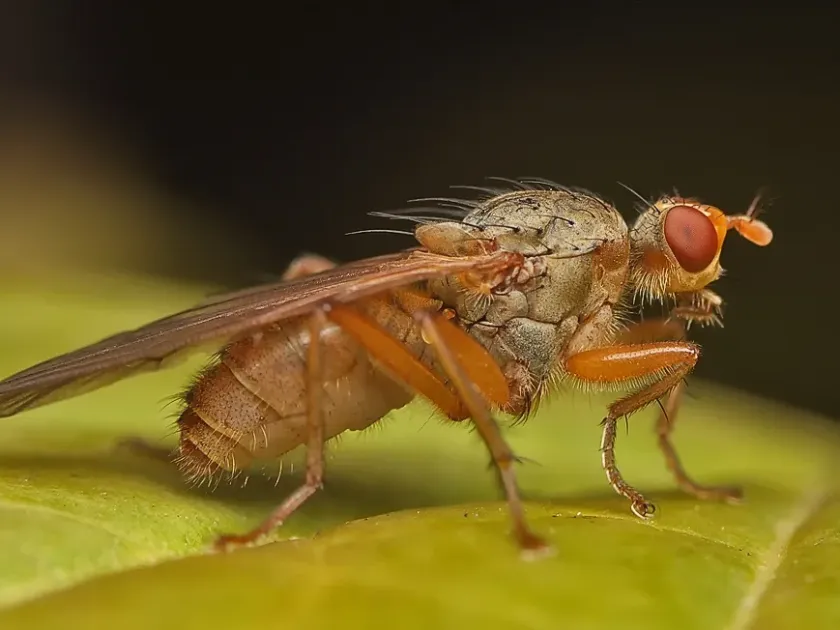
The garlic fly (Suillia univittata) is a member of the Heleomyzidae family within the order Diptera. These small flies, measuring about 5–8 mm in length, are typically yellowish-brown to reddish in color.
Adults possess clear wings with faint shading and long, slender legs. The larvae are small, legless, and white or yellowish, designed for burrowing within plant tissues.
A key biological feature is their activity during cold weather. Unlike many other pests that prefer warmth, the garlic fly begins its lifecycle as soon as temperatures rise above 3–5 degrees Celsius.
The development cycle consists of four stages: egg, larva, pupa, and adult. Females deposit eggs in the soil near the base of young plants or between the leaves of emerging shoots.
Being highly mobile, the adults can spread rapidly across a field, making them a significant challenge for both small-scale gardens and larger agricultural plots.
What it damages
The primary hosts of this pest are garlic (both winter and spring varieties) and onions. The larvae are responsible for the damage as they feed on the inner tissues of the stem and bulb.
Larvae penetrate the young stems of plants during the early stage of growth. Their feeding disrupts nutrient circulation, causing the plant to wither and stop developing.
In cases of heavy infestation, larvae may completely destroy the basal plate of the bulb, leading to the total death of the plant within a very short timeframe.
The tunnels created by the larvae provide an entry point for secondary bacterial and fungal infections, which further accelerate the decay of the plant.
Agricultural losses can be significant, as early-stage damage often renders the entire crop unmarketable or unsuitable for long-term storage.
When it appears
The garlic fly is most active during early spring, immediately following the thaw of snow when ambient temperatures stabilize around +3°C to +7°C.
The peak emergence of adults perfectly coincides with the appearance of garlic sprouts, making these young, tender plants highly susceptible targets.
The period of maximum larval damage occurs during April and early May. This is a critical time when the plant is establishing its root system and foliage.
After the larvae complete their feeding stage, they move into the soil to pupate, and the adult population becomes less visible as temperatures climb during the summer months.
While a second generation may occur in the autumn, the primary economic impact is felt from the initial spring generation.
Signs of infestation
One of the earliest signs is the yellowing and wilting of the tips of the youngest leaves, which is often misidentified as a nutrient deficiency or cold damage.
Close inspection reveals stunted growth, soft or limp stems, and occasionally a distorted appearance at the base of the plant.
If an affected plant is pulled from the ground, one can often find white larvae inside the hollowed-out portions of the stem or the bulb tissue.
A distinct, unpleasant odor of rot often accompanies an infestation, indicating that the damaged tissue has become a site for secondary pathogens.
Visible patches of wilting or dying plants amidst healthy ones on a garden bed are a classic indicator of a localized garlic fly outbreak.
Control measures
Crop rotation is the most effective preventative measure; garlic should not be replanted in the same soil for at least three to four years.
Using certified, high-quality planting material and maintaining proper spacing are essential strategies to reduce the overall risk of infestation.
- Dusting rows with a mixture of tobacco dust and wood ash to deter egg-laying.
- Regular hoeing and cultivation of soil to disturb and destroy pupae.
- Application of appropriate insecticides during the period of adult emergence.
- Using protective row covers or agro-textiles during early spring to exclude flies from the crops.
Fall tillage is highly recommended to expose pupae to winter temperatures and predators, thereby reducing the number of flies that emerge the following spring.
Removal and immediate destruction of infested plants, including their roots, are vital to prevent the larvae from completing their lifecycle and moving to adjacent crops.
Taxonomy
- Latin name
- Suillia univittata
- Order
- Diptera (flies)
- Family
- Heleomyzidae
- EPPO code
- SUIIUN
Discussion
No discussions yet — be the first.