
Amber Snail
Succinea lauta
Description
How to identify
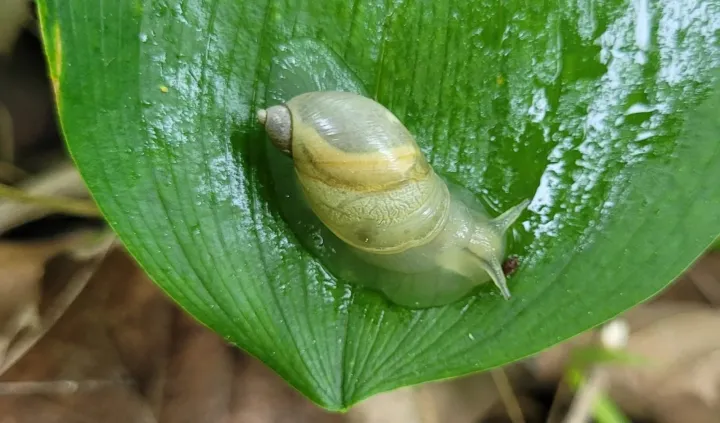
The amber snail (Succinea lauta) is a terrestrial pulmonate gastropod mollusk belonging to the family Succineidae. It is characterized by a fragile, semi-transparent, amber-colored shell with relatively few whorls, which appears disproportionately small compared to its soft body.
The snail's body is typically greyish or yellowish and produces abundant mucus, facilitating movement across various surfaces, including stems and leaves. It is a moisture-loving species that thrives in humid environments such as marshes, damp soil, and dense garden foliage.
Adult individuals usually measure between 10 and 15 millimeters. Their sensitivity to dehydration forces them to seek shelter during the day, making them highly active primarily during early morning hours, evenings, or rainy weather.
The life cycle involves egg deposition in moist soil or decaying organic matter. The young snails emerge fully formed and begin feeding almost immediately on available vegetation.
Their distribution is highly dependent on local climatic conditions and irrigation practices, as they cannot survive in dry or arid environments without access to significant water sources.
What it damages
Amber snails are polyphagous pests capable of attacking a wide range of agricultural and ornamental plants. They are particularly destructive to vegetable crops, leafy greens, and young nursery seedlings during periods of high humidity.
They feed on the epidermis and parenchyma of leaves, often leaving only the veins intact in severe cases. This feeding behavior significantly reduces the plant's photosynthetic capacity and can lead to stunted growth or total plant failure.
Signs of infestation
Signs of infestation include irregular holes in the leaf blades and stems of affected crops. One of the most distinct indicators is the presence of shiny, dried mucus trails left on the foliage and soil surface, which remain visible even after the snails have retreated to shelter.
In addition to physical holes, feeding patterns often show ragged leaf edges. Heavy infestations can lead to substantial loss of biomass, rendering the crop unmarketable or susceptible to secondary fungal and bacterial rot infections.
Control measures
Management of the amber snail focuses on habitat modification and non-chemical barriers. Reducing overall soil moisture and eliminating overgrown weeds around crop zones are the primary steps in preventing population spikes.
- Maintaining proper plant spacing to improve air circulation and reduce humidity.
- Creating physical barriers using wood ash, lime, or coarse sand around vulnerable plants.
- Utilizing liquid bait traps (yeast or beer-based) to capture and remove individuals.
- Applying molluscicides containing metaldehyde only when infestation thresholds are exceeded.
- Manual collection and destruction of snails during peak activity periods.
Taxonomy
- Latin name
- Succinea lauta
- Order
- Molluscs
- Family
- Succineidae
- EPPO code
- SUCCLA
Discussion
No discussions yet — be the first.