
Amber snail
Oxyloma
Description
How to identify
Amber snails (genus Oxyloma) belong to the family Succineidae. These are small terrestrial air-breathing mollusks often found near water bodies and in damp, humid environments.
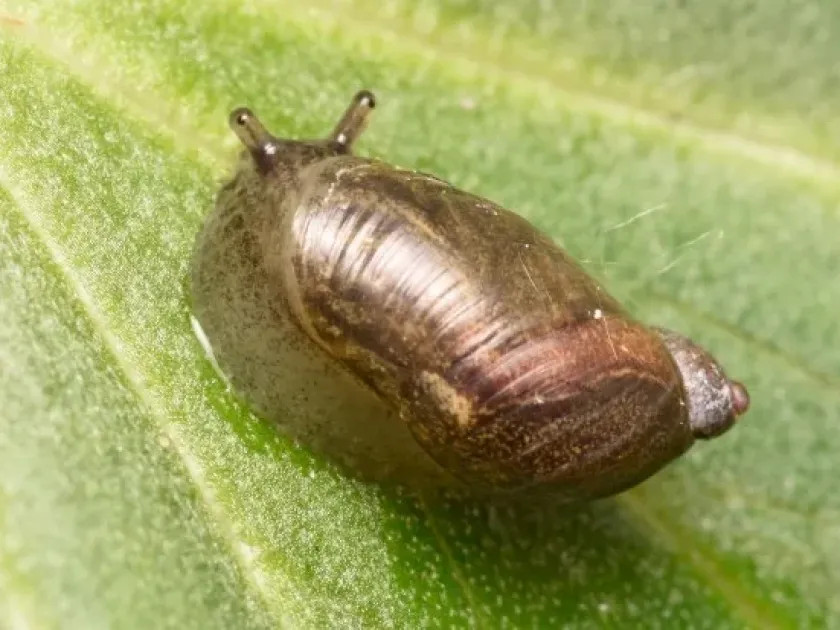
The mollusk's body is typically translucent, colored in shades of gray or yellow. Their shell is distinguished by an elongated shape resembling an ear, featuring a very large aperture and few whorls.
Unlike many other terrestrial mollusks, amber snails have the ability to move quite quickly across moist surfaces. Adult individuals rarely exceed 10–15 millimeters in length.
They can be identified by their shiny, thin-walled amber-colored shells, through which the internal organs of the mollusk are often visible. They prefer to stay on the undersides of leaves.
The biology of this species is closely linked to high humidity, which is why their activity increases sharply during rainy weather or in areas with artificial soil waterlogging.
What it damages
Amber snails are polyphagous, meaning they can feed on a wide range of agricultural crops. They cause the most damage to seedlings and young shoots.
They pose a particular threat to vegetable crops such as lettuce, cabbage, cucumbers, and various ornamental plants with succulent, soft leaves.
The mollusks eat large, irregular holes in leaf blades, which leads to significant loss of the plant's assimilatory surface. In cases of mass outbreaks, they can destroy young plantings in a matter of days.
Beyond direct damage, these pests facilitate the spread of fungal and bacterial infections by carrying pathogens on their bodies from the soil to healthy plant tissues.
Furthermore, the wounds caused by amber snails often become entry points for secondary pests and viral diseases that significantly weaken the plant's immune system.
When it appears
The activity of the amber snail begins with the arrival of warm spring weather, as soon as the soil temperature rises above 10 degrees Celsius and humid weather persists.
The peak population density is usually observed in summer months during frequent rainfall and cloudy days. In dry, hot weather, the pest is significantly less active.
The mollusk life cycle involves laying eggs in moist substrate. Juveniles appear quite rapidly, continuing to feed and grow throughout the entire growing season.
By autumn, amber snails head for hibernation, burrowing into the topsoil, under fallen leaves, or plant debris, where their development pauses until the following season.
Understanding seasonal cycles is crucial for planning protective measures, as the main control strategies are most effective during the period of peak pest reproduction.
Signs of infestation
The primary sign of the amber snail's presence on a plot is characteristic, irregular holes in the leaves of cultivated plants, usually located in the lower parts of the plant.
A dried mucus trail, left by the mollusk as it moves, can often be observed on the leaf surface and around damaged areas.
During the day, it is difficult to spot the pest as it hides in shaded, damp places, but they can be seen on the undersides of leaves during evening and early morning hours.
The presence of specific damage on seedlings, which may look gnawed along the edges, is a clear indicator of gastropod activity.
When inspecting the site in the morning, one can often find the mollusks themselves attached to stems or leaves, especially in dense and poorly ventilated plantings.
Control measures
To control the population of the amber snail, it is first necessary to implement agrotechnical measures: regular weeding, soil cultivation, and the removal of plant debris.
It is important to limit excessive irrigation and establish good drainage to avoid creating permanent zones of high humidity that attract mollusks.
As a mechanical defense, special traps can be installed or barriers made of materials that are unpleasant for mollusks to traverse, such as gravel or wood ash, can be created.
Chemical control involves the use of specialized molluscicides based on metaldehyde, which are scattered in areas where pests congregate.
- Regular mowing of grass around garden beds.
- Manual collection of mollusks during the evening.
- Use of biological control agents (entomopathogenic nematodes).
- Mulching the soil with materials that repel slugs.
Taxonomy
- Latin name
- Oxyloma
- Order
- Molluscs
- Family
- Succineidae
- EPPO code
- OXLMSP
Discussion
No discussions yet — be the first.