
Sunflower maggot
Strauzia longipennis
Description
How to identify
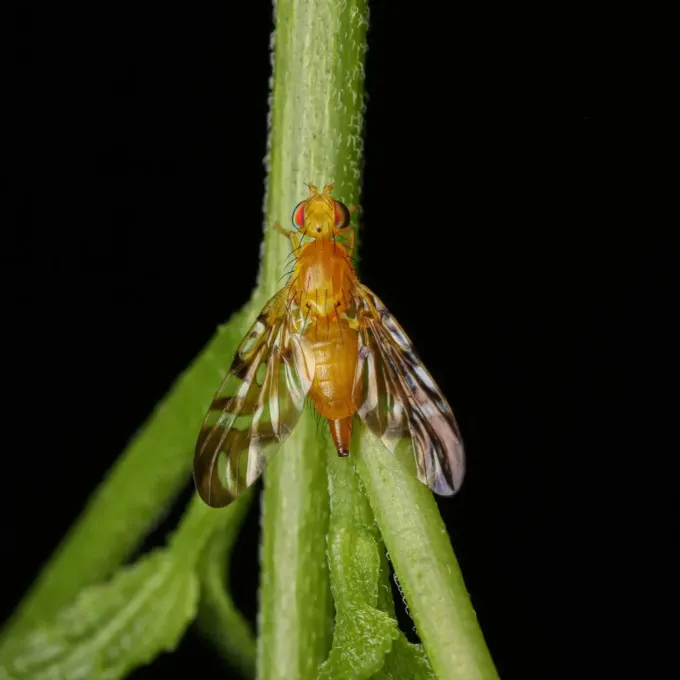
The sunflower maggot, scientifically known as Strauzia longipennis, is a member of the Tephritidae family of flies, commonly referred to as fruit flies or picture-winged flies. These insects are easily recognized by the intricate, banded patterns on their wings.
Adult flies are typically 5 to 7 mm long, featuring a yellowish-brown body and distinct, often iridescent, eyes. Their appearance is well-adapted for camouflage on the vegetation of their host plants.
The larvae are creamy-white, legless maggots that grow up to 8 mm in length. Because they live inside the host plant's tissues, their presence remains hidden until significant damage has occurred.
The life cycle consists of egg, larval, pupal, and adult stages. They overwinter as pupae in the soil, protected by a hardened casing (puparium) that allows them to survive cold winter temperatures.
Adult emergence typically begins in early summer, coinciding with the rapid growth phase of sunflowers, which is the period when they are most susceptible to oviposition by the females.
What it damages
The primary host for this pest is the sunflower, Helianthus annuus. Female flies deposit eggs into the epidermis of the stem, leaf petioles, or the base of the flower head.
Once the larvae hatch, they tunnel into the plant tissue, feeding on the pith and internal structures. This boring activity disrupts the plant’s nutrient transport, leading to reduced overall vigor.
Infested stalks are significantly weakened, making them susceptible to lodging during windy conditions. This can lead to total crop loss if the stalks break before harvest begins.
The tunnels created by the larvae serve as entry points for various secondary pathogens, including bacteria and fungi, which cause the tissues to rot prematurely and kill parts of the stem.
Crop loss is also attributed to the reduced seed fill and lower oil content, as the plant redirects energy away from grain production to cope with the tissue destruction and stress caused by the infestation.
Signs of infestation
The initial signs of an infestation include small, discolored puncture marks on the stem or petiole where the female fly has inserted her ovipositor to lay eggs.
A major diagnostic feature is the presence of internal tunneling within the stalk. If an infested stem is split open, the frass (excrement) left behind by the larvae is clearly visible, often accompanied by the maggots themselves.
Plants may show stunted growth and a general lack of health compared to non-infested plants. During peak heat, leaves on infested sunflowers may wilt even if soil moisture levels are adequate.
Severe infestations can cause visible deformation, such as swellings or lesions on the stalk. In some cases, the tissue around these areas may turn dark and necrotic.
Adult flies can sometimes be spotted resting on the leaves or the undersides of the sunflower heads, particularly during the cooler parts of the day when they are less active.
Control measures
Integrated Pest Management (IPM) is the most effective approach. Crop rotation is vital, as it disrupts the life cycle by moving the host plant away from the previous year’s pupation sites.
Deep plowing or mechanical tillage following harvest is an excellent way to expose pupae to the surface, where they become vulnerable to predators and environmental stresses like freezing temperatures.
Weed management is essential, as the sunflower maggot can also utilize other Asteraceae species as alternate hosts. Removing these weeds from the perimeter of fields reduces the local population.
Chemical control is generally reserved for situations where monitoring indicates that the population has exceeded the economic threshold, requiring the application of insecticides during the adult flight window.
- Practice long-term crop rotation.
- Implement post-harvest tillage.
- Control wild host plants in and around fields.
- Use yellow sticky traps for monitoring fly activity.
Taxonomy
- Latin name
- Strauzia longipennis
- Order
- Diptera (flies)
- Family
- Tephritidae
- EPPO code
- STRALO
Discussion
No discussions yet — be the first.