
Sunflower maggot
Strauzia
Description
How to identify
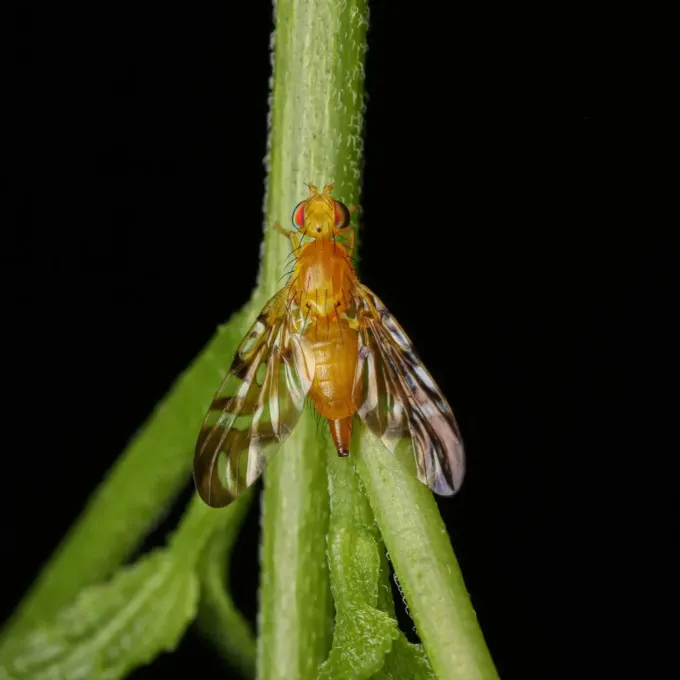
The sunflower maggot (Strauzia longipennis) belongs to the Tephritidae family, order Diptera. These flies are easily recognized by the complex, lace-like or banded pattern on their wings.
Adult flies measure about 5-6 mm in length. They typically have a yellow-brown body color, with large eyes that often exhibit a vibrant, metallic sheen in direct sunlight.
The larvae are creamy-white, legless maggots that grow up to 7 mm long. Their bodies are cylindrical and taper towards the head, which is highly specialized for tunneling inside plant tissues.
The life cycle is holometabolous, consisting of the egg, three larval instars, puparium, and adult stage. They spend the winter as pupae buried in the soil or within old plant debris.
The species is highly specialized, having evolved unique physiological traits to thrive specifically within the stalks of its primary host plants.
What it damages
The larvae primarily feed on the internal tissues of the sunflower stalk. By tunneling through the pith, they disrupt the vascular system responsible for nutrient and water transport.
This internal structural damage weakens the plant, making it highly susceptible to lodging, especially during heavy wind or rainfall events near the harvest season.
Nutrient flow restriction leads to stunted head development and reduced seed filling, which directly impacts the overall oil content and yield quality of the crop.
Feeding tunnels created by the maggots provide entry points for secondary pathogens, including bacteria and fungi, which cause internal stalk rot and premature plant death.
While an individual maggot might cause limited damage, high infestation rates can lead to significant economic loss across entire sunflower fields.
When it appears
Adult flies typically emerge in early summer, coinciding with the rapid growth phase of sunflower plants. Emergence is triggered by specific temperature thresholds.
Females use their sharp ovipositors to insert eggs directly into the soft upper portions of the sunflower stalk. This process is repeated multiple times throughout the season.
Larval development takes place during the mid-summer period. The maggots consume the pith as they grow through their three instars, remaining protected inside the stem.
By late summer or early autumn, the larvae mature and exit the stem to pupate in the soil, entering a dormant state until the following spring.
Monitoring for adult flight during the early growth stages is essential for predicting the potential intensity of the infestation for that year.
Signs of infestation
The most visible sign of infestation is the presence of small, dark, or discolored puncture wounds on the upper stem, indicating where eggs were deposited by females.
Wilting of the top leaves or a noticeable droop in the terminal head area suggests that the vascular pathways have been compromised by larval feeding.
Internally, the pith of the stalk will appear consumed or hollowed out, often filled with decaying plant matter and larval frass, leading to a dark, soggy appearance.
Infested plants often show non-uniformity in height and vigor compared to neighboring healthy sunflowers, providing a visual cue for field scouting.
- Stunted terminal growth.
- Structural failure or lodging of stalks under low wind pressure.
- Internal stalk tissue discoloration and rot.
Control measures
Crop rotation is the most effective preventative measure; moving sunflowers away from previously infested fields helps break the lifecycle of the pest.
Post-harvest tillage, particularly deep plowing, helps bury or expose the pupae in the soil to environmental stressors, effectively reducing the overwintering population.
Sanitation efforts, including the destruction of wild Asteraceae weeds in and around the field, eliminate alternative hosts for the fly.
Systemic insecticides may be used if adult population thresholds are exceeded, targeting the flies before they can successfully lay eggs in the stems.
Integrating biological controls or using resistant hybrid varieties that can compensate for minor stalk damage can significantly reduce the dependency on chemical sprays.
Taxonomy
- Latin name
- Strauzia
- Order
- Diptera (flies)
- Family
- Tephritidae
- EPPO code
- STRASP
Discussion
No discussions yet — be the first.