
Buffalo treehopper
Stictocephala rotundata
Description
How to identify
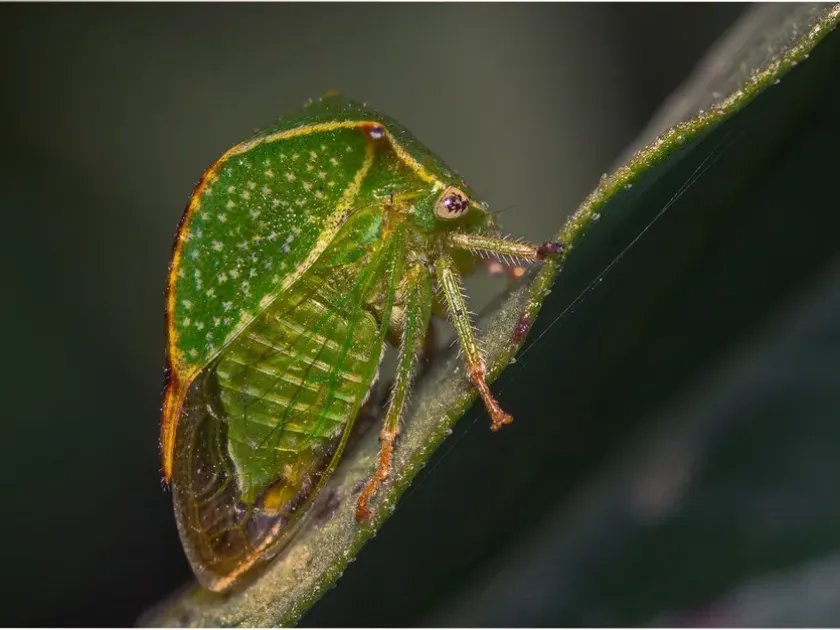
The buffalo treehopper (Stictocephala rotundata) is a member of the Membracidae family within the order Hemiptera. These insects are easily recognized by their unique pronotum, which extends over the body and resembles a thorn or a hump.
Adult insects typically measure 7–9 mm in length and exhibit a light green to olive-colored body, which provides excellent camouflage against the foliage and young twigs of host trees.
While they possess transparent wings and are capable of swift flight, they are primarily known for their ability to jump quickly when disturbed by predators or human activity.
Nymphs, or immature treehoppers, lack developed wings and are covered in characteristic spines that help them cling to the plant surfaces while feeding.
The lifecycle includes the egg stage, five nymphal instars, and the adult stage, with the development usually occurring on various woody plants throughout one or two generations per year.
What it damages
This pest affects a wide range of fruit and ornamental crops, including apple, pear, cherry, peach, and various woody ornamental species found in nurseries and orchards.
The primary damage is caused by females during oviposition. They create deep, crescent-shaped slits in the bark of young twigs to lay their eggs, which severely impacts the cambium layer.
These damaged bark areas often become deformed and necrotic, leading to weakened plant immunity and a significant decrease in winter hardiness for the affected branches.
Both nymphs and adults feed on plant sap, which depletes essential nutrients, slows down shoot growth, and often leads to premature leaf drop during the summer.
The scarred tissue often serves as an entry point for secondary fungal infections, which can result in limb dieback or the eventual death of young trees if the infestation is severe.
When it appears
The pest overwinters primarily in the egg stage, deposited under the bark of one- or two-year-old twigs by females during the late summer and autumn.
In spring, synchronized with bud break and active sap flow, the nymphs emerge from the eggs and begin their feeding cycle on young, tender shoots.
Adult treehoppers typically appear by mid-summer and remain active throughout the season, continuing to feed and mate until the arrival of cooler autumn weather.
The period of greatest economic impact coincides with the most intensive growth phases of the trees, when bark damage interferes with the physiological development of the twigs.
As autumn approaches, adult treehoppers actively search for suitable shoots to begin the egg-laying process, ensuring the survival of the next generation.
Signs of infestation
The most prominent sign of a buffalo treehopper infestation is the presence of characteristic scarring on the bark of twigs, often appearing as parallel or crescent-shaped slits.
Visible deformation or curling of young shoots is a strong indicator that the vascular tissue has been compromised by the female's egg-laying activity.
A general lack of vigor in young orchard plantings, characterized by stunted growth and poor shoot elongation, often points to a persistent treehopper presence.
Observers may notice the adult insects perched on branches during sunny days, where they will quickly jump away upon any tactile disturbance.
The development of secondary diseases, such as perennial cankers or black rot, is frequently localized around the damaged sites caused by the treehoppers.
Control measures
Managing the buffalo treehopper requires an integrated approach focusing on the physical removal of egg-laying sites and the reduction of adult populations.
Regular sanitation, specifically the pruning and destruction of heavily infested twigs, is highly effective for reducing the carryover of the population for the next season.
If economic thresholds are exceeded, the application of systemic insecticides during the peak of nymph activity can significantly reduce damage to young trees.
Maintaining clear surroundings by removing weeds and tall grasses from the orchard floor reduces the attractiveness of the site to the insects.
- Use of sticky traps for monitoring adult activity.
- White-washing trunks and main branches to discourage female egg-laying.
- Promoting strong tree growth through proper fertilization and irrigation to help tissues heal.
Taxonomy
- Latin name
- Stictocephala rotundata
- Order
- Hemiptera (bugs, aphids, leafhoppers)
- Family
- Membracidae
- EPPO code
- STICRO
Discussion
No discussions yet — be the first.