
Pacific treehopper
Stictocephala pacifica
Description
How to identify
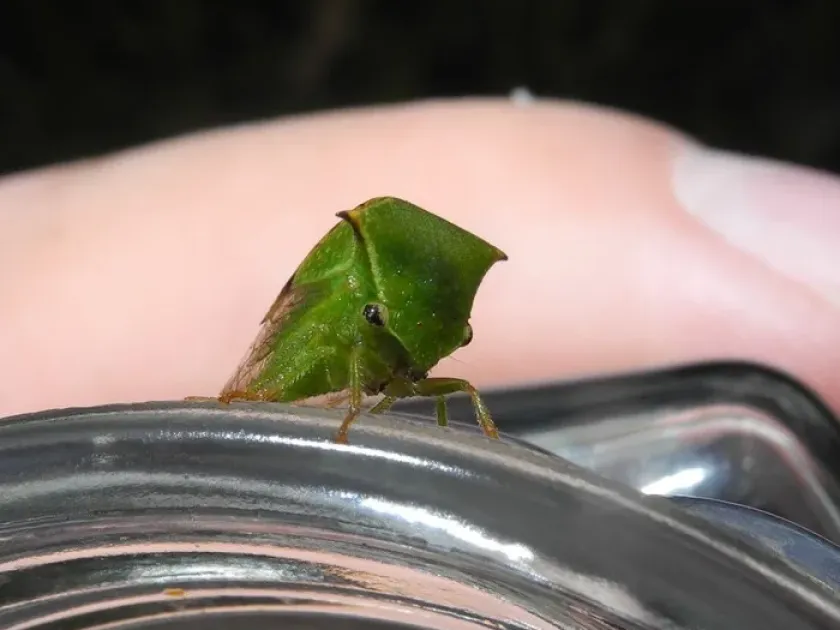
The Pacific treehopper (lat. Stictocephala pacifica) belongs to the order Hemiptera and the family Membracidae. The adult insect is distinguished by its enlarged pronotum, which forms a helmet-like structure, often resembling a thorn or protrusion, providing effective camouflage.
The coloration of the insect ranges from green to brownish, allowing it to blend seamlessly into foliage and young stems. Adults typically reach a length of about 8-10 mm and possess strong wings, enabling them to move across the orchard easily.
Nymphs are wingless and have a sedentary lifestyle, often characterized by specialized spines or bristles on their bodies. They tend to cluster on young, succulent parts of the plant, where they are protected by their natural mimicry.
Their biological cycle comprises the egg stage, five nymphal instars, and the adult stage. The treehopper possesses a powerful piercing-sucking mouthpart, which is specifically adapted for feeding on plant sap.
Reproduction involves laying eggs under the bark of woody plants, which is the most critical stage for fruit growers. In temperate climates, the species usually produces one generation per year, overwintering as fertilized females or eggs.
What it damages
The Pacific treehopper primarily damages fruit crops such as apples, pears, cherries, plums, and peaches. Additionally, it frequently infests various wild woody shrubs, which can act as secondary hosts near orchards.
The main harm is caused during the egg-laying process, when females use their ovipositor to create deep incisions in the young bark. These wounds disrupt the cambium and vascular tissues, significantly hindering the flow of nutrients.
Feeding by both nymphs and adults causes general weakening of the host plant, resulting in stunted growth and increased susceptibility to environmental stress. Over time, this leads to a reduction in fruit yield and overall tree vigor.
The bark injuries created by the ovipositor often become entry points for secondary pathogens, including fungi and bacteria. This can lead to the development of necrotic lesions and wood rot, potentially killing individual branches.
Young nursery saplings are particularly vulnerable to this pest, as their bark is thin and easily penetrated. Heavy infestations can cause significant structural damage, leading to the deformation or dieback of young, developing trees.
When it appears
Adult activity begins in late spring, as temperatures consistently rise above 15 degrees Celsius. The peak period for flying and mating usually occurs during the warm summer months.
Nymphs emerge in late spring or early summer, feeding actively for 4-6 weeks before reaching the adult stage. This is the period when they are most likely to be detected during routine orchard inspections.
Egg-laying activities are concentrated in the mid-to-late summer and can continue into the autumn. Monitoring for bark damage during this time is essential to gauge the severity of the potential infestation for the following season.
As autumn temperatures drop, adults search for overwintering sites, often hiding in bark crevices or dense vegetation. Effective orchard management before winter can help reduce the population for the next cycle.
Population dynamics are highly dependent on weather conditions; warm and dry summers typically facilitate faster nymphal development and higher survival rates for the entire population.
Signs of infestation
The most prominent sign of infestation is the presence of characteristic longitudinal or arc-shaped scars on the bark of young branches. These are the direct result of female oviposition and often look like small, dry surface cuts.
Nymphs may be observed on the undersides of leaves or along succulent shoots, often remaining stationary for extended periods. Careful examination of these areas is necessary to detect them due to their effective camouflage.
Wilting and yellowing of young shoot tips in mid-summer indicate that the vascular system has been compromised by previous bark damage. These branches often fail to thrive compared to healthy parts of the tree.
Development of necrotic patches or peeling bark around the egg-laying sites is a clear indicator of long-term damage. These areas may harbor pathogens that further degrade the health of the tree structure.
- Small, distinct bark incisions or scar lines on young branches.
- Presence of small, green, sedentary nymphs on new growth.
- Reduced shoot elongation and tip dieback in young saplings.
Control measures
Implementing strict cultural controls, such as removing wild host shrubs and weeds from the orchard perimeter, is the first step in population management. Reducing habitat diversity helps limit the reservoir of the pest.
Chemical control using systemic insecticides is most effective during the early nymphal stages. It is crucial to use authorized treatments and rotate active ingredients to prevent the development of pesticide resistance.
Pruning damaged branches during the winter or early spring allows growers to remove a significant portion of overwintering eggs, effectively lowering the infestation pressure for the upcoming growing season.
Applying white latex paint or lime wash to tree trunks and main branches can discourage females from laying eggs. This simple, cost-effective physical barrier is highly beneficial in nursery and young orchard settings.
Promoting natural predators, such as predatory bugs, ladybeetles, and insectivorous birds, is a key component of integrated pest management. Enhancing biodiversity in the orchard creates a more resilient ecosystem against treehopper outbreaks.
Taxonomy
- Latin name
- Stictocephala pacifica
- Order
- Hemiptera (bugs, aphids, leafhoppers)
- Family
- Membracidae
- EPPO code
- STICPA
Discussion
No discussions yet — be the first.