
Buffalo treehopper
Stictocephala bisonia
Description
How to identify
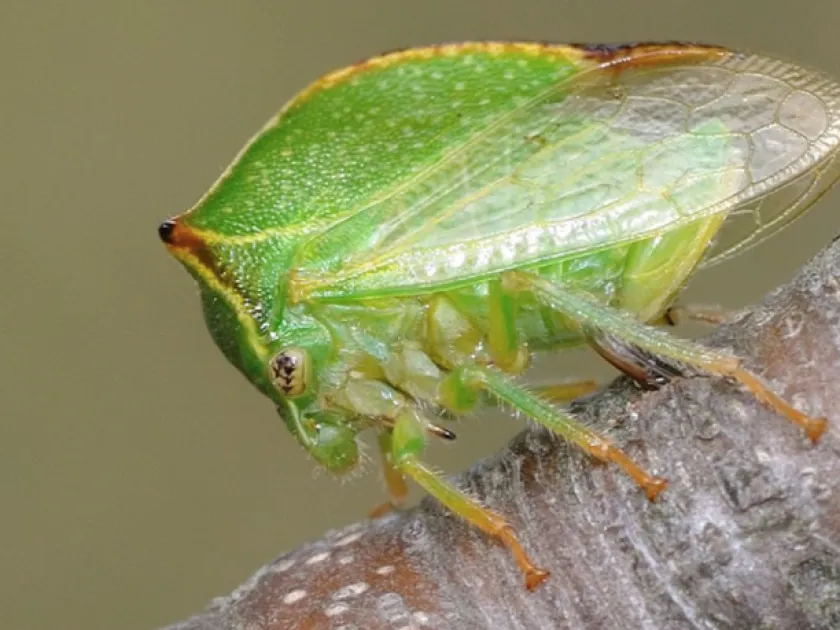
The buffalo treehopper (Stictocephala bisonia) belongs to the family Membracidae. The insect is named after its distinct pronotum, which resembles the humped back of a buffalo.
Adults are typically 8 to 10 mm long, with a triangular, bright green, or olive-colored body. Their shape allows them to camouflage perfectly among leaves and green twigs.
The wings are transparent and held roof-like over the body. Their hind legs are well-developed for jumping, allowing them to escape quickly when disturbed by predators or human activity.
Nymphs possess a flattened body covered with spikes and spines. These defensive structures protect them from predators while they feed on herbaceous plants in the understory.
The species completes one generation per year. They overwinter as eggs, which are inserted under the bark of woody twigs, ensuring the survival of the population during harsh winters.
What it damages
The buffalo treehopper attacks a variety of fruit trees, including apples, pears, peaches, and plums, as well as grapevines and various deciduous trees in nurseries.
Both adults and nymphs feed on plant sap by piercing the plant tissues. This feeding process depletes the plant's resources and can cause stunted growth and yellowing of the foliage.
The most significant harm is caused by the female during oviposition. She uses her sharp ovipositor to make deep, crescent-shaped cuts in the bark of young twigs to lay her eggs.
These wounds serve as entry points for pathogens and wood-decay fungi. The physical damage to the vascular tissues disrupts nutrient flow, often leading to branch dieback.
In cases of severe infestation, young saplings may suffer from permanent structural damage, leading to significant yield losses or even the total death of the tree.
When it appears
Egg hatch typically occurs in spring, coinciding with bud break and the beginning of the growing season when temperatures are consistently above 10-12°C.
Newly emerged nymphs are primarily found on weeds, clover, or other herbaceous plants under the tree canopy, where they spend the initial stages of their life cycle.
Adults emerge in mid-summer, usually in July. They are highly active and mobile, often moving into the canopies of fruit trees to feed and find mates.
The mating and egg-laying period extends from late summer through autumn. Females carefully select smooth, young branches for oviposition to ensure the survival of the next generation.
The species remains active until the first hard frosts, after which the adults die, leaving only the overwintering eggs hidden securely beneath the bark.
Signs of infestation
The most prominent sign of infestation is the appearance of distinct, crescent-shaped scars on the bark of young branches, which are the result of egg-laying activity.
Leaves may exhibit early signs of stress, including chlorosis and marginal necrosis, due to the extraction of nutrients by the treehoppers feeding on the sap.
The bark at the site of oviposition may crack, swell, or exhibit sap exudation, indicating secondary infection or the plant's attempt to seal the damaged tissues.
In infested orchards, gardeners may hear a faint, buzzing sound produced by adults, especially during warm and sunny afternoons in late summer.
Severe infestations often result in terminal growth death, where the tips of young branches wilt and turn brown as the vascular system fails.
Control measures
Cultural control is the most effective management strategy. Keeping orchards free of weeds and tall grasses prevents nymphs from completing their early development.
Pruning and destroying severely infested branches before spring ensures that the overwintering egg population is significantly reduced before the new season starts.
Chemical control can be applied if necessary, targeting nymphs during their active feeding period. Systemic insecticides are generally more effective than contact ones.
Encouraging natural predators, such as wasps and birds that eat nymphs or eggs, helps maintain population levels below the economic threshold without the use of harsh chemicals.
- Monitor young trees frequently for bark scars.
- Maintain a clean orchard floor to disrupt the life cycle.
- Use appropriate insecticides only when thresholds are exceeded.
- Avoid over-fertilizing, which can promote lush growth attractive to females.
Taxonomy
- Latin name
- Stictocephala bisonia
- Order
- Hemiptera (bugs, aphids, leafhoppers)
- Family
- Membracidae
- EPPO code
- STICBI
Discussion
No discussions yet — be the first.