
Buffalo treehopper
Stictocephala alta
Description
How to identify
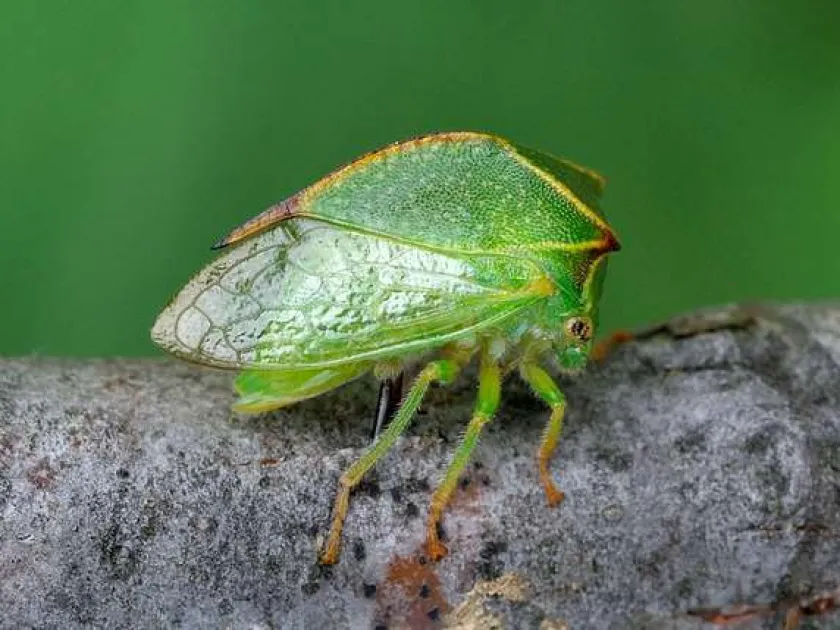
The Buffalo treehopper (Stictocephala alta) is a member of the Membracidae family, commonly known for their unusual body shapes. The adult insect resembles a tiny, green, triangular-shaped buffalo when viewed from the side, which explains its common name.
Adults are typically 8 to 10 mm long, with a bright green or yellowish-green color that provides excellent camouflage among foliage. The nymphs, or immature stages, have spiny projections on their backs and are often found on stems and leaves of host plants.
This species is univoltine, meaning it completes only one generation per year. The insect overwinters in the egg stage, which the female deposits beneath the bark of young twigs or branches of woody host plants.
The life cycle involves a transition between trees and herbaceous plants. While adults feed on various plants, they rely specifically on fruit trees and woody shrubs as sites for egg deposition in late summer and autumn.
Due to their jumping ability and cryptic coloration, they are often difficult to spot during the day. They are most active during warm, sunny weather and can be found in orchards, nurseries, and wild habitats with abundant weeds.
What it damages
The primary hosts of the Buffalo treehopper are fruit trees, including apple, pear, peach, plum, and apricot. Young trees, especially those under five years old, are the most susceptible to severe damage and growth retardation.
The damage is caused by the female's ovipositor. When laying eggs, the female cuts two parallel, crescent-shaped slits into the bark. These wounds interfere with the tree's vascular system, preventing proper nutrient flow.
These injury sites often fail to heal correctly, leading to large, scarred areas on the twigs. These wounds serve as entry points for various fungal and bacterial pathogens, which can cause diseases such as black rot or cankers.
In young trees, repeated damage can lead to structural weakness, causing branches to bend or break under their own weight. In severe cases, the tree's health declines, leading to reduced vigor and, in extreme situations, the death of the tree.
Because these insects are polyphagous, they also feed on a wide variety of weeds found in orchard floors. This makes weed management a crucial component of controlling the pest's population in the orchard.
Signs of infestation
The most visible sign of infestation is the presence of characteristic twin slits on the bark of young, tender twigs. These scars are typically arranged in a curved or spiraling pattern around the stem.
As the tree continues to grow, these egg-laying sites often develop into rough, scaly patches or open lesions on the bark. In some cases, the tissue around the wound may exhibit abnormal swelling or gall-like growth.
Leaves on the affected branches may show signs of yellowing or wilting in late summer, as the deep bark injuries restrict the movement of water and nutrients to the distal parts of the branch.
Another sign is the presence of the insects themselves, which can be disturbed by shaking the branches during the summer months. The adults will jump and fly away with a brief, buzzing sound.
During winter, the inspection of small twigs can reveal the presence of the eggs. Infested branches may appear stunted or show significant dieback above the point of the oviposition scars.
Control measures
Controlling the Buffalo treehopper primarily involves orchard hygiene and vegetation management. Eliminating broadleaf weeds and leguminous plants, such as clover, from the orchard floor is highly effective in reducing their population.
Pruning is a vital mechanical control method. Removing and destroying infested twigs during the dormant season helps eliminate the eggs before they hatch in the spring, significantly lowering the next generation's numbers.
Chemical control, if necessary, should be targeted at the adult stage before egg-laying begins. Applications are most effective in late summer when adults are actively moving between the ground vegetation and trees.
In nurseries and young orchards, maintaining a clean, weed-free zone around the base of the trees helps prevent the nymphs from climbing up to feed and the adults from utilizing the area for egg deposition.
- Keep orchard aisles mowed to discourage weed growth.
- Avoid intercropping with host-favorable plants like legumes.
- Regularly monitor young trees for signs of bark damage.
- Use contact insecticides if populations reach economic thresholds.
Taxonomy
- Latin name
- Stictocephala alta
- Order
- Hemiptera (bugs, aphids, leafhoppers)
- Family
- Membracidae
- EPPO code
- STICAL
Discussion
No discussions yet — be the first.