
Buffalo treehopper
Stictocephala
Description
How to identify
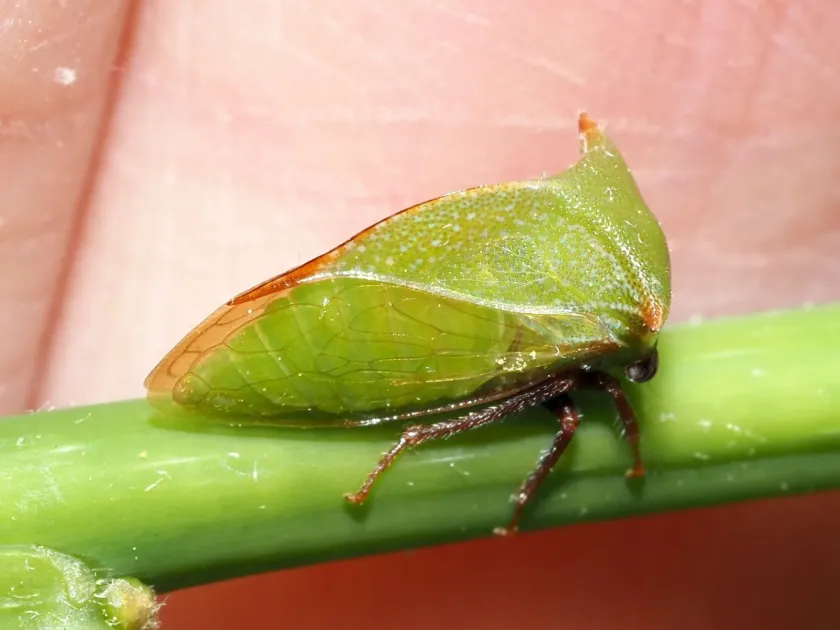
The buffalo treehopper (Stictocephala bisonia) is a member of the Membracidae family. Adult insects typically measure 8–10 mm in length and are easily recognized by the elevated, horn-like extensions on their pronotum, which resemble the horns of a buffalo.
Their coloration is generally light green to olive-green, providing excellent camouflage against leaves and stems. They are highly active and capable of jumping quickly when disturbed, often making a buzzing sound during flight.
Nymphs are wingless and have a flattened appearance with spiny lateral projections along their bodies. They are often gray or brown, blending into the bark of the host plant, making them difficult to detect.
The species completes one generation per year. They overwinter in the egg stage, with eggs deposited by females in small slits they carve into the bark of young twigs or small branches.
These insects are highly specialized in feeding on plant sap. Both nymphs and adults utilize a piercing-sucking mouthpart to extract nutrients from host plants, causing localized physiological stress.
What it damages
This pest is a generalist feeder that attacks a wide array of woody plants, including apple, pear, peach, and various ornamental trees. It is particularly damaging to young nursery stock and newly planted orchards.
The primary damage is caused by females during oviposition. They use their saw-like ovipositor to make two semi-circular or parallel cuts in the bark, creating deep wounds that can sever the vascular tissue.
Mechanical injury to the bark prevents normal sap flow and creates entry points for secondary infections, such as fungi or bacteria, which can lead to branch dieback or total death of young trees.
In addition to physical scarring, heavy feeding by nymphs on leaves and young shoots can lead to stunting, chlorosis, and reduced overall plant vigor throughout the growing season.
Repeated oviposition in the same area causes the bark to become cracked, gnarled, and rough, which significantly decreases the aesthetic value and commercial quality of nursery plants.
When it appears
Nymphs hatch from overwintering eggs in late spring, typically in May, depending on the climatic conditions of the region. They immediately move to the lower vegetation layer.
During the early summer months, nymphs feed primarily on weeds, clover, and other herbaceous plants found in the understory of orchards, where they go through several molting stages.
Adults begin to emerge from mid-summer onwards. They migrate from their herbaceous hosts to woody plants, where they begin the process of mating and feeding on the bark and leaves of trees.
The peak period for egg-laying occurs in late summer and early autumn (August to September). During this time, adult females are highly active and visible on the branches of the host trees.
The life cycle concludes with the eggs remaining dormant in the bark throughout the winter, protected from harsh weather until the next spring when the cycle begins anew.
Signs of infestation
The most distinctive sign of infestation is the presence of twin semi-circular scars on the bark of young twigs. These are usually arranged in rows or patterns along the branches.
Branch dieback, where the tips of young shoots turn brown and wither in late summer, often indicates severe vascular damage caused by oviposition sites.
Heavy weed presence in orchards acts as a major attractor for nymphs in the early spring, serving as a reservoir for the population before they transition to trees.
Exfoliating or cracked bark on young stems, which looks abnormally rough, is a clear indicator that the tree has been repeatedly used as an egg-laying site over several seasons.
Observing jumping adults on the foliage during August is a strong indicator of an active population that will lead to oviposition on the trees in the following weeks.
Control measures
Effective management requires a combination of cultural practices and chemical interventions, focusing on the susceptible life stages of the pest.
- Maintain a clean orchard floor by removing weeds and grasses, which serve as essential food sources for nymphs during their early development.
- Prune and destroy severely infested twigs during the dormant season to remove overwintering eggs before they hatch in the spring.
- Apply contact insecticides during the nymphal stage (May-June) to reduce the population before they mature and move to trees.
- Utilize sticky traps to monitor adult migration and population density throughout the summer months.
- Encourage natural predators, such as spiders, birds, and parasitic wasps, to inhabit the orchard ecosystem to provide biological control.
Proper fertilization and irrigation are crucial to ensure that young trees have the vigor to heal bark wounds quickly after an attack.
Careful timing of pesticide applications is essential to avoid harming pollinators, as treatments are most effective during the specific period when nymphs are active on ground cover.
Taxonomy
- Latin name
- Stictocephala
- Order
- Hemiptera (bugs, aphids, leafhoppers)
- Family
- Membracidae
- EPPO code
- STICSP
Discussion
No discussions yet — be the first.