
Bulb scale mite
Steneotarsonemus laticeps
Description
How to identify
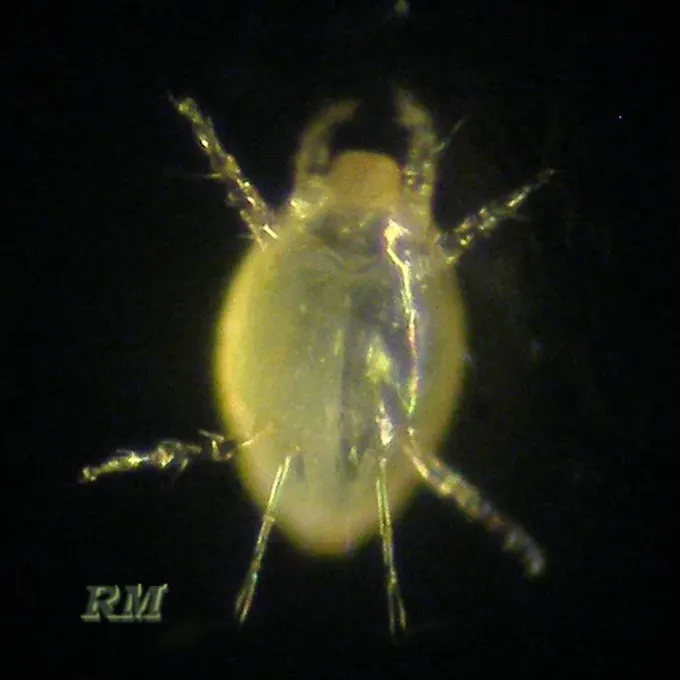
The bulb scale mite (Steneotarsonemus laticeps) is a microscopic arachnid belonging to the Tarsonemidae family. Due to its extremely small size, it is nearly invisible to the naked eye, making early detection a significant challenge for growers.
These mites have an oval-shaped, yellowish-brown body and thrive in hidden environments. They spend most of their life cycle sequestered between the scales of bulbs, which offers them physical protection.
Their life cycle is temperature-dependent and can be very rapid during warm seasons. Under optimal conditions, the population can multiply significantly within a few weeks, leading to severe infestations.
The mites survive on plant sap, and their biology is specifically adapted to the internal environment of bulbs, where humidity levels remain constant and provide a suitable habitat for breeding.
Dissemination primarily occurs through the trading and planting of infested bulb material, as symptoms are often not apparent until the mite population reaches critical levels.
What it damages
The bulb scale mite primarily targets members of the Amaryllidaceae family, including popular ornamental plants such as Hippeastrum, Narcissus, Amaryllis, and Crinum.
Feeding occurs through the piercing of plant cells and the injection of salivary enzymes. This causes localized necrosis, tissue deformation, and the inhibition of normal cellular development.
The most severe damage occurs when mites feed on the flower bud while it is still developing within the bulb, often resulting in deformed, withered, or entirely aborted blossoms.
In addition to direct feeding damage, the mites create entry points for opportunistic bacterial and fungal pathogens, which frequently lead to the rotting of the bulb.
Over time, infested plants show stunted growth, twisted leaves, and a significant reduction in the quality and quantity of flower production, making the plant non-viable for ornamental purposes.
Signs of infestation
Early symptoms include the emergence of distorted, curled, or twisted foliage that appears soon after the plant begins its growth cycle. Light streaks on leaves are also common.
Upon inspecting a cross-section of an infested bulb, reddish-brown or rusty lesions can be observed on the fleshy scales, indicating areas where colonies have been feeding.
Flower stalks are often shorter than normal, showing characteristic kinking or twisting. In severe cases, the stalks may fail to emerge properly, or buds may dry out before opening.
The internal structure of the bulb may become spongy or soft due to the tissue damage caused by the mites, leading to a noticeable loss of firmness in affected specimens.
During the dormant storage period, infested bulbs tend to lose weight more rapidly than healthy ones due to moisture loss and exhaustion of energy reserves caused by the pest.
Control measures
Strict quarantine protocols should be applied to all incoming plant materials. Inspecting bulbs for external signs of damage is the first line of defense against introducing the mite to new areas.
Hot water treatment is a standard and effective non-chemical control method. Immersing bulbs in water at approximately 43–45 degrees Celsius for about one to two hours can effectively kill the mites.
Systemic acaricides are recommended for chemical control. The most effective strategy is the pre-planting soak, which ensures the active ingredient penetrates the bulb scales to reach the mites.
Proper environmental management in storage areas is crucial. Maintaining cooler temperatures can significantly slow down the reproduction rate of the mite population.
- Use only certified disease-free planting material
- Implement hot water treatment for infested lots
- Apply systemic acaricides during pre-planting treatment
- Ensure excellent sanitation of gardening tools and storage facilities
- Routinely monitor for symptoms of deformed growth
Taxonomy
- Latin name
- Steneotarsonemus laticeps
- Order
- Mites
- Family
- Tarsonemidae
- EPPO code
- TARSLA
Discussion
No discussions yet — be the first.