
Three-cornered alfalfa hopper
Spissistilus festinus
Description
How to identify
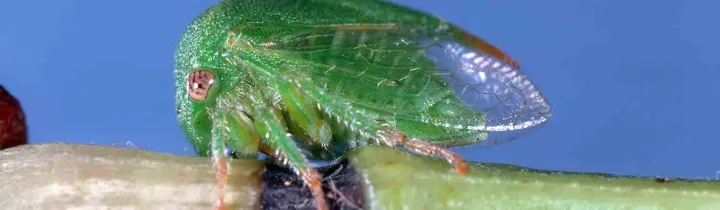
The three-cornered alfalfa hopper (Spissistilus festinus) is a member of the Membracidae family, belonging to the order Hemiptera. Adult insects are easily identified by a prominent, triangular-shaped pronotal process that extends over the back, giving them a wedge-like appearance.
Adults typically measure between 6 and 8 millimeters in length. Their coloration ranges from light green to brownish, providing excellent camouflage against the stems of their host plants, which makes them difficult to spot in the field.
Nymphs lack wings and are generally smaller than adults, often appearing with small spines along their backs. They progress through five distinct instars before reaching the adult stage, becoming larger with each molting phase.
These insects are highly agile and possess strong jumping capabilities. They prefer to inhabit the lower, more shaded parts of plants, making them elusive during routine crop inspections by field scouts or agronomists.
The hopper's biology is highly adaptive to agricultural landscapes. They frequently move between host crops and perennial leguminous weeds, allowing them to maintain active populations throughout the growing season.
What it damages
Both nymphs and adults cause damage by using their piercing-sucking mouthparts to feed on plant sap. They puncture the epidermis of stems and leaf petioles, which disrupts the normal flow of nutrients and moisture within the plant.
The species feeds on a wide range of crops, including alfalfa (their primary host), soybeans, clover, beans, and peanuts. High infestation levels can lead to significant economic losses in both yield and plant health.
A distinctive type of damage is caused by the female's egg-laying process, where she cuts a circular slit into the stem. This wound often results in a full or partial girdle around the stem, obstructing the translocation of vital fluids.
Girdled stems are structurally weakened, leading to increased lodging, especially during windy conditions. This significantly hampers mechanized harvesting operations and may cause the entire plant to wilt or die.
Beyond physical damage, the three-cornered alfalfa hopper is known to transmit certain plant viruses. This pathogen transmission can further stress the crop, reducing the quality and quantity of the harvest.
When it appears
Adults overwinter in protected areas such as dense plant debris, leaf litter, or at the base of perennial plants. They emerge as soon as temperatures become favorable in early spring to begin their feeding cycle.
The insect completes multiple generations throughout a single growing season. The duration of each generation depends heavily on local temperatures, usually ranging from 30 to 45 days in optimal climate conditions.
Peak population levels typically occur during mid-summer. During this period, the hopper's activity is at its highest, and significant damage to younger stems can be observed across various agricultural fields.
As autumn approaches and temperatures begin to drop, adult hoppers prepare for the winter months. They often migrate from agricultural fields to field margins and ditch banks, where leguminous weeds provide suitable shelter.
The number of generations per year varies by geography, with warmer regions supporting longer breeding periods. This cumulative reproduction increases the pest pressure on agricultural systems in these specific areas.
Signs of infestation
The most visible sign of an infestation is the presence of a girdling scar at the base of the stem. These scars may take on a reddish or purplish discoloration as the plant reacts to the tissue damage.
Affected plants often show signs of stunted growth, chlorosis, and general weakness. Severe infestations can cause the early shedding of flowers and pods, which is particularly detrimental to seed production crops.
Adult hoppers can be spotted by carefully inspecting the lower canopy of the plants. They are most active during the cooler parts of the day, such as early morning or late evening, when they may be found feeding.
- Circular scars or lesions encircling the stem base.
- Discoloration of the stem tissue near the feeding site.
- Reduced plant height and overall vegetative growth.
- Presence of nymphs or adults detected during sweep net sampling.
Agronomists often use sweep nets to quantify the population density. Regular scouting is essential for distinguishing between hopper damage and other vascular diseases that might present similar symptoms.
Control measures
Cultural control strategies focus on eliminating alternative hosts, such as wild legumes along fence rows and field edges. By reducing these reservoirs, the overall hopper population can be significantly suppressed.
Implementing crop rotation helps break the life cycle of the pest. Additionally, selecting crop varieties that demonstrate tolerance or resistance to stem damage can help maintain productivity in infested areas.
Chemical control is warranted when the insect population exceeds the economic injury level. Systemic insecticides are generally effective as they provide long-lasting protection against piercing-sucking insects.
Biological control agents, such as egg parasitoids and predatory bugs, can play a role in natural pest management. Conserving these beneficial insects can help keep hopper numbers below the threshold for chemical intervention.
Effective management requires ongoing monitoring using traps and field surveys. Rotating insecticide modes of action is critical to preventing the development of resistant hopper populations over multiple seasons.
Taxonomy
- Latin name
- Spissistilus festinus
- Order
- Hemiptera (bugs, aphids, leafhoppers)
- Family
- Membracidae
- EPPO code
- STICFE
Discussion
No discussions yet — be the first.