
Buffalo treehopper
Spissistilus
Description
How to identify
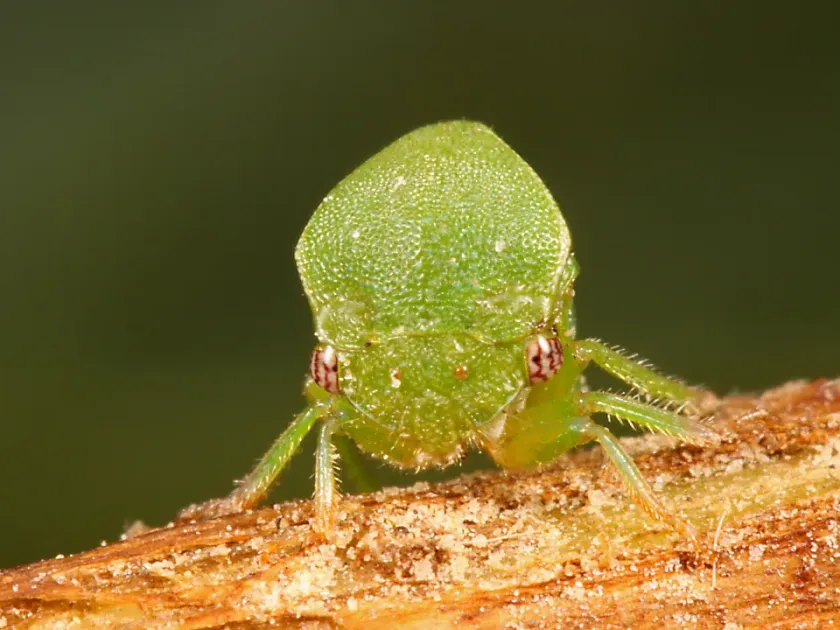
The buffalo treehopper (Spissistilus festinus) is a member of the Membracidae family, easily recognizable by the distinct pronotum shape that resembles the horns of a buffalo.
Adults are approximately 8–10 mm long and typically display a bright green color, which acts as camouflage against the foliage of their host plants.
Nymphs are wingless, possess spiny projections on their backs, and are generally sedentary during their early development stages on low-growing vegetation.
The insect possesses powerful hind legs designed for jumping, allowing adults to quickly escape from potential threats or predators when disturbed.
The life cycle includes overwintering as eggs inserted into the bark of woody plants, which protects them from environmental extremes during the winter months.
What it damages
This pest is highly polyphagous, targeting a wide range of hosts including apple, pear, peach, plum, grapevines, and various broadleaf weeds.
Damage is primarily caused by females, which use their sharp ovipositors to cut deep, crescent-shaped slits into the bark of young twigs to deposit their eggs.
These physical incisions damage the vascular tissues, impeding the flow of water and nutrients, which causes stunted growth and twig dieback.
The wounds left in the bark serve as entry points for secondary fungal and bacterial infections, leading to cankers and long-term structural weakness.
In nurseries and young orchards, heavy infestations can lead to significant tree deformity and loss of vigor, ultimately affecting the commercial value of the stock.
When it appears
Nymphs emerge from overwintered eggs in the spring, typically migrating to the ground cover of weeds and grasses, which serve as their primary food source.
Adults migrate to fruit trees during the mid-to-late summer months, coinciding with the peak period for mating and egg-laying on woody tissues.
The peak activity of adults usually occurs between August and September, when they are most actively involved in oviposition on the current season's growth.
The duration of the life cycle varies depending on regional temperatures, with warmer autumns extending the period during which females can damage trees.
The species completes one or two generations per year depending on the climate, ensuring that the eggs are securely embedded in the bark before dormancy.
Signs of infestation
The most diagnostic sign of an infestation is the presence of parallel, crescent-shaped scars on the bark of young twigs, often occurring in pairs or long rows.
Leaf yellowing or wilting on the terminals of shoots is a common symptom resulting from the disruption of the branch's vascular system caused by oviposition.
Adult treehoppers can be spotted on weeds or low branches on warm, sunny days when they are most active and likely to move upon disturbance.
Over time, the affected areas of the bark may become corky, crack open, or show signs of premature necrosis, especially if the infestation is severe.
Retarded growth and lack of vigor in young saplings compared to unaffected trees serve as critical field indicators that a treehopper infestation may be present.
Control measures
Sanitation is the most effective management strategy, specifically the removal and destruction of host weeds around the base of trees to eliminate nymphal habitats.
Pruning out and burning infested twigs during the dormant season helps significantly reduce the population of eggs that would otherwise hatch the following spring.
Insecticidal treatments should be timed with the emergence of adult treehoppers, ensuring applications are made before significant egg-laying occurs in late summer.
Maintaining a clear zone around the base of fruit trees and avoiding adjacent areas with dense tall weeds reduces the likelihood of adult migration into the orchard.
Encouraging the presence of natural predators, such as spiders, birds, and predatory insects, can assist in naturally suppressing treehopper population density.
Taxonomy
- Latin name
- Spissistilus
- Order
- Hemiptera (bugs, aphids, leafhoppers)
- Family
- Membracidae
- EPPO code
- SPISSP
Discussion
No discussions yet — be the first.