
Brown-tail moth
Sphrageidus similis
Description
How to identify
The brown-tail moth (Sphrageidus similis) is a moth of the family Erebidae. It is widely distributed across Europe and is considered a significant orchard pest.
Adult moths are characterized by white wings with a span of up to 45 mm. The female possesses a distinctive tuft of golden-brown hairs at the tip of her abdomen.
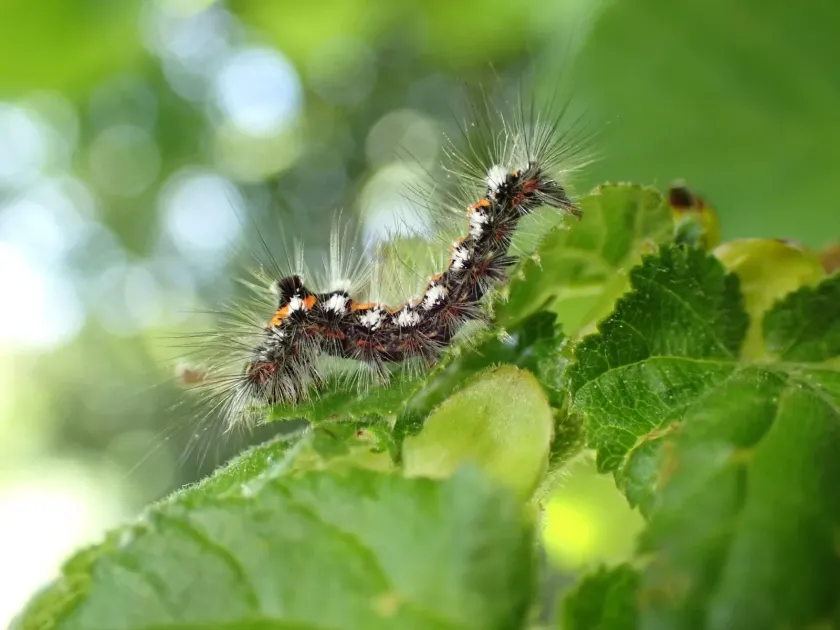
Caterpillars are dark-colored with reddish-brown lateral stripes and white spots. They are covered in long, dense, poisonous hairs that cause severe skin irritation.
Pupation occurs within dark-brown cocoons, often spun between leaves or attached to branches using strong silk webbing.
The species is easily recognizable by its overwintering nests, which remain prominent on the branches of host trees during the winter months.
What it damages
This species is highly polyphagous, attacking a variety of trees and shrubs. It shows a strong preference for members of the Rosaceae family.
Common hosts include apple, pear, plum, cherry, hawthorn, and oak. Severe infestations can lead to the complete defoliation of these trees.
The damage is caused exclusively by the caterpillars, which skeletonize leaves during their early stages and eventually consume the entire leaf lamina.
Defoliation significantly reduces the photosynthetic capacity of the trees, leading to lower fruit yield and impaired growth in subsequent seasons.
Additionally, the presence of these caterpillars in gardens poses a health risk to humans due to the urticating hairs that can cause persistent dermatitis.
When it appears
The brown-tail moth has one generation per year. They overwinter as second or third-instar larvae within communal silken nests.
In early spring, as temperatures rise and buds begin to swell, the larvae emerge from their nests to feed on the tender young foliage.
Feeding continues through May and June. By late June or early July, the mature caterpillars spin cocoons and undergo pupation.
Adults emerge in July and August. After mating, females lay eggs on the undersides of leaves and cover them with the golden hairs from their abdomens.
New larvae hatch by late summer, feed for a short period, and then collectively construct the winter nest where they will spend the dormant season.
Signs of infestation
The most reliable sign of an infestation is the presence of winter nests — tightly woven, brownish leaf clusters firmly attached to small twigs.
Spring feeding results in damaged, skeletonized leaves and the partial destruction of developing flower and vegetative buds.
During the summer months, one may observe clusters of eggs on the undersides of leaves, covered by the characteristic golden-brown hair mass.
The caterpillars themselves are often visible during the day as they feed in groups, especially in the early stages of their development.
Accumulation of larval frass (droppings) on the leaves and ground beneath the tree canopy is a common indication of a heavy infestation.
Control measures
The primary control method is the manual removal of winter nests. Pruning and burning these nests during winter significantly reduces the spring population.
If chemical intervention is necessary, apply registered insecticides during the early larval stages when they are most vulnerable to treatment.
Biological control using sprays containing Bacillus thuringiensis is highly effective and environmentally friendly, targeting larvae without harming beneficial species.
Encouraging natural predators, such as birds and parasitic wasps, can help manage populations in orchards where chemical use is restricted.
- Sanitary pruning of infested branches.
- Use of pheromone traps to monitor adult moth activity.
- Protective clothing when removing nests to avoid contact with urticating hairs.
Taxonomy
- Latin name
- Sphrageidus similis
- Order
- Lepidoptera (butterflies)
- Family
- Erebidae
- EPPO code
- PORTSI
Discussion
No discussions yet — be the first.