
Brown-tail moth
Sphrageidus
Description
How to identify
The brown-tail moth (Sphrageidus similis) is a moth of the Erebidae family. The adult moth features snowy white wings, while the female possesses a distinct patch of golden-brown hairs at the tip of its abdomen, which gives the species its name.
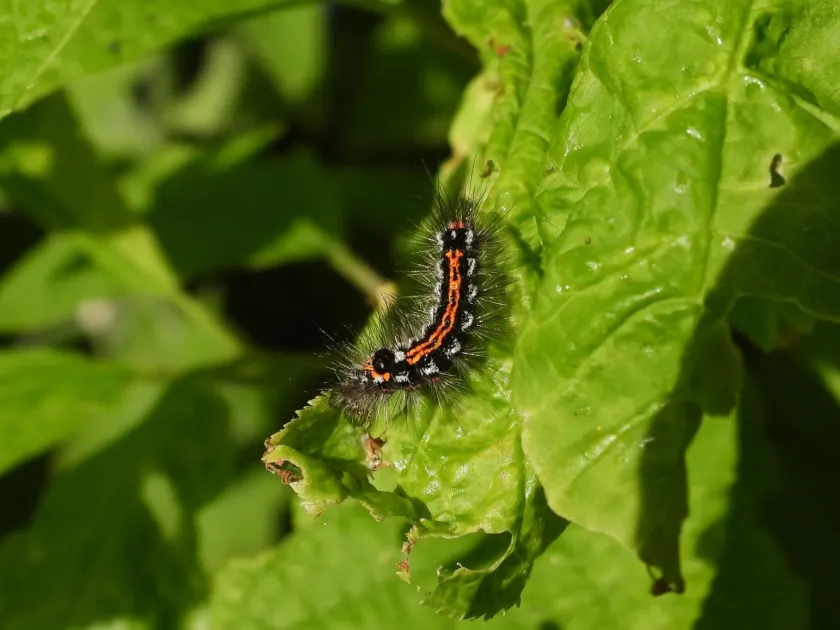
The larvae, or caterpillars, grow up to 40 mm in length. They have a grey-black body with broken red and white stripes and are covered in numerous irritating hairs that can cause allergic skin reactions in humans upon contact.
The pupa is dark brown and develops within a dense, grey-brown cocoon constructed from silk webbing. Females typically lay eggs on the undersides of leaves, covering them with the aforementioned golden hairs.
The life cycle consists of one generation per year. The caterpillars hibernate in winter within specialized communal nests made of leaves bound together with silk at the ends of branches.
These winter nests are highly resilient, providing the larvae with essential protection against harsh weather conditions and various predators during the coldest months.
What it damages
The brown-tail moth is a generalist feeder (polyphagous) that attacks a wide variety of deciduous trees. In orchards, it commonly infests apple, pear, plum, cherry, and apricot trees.
Beyond orchards, it significantly impacts woodland and urban settings, frequently feeding on oak, elm, linden, and willow species, often stripping trees of their foliage.
Caterpillars feed on the leaves, leaving only the primary veins behind, which severely impairs the tree's photosynthetic capability and impacts fruit development.
Extensive defoliation stresses the trees, weakening their immune response and leaving them susceptible to opportunistic diseases, drought, and severe winter conditions.
During outbreak years, the infestation can lead to complete defoliation, resulting in significant yield loss and a decline in the tree's overall vigor for the following season.
When it appears
Larvae emerge from their winter nests in the spring as soon as buds begin to burst and temperatures consistently exceed 10-12 degrees Celsius.
The active feeding phase lasts for approximately 30 to 45 days. During this window, the caterpillars voraciously consume emerging buds and young leaves, causing maximum damage.
Pupation typically occurs during June. Following the pupal stage, the adult moths emerge in July, with the flight period often lasting several weeks across the summer.
The latter half of the summer is dedicated to mating and egg-laying, resulting in a new generation of larvae that feed until the cooling temperatures signal the onset of winter.
As autumn deepens in October, the larvae cease feeding and retreat into their silken web nests, where they remain in a state of dormancy until the following spring.
Signs of infestation
The most visible indicator of an infestation is the presence of distinctive, dry, silk-bound leaf clusters (nests) located at the tips of branches during the winter and early spring.
In spring, clear evidence is provided by skeletonized leaves, where only the leaf veins remain, or by complete consumption of the leaf canopy by the larvae.
Gardeners may also observe groups of hairy caterpillars congregating on trunks or branches during their peak activity periods in the spring.
At night, the presence of adult moths attracted to porch lights or other artificial illumination can serve as a warning to monitor trees for potential egg clusters.
- Winter silken nests at branch tips.
- Skeletonized or missing leaf tissue.
- Damage to emerging spring buds.
- Presence of hairy, striped caterpillars.
Control measures
The most effective mechanical control method is to prune and burn the winter silken nests during the dormant season before the larvae emerge in spring.
If an outbreak is detected, insecticide applications may be necessary, especially targeting the early larval stages when they are most vulnerable to chemical treatments.
Biological control, such as using preparations containing Bacillus thuringiensis, is highly effective for managing larvae while being safe for non-target insects and the environment.
Encouraging natural predators, including parasitic wasps and tachinid flies, helps maintain pest populations at manageable levels without chemical intervention.
Regular tree canopy inspections and prompt removal of larval nests represent the foundation of long-term preventative care against this destructive moth.
Taxonomy
- Latin name
- Sphrageidus
- Order
- Lepidoptera (butterflies)
- Family
- Erebidae
- EPPO code
- SPAGSP
Discussion
No discussions yet — be the first.