
Hunting billbug
Sphenophorus venatus
Description
How to identify
The hunting billbug (Sphenophorus venatus) is a beetle belonging to the Curculionidae family, widely recognized as a significant pest of turfgrass and certain landscape plants.
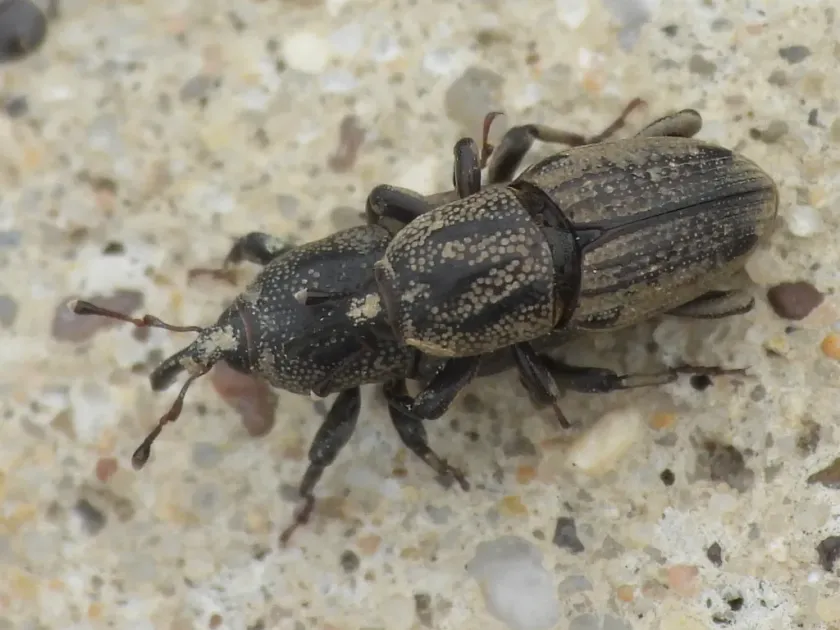
Adult beetles are approximately 6 to 9 mm long, with a robust, dark body and a distinctively pitted, coarse texture on the pronotum that helps in species identification.
They feature a long, snout-like rostrum, which is a classic characteristic of the weevil family, used for feeding on plant stems and creating cavities for oviposition.
The larvae are legless, C-shaped grubs with creamy-white bodies and a tan-colored head capsule, typically residing within the soil or the lower crown of the plant.
Due to their nocturnal behavior and tendency to blend in with soil or mulch, adult hunting billbugs are rarely seen during daylight hours, making early detection a primary challenge.
What it damages
The primary hosts of the hunting billbug include various turfgrass species such as Bermuda grass, zoysia, and Kentucky bluegrass, which are frequently used in residential and commercial landscapes.
The damage is primarily caused by the larvae, which feed on the roots and the base of the stems, effectively severing the plant's connection to its vital nutrients and water supply.
As the root system is destroyed, affected areas of the lawn begin to yellow and eventually turn brown, creating irregular patches that mimic drought stress or fungal infections.
Adults also contribute to the damage by feeding on stems, creating small pits or holes that weaken the structural integrity of the grass blades.
In severe infestations, large sections of turf can be easily pulled away from the soil, essentially resembling a loose carpet due to the complete loss of the anchoring root system.
When it appears
The life cycle of the hunting billbug is highly seasonal, with adults becoming active in early spring as temperatures begin to rise, signaling the start of the breeding season.
Females deposit eggs during the spring and early summer, leading to the emergence of larvae that remain active through the warmest months of the year.
The developmental rate of the larvae is heavily influenced by soil moisture and temperature, with peak damage often observed during the mid-summer drought periods.
As the fall season approaches, the population begins to transition, with adults seeking shelter in protected areas such as leaf litter, mulch, or deeper soil layers to survive the winter.
In warmer climates, the hunting billbug may complete multiple generations within a single calendar year, necessitating a sustained management approach throughout the growing season.
Signs of infestation
One of the most reliable signs of an infestation is the appearance of "dying" patches of turf that do not respond to supplemental irrigation or fertilization.
A quick field test involves pulling at the affected grass; if it detaches easily from the soil with missing roots, it is a strong indicator of larval billbug activity.
Searching for the larvae involves cutting back the turf and inspecting the root zone, where the small, C-shaped grubs can often be found among the soil and debris.
Small, sawdust-like frass (excrement) found near the base of the plant stems is another diagnostic indicator of larval activity within the crown.
For adult detection, homeowners or professionals can perform a soapy water flush in the evening to force beetles to the surface, allowing for accurate identification.
Control measures
Integrated pest management (IPM) for hunting billbugs starts with good cultural practices, such as maintaining proper irrigation and preventing excessive thatch buildup.
Aeration of the soil can help reduce compaction and improve the penetration of biological or chemical treatments, making them more effective against soil-dwelling larvae.
- Application of entomopathogenic nematodes (such as Steinernema carpocapsae) during peak larval activity.
- Targeted use of systemic insecticides as a last resort when threshold populations are exceeded.
- Removal of debris and leaf litter to eliminate overwintering sites for adult beetles.
Timing of chemical treatments is critical and should be aligned with the early larval development stage to maximize efficacy and minimize collateral damage.
Regular monitoring through turf scouting allows for precise intervention, preventing the spread of the pest and ensuring long-term health of the turfgrass stand.
Taxonomy
- Latin name
- Sphenophorus venatus
- Order
- Coleoptera (beetles)
- Family
- Dryophthoridae
- EPPO code
- SPPHVN
Discussion
No discussions yet — be the first.