
Maize billbug
Sphenophorus striatopunctatus
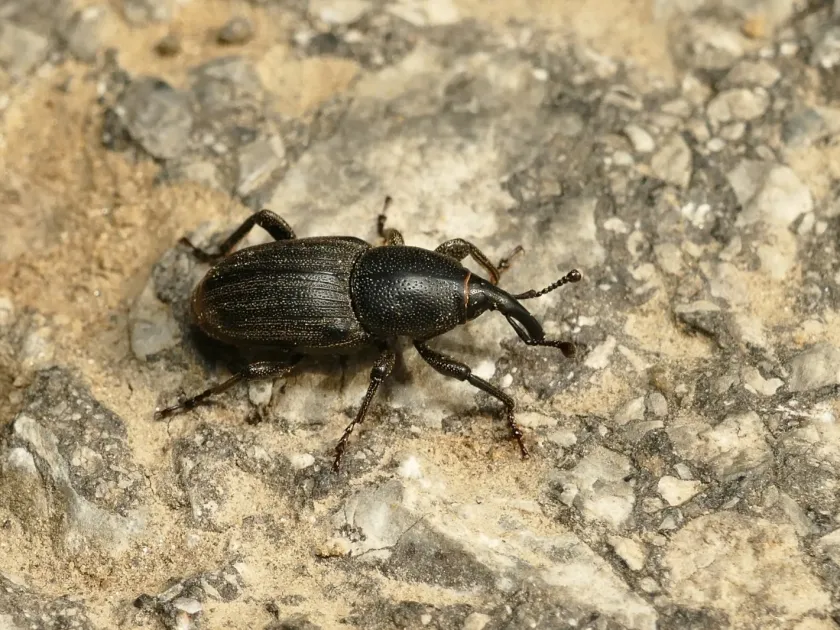
Description
How to identify
The maize billbug (Sphenophorus striatopunctatus) is a member of the Curculionidae family, commonly known as weevils or snout beetles. These insects are characterized by their elongated snout and hardened, pitted elytra.
Adult beetles typically measure between 8 and 12 mm in length. Their coloration ranges from dark brown to black, allowing them to blend seamlessly with soil particles and crop debris, making detection difficult.
The larvae are legless, fleshy, and C-shaped, featuring a creamy white body and a dark brown head capsule. They spend their entire developmental phase feeding inside the stalks of host plants.
The lifecycle follows a complete metamorphosis pattern: egg, larva, pupa, and adult. Adults are hardy and capable of surviving harsh conditions by overwintering in protected areas.
During the warmer months, the females bore small holes into the plant base and deposit their eggs, ensuring the larvae have immediate access to plant tissue upon hatching.
What it damages
Maize billbugs primarily target corn crops, but they can infest other wild grasses if their primary host is unavailable. Both adults and larvae contribute to significant crop losses.
Adults feed on young foliage, creating characteristic holes or feeding scars. While this causes some stress, the most severe damage is inflicted by the larvae feeding inside the stem.
Larval feeding destroys the vascular tissue within the stalk, which severely restricts the flow of water and nutrients to the upper parts of the plant, often leading to stunted growth.
In cases of severe infestation, plants may collapse or die prematurely. The damaged tissues are also highly susceptible to secondary pathogens, including various fungal stalk rots.
Yield loss is directly proportional to the density of the larval population. Even if plants survive, their ability to produce healthy ears is significantly compromised by the internal damage.
Signs of infestation
The initial signs of an infestation include small, transverse rows of holes on the leaves of young corn plants, which occur when the leaves are unfolding.
A key indicator of larval activity is the wilting of the central whorl or the youngest leaf. This "dead heart" symptom suggests that the stem base has been hollowed out.
Affected plants are often easily pulled from the ground because their root systems and lower stalks have been heavily damaged by larval tunneling.
Upon splitting open the base of a suspected plant, one can observe larval frass (excrement), internal tunnels, and the presence of the cream-colored larvae themselves.
Stunted, yellowed, and unevenly growing plants in patches across the field should be closely examined to confirm the presence of this pest during the early vegetative stages.
Control measures
Crop rotation is the most effective cultural practice to manage maize billbug populations, as they do not travel long distances and rely on consistent host availability.
Aggressive management of crop residues and deep tillage in the autumn can destroy overwintering sites, significantly reducing the number of emerging adults the following spring.
Seed treatments with systemic insecticides are recommended in areas with a history of infestation to provide a protective barrier during the critical early growth phases.
Weed management is vital, as wild grasses serve as alternative hosts and reservoirs for adult beetles throughout the season, helping to sustain the population between crops.
- Applying systemic insecticide seed treatments before planting.
- Implementing long-term crop rotation to break the lifecycle.
- Removing and destroying crop residues after harvest.
- Scouting fields regularly during the V2 to V5 vegetative stages.
Taxonomy
- Latin name
- Sphenophorus striatopunctatus
- Order
- Coleoptera (beetles)
- Family
- Dryophthoridae
- EPPO code
- SPPHST
Discussion
No discussions yet — be the first.